The Supreme Court just turbocharged the gerrymandering war. It was already to blame for unleashing it
 Prefer us on Google
to see more of our voting rights news coverage when you search.
Yesterday, the Supreme Court gutted the Voting Rights Act in Louisiana v. Callais, sending Republican-controlled states off to the races to gerrymander congressional maps ahead of the midterms.
But the high court’s enabling of gerrymandering started much earlier than that. It had already turned its back on voters — and on democracy — back in 2019.
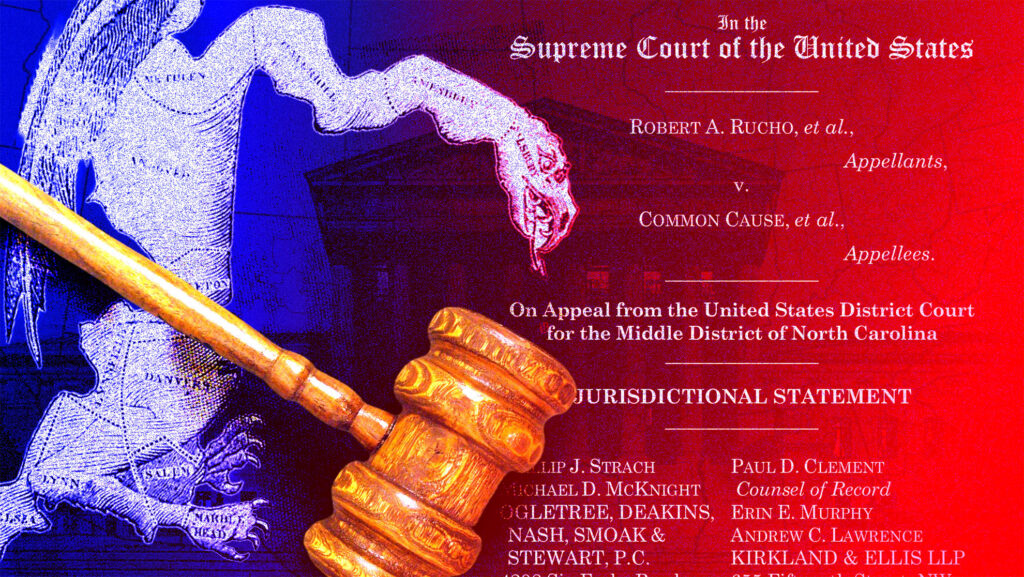
In Rucho v. Common Cause, SCOTUS ruled that federal courts would not hear challenges to partisan gerrymandering, even when politicians draw maps that blatantly rig elections in their favor. It was a stunning abdication of duty, one that paved the way for Donald Trump’s unprecedented authoritarian effort to rig the 2026 midterm elections.
Get updates straight to your inbox — for free
Join 350,000 readers who rely on our daily and weekly newsletters for the latest in voting, elections and democracy.
Common Cause knew that Rucho would unleash more gerrymandering. If politicians are allowed to choose their voters, they will. When there are no enforceable standards for fairness, maps will be drawn to entrench power instead of reflecting communities. And when courts refuse to act, the damage doesn’t stay contained. It spreads.
Last year, President Trump launched an aggressive, mid-decade redistricting effort to tilt the playing field and protect his own power. This is not a routine political dispute or typical redistricting cycle. It is part of a broader, authoritarian effort to manipulate the rules of our elections and avoid being held accountable by voters.
What started in Texas quickly spread to California. Before the end of 2025, another four states would push for new maps impacting millions of voters. As redistricting became an expected countermeasure to President Trump’s partisan intervention in Texas, Common Cause established fairness criteria to create guardrails across Democratic and Republican states. Fighting for fair representation means holding both parties accountable, not shirking from the fight altogether. We are here because Congress has failed to act.
Since Rucho, courts across the country have repeatedly cited the decision to avoid reviewing even the most extreme partisan gerrymanders. In states like Kansas, Kentucky, New Hampshire, North Carolina, South Carolina and Texas, courts have pointed to Rucho as a reason not to intervene. In many more places, challenges were never filed because voters and advocates knew the courts wouldn’t hear them.
Accountability is a core requirement of democracy. When elected officials no longer have to answer to the people they represent, they can rely on maps engineered to protect them, even when their policies are out of step with the majority of voters.
Fair maps are not a technical issue. They are a safeguard for all our rights and a check on entrenched political interests.
Our country stands at a crossroads, and the stakes go beyond gerrymandering alone. Either voters choose their leaders, or we allow those in power to rewrite the rules to protect themselves. When politicians manipulate maps to insulate themselves from electoral consequences, they’re weakening the foundation of our representative government and undermining people’s confidence that democracy can deliver anything at all.
Fair maps are not a technical issue. They are a safeguard for all our rights and a check on entrenched political interests.
The question is no longer whether the threat is real — the question is whether our leaders are willing to act. Congress has the power to fix this, but has chosen, again and again, to sit on the sidelines.
We need national reform, and it has to come from Congress. Clear, enforceable standards that ban partisan gerrymandering and guarantee fair representation in every state. We need rules that ensure transparency, protect communities, and prevent politicians from manipulating maps for their own gain. And we need a renewed commitment to the principle that our democracy belongs to the people, not those in power.
Because if Congress fails to act, they are saddling all of us with a future where accountability erodes, where voters’ voices are diminished, and where democracy itself is at risk.
The American people deserve a democracy where voters choose their leaders — not the other way around.
Dan Vicuña is the Senior Director of Voting & Fair Representation at Common Cause.