Alabama keeps telling us what it thinks democracy should look like
 Prefer us on Google
to see more of our voting rights news coverage when you search.
What is unfolding in Alabama is not just another redistricting fight. It is a warning.
A federal court has again blocked Alabama from using its 2023 congressional map, ruling that the map was tainted by intentional race-based discrimination and that the state must continue using the court-ordered map already used during the 2024 election cycle, which also resulted in the election of Rep. Shomari Figures in the new congressional District 2.
Get updates straight to your inbox — for free
Join 350,000 readers who rely on our daily and weekly newsletters for the latest in voting, elections and democracy.
But the issue is not settled. Alabama has asked the Supreme Court to block the federal court’s ruling, which would allow them to eliminate the second majority-Black district in the state. Alabama’s decision to appeal makes clear, if it wasn’t already, that the state’s leaders believe there should be no meaningful curbs on their ability to eviscerate Black political power. The district court did not simply say Alabama got the lines wrong. It said Alabama’s legislature intentionally discriminated against Black voters, violated the 14th Amendment, and likely violated Section 2 of the Voting Rights Act even under the newer, harder standard shaped by Louisiana v. Callais.
That should stop all of us in our tracks.
Because this is not a story about a technical map dispute. This is a story about a state being told by federal courts, more than once, that its congressional map unlawfully diluted Black voting power, on purpose, then choosing to resist, rework, relitigate and return to the same pattern of disenfranchisement. The courts ruled. Alabama refused to accept the loss. The courts ruled again. And again the state refused to accept it.
That is the real story. And that is exactly why Section 2 of the Voting Rights Act still matters.
While the bar for Section 2 claims is much higher post-Callais, it is one of the remaining tools communities have to challenge voting practices that deny people of color an equal opportunity to participate in the political process and elect representatives of their choice. It does not give Black voters special treatment. It simply says states cannot design election systems that weaken the voting strength of communities because of race. A voting system built on racial inequality does not suddenly become equal just because the country starts reframing the inequality it was built on. In Alabama, the Section 2 claim was successful because of the state’s disastrous record on racial discrimination. Clearly, Section 2 is still doing the work certain elected officials keep pretending this country no longer needs.
Alabama’s decision to appeal makes clear, if it wasn’t already, that the state’s leaders believe there should be no meaningful curbs on their ability to eviscerate Black political power.
The court record makes plain that Black Alabamians are a large and geographically compact community, that voting in Alabama remains deeply racially polarized, and that Black voters have less opportunity than other voters to elect candidates of their choice. The 2025 ruling called the Section 2 claims “not a close call” and found that Alabama’s 2023 plan unlawfully diluted Black voting strength.
If a case this clear can still be dragged through years of delay, defiance and legal maneuvering, what happens when the facts are less visible? What happens when discriminatory intent is buried under softer language? What happens when the public is too exhausted or misinformed to follow the thread? Modern voter suppression does not always announce itself with poll taxes and literacy tests. Sometimes it shows up as district lines and appears as “race-neutral” language that produces racially unequal outcomes.
That is why this moment is bigger than Alabama.
We are watching a full-scale attempt to roll back the Reconstruction Amendments and the civil rights gains of the Second Reconstruction. The 14th Amendment promised equal protection under the law. The 15th Amendment prohibited racial discrimination in voting. The Voting Rights Act gave those promises enforcement power after states spent nearly a century finding ways to evade them.
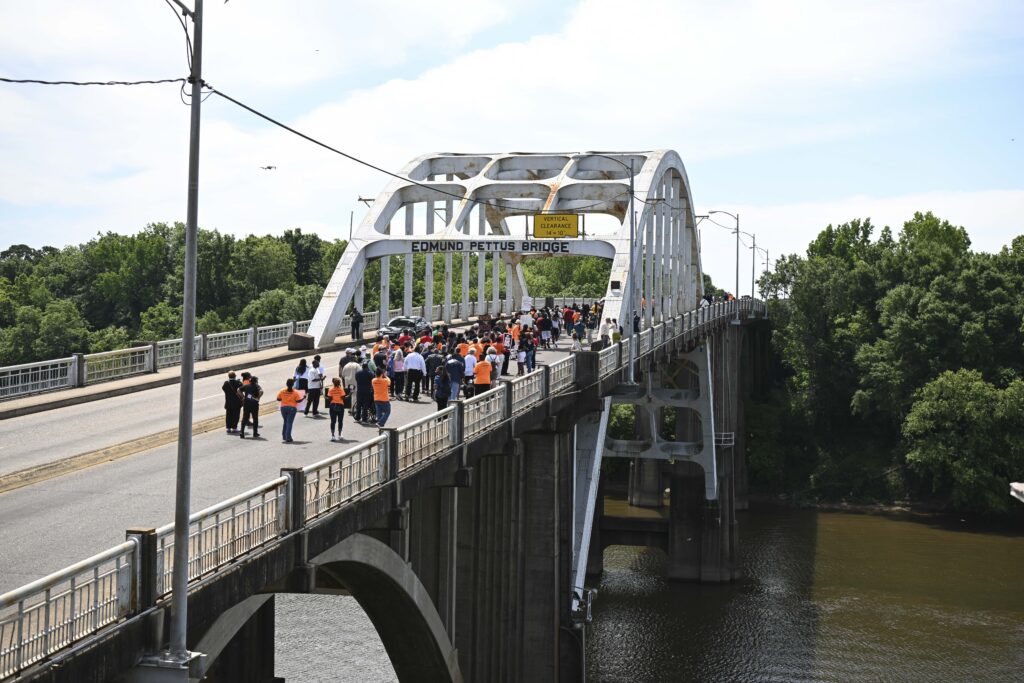
Alabama knows this history because Alabama helped write this history. Selma is not a symbol because the nation loves commemoration. Selma is a symbol because the fight for Black voting power has always exposed the gap between America’s democratic language and its governing reality.
That is still the question.
Can a state lose under the Voting Rights Act, lose at the Supreme Court, draw another discriminatory map, get called out for violating the 14th Amendment, and still expect the public to treat this as ordinary politics? Can democracy survive if those in power can simply keep changing the rules until the people they want silenced are functionally erased?
We need to be honest about what is being tested. This is not only a test of Alabama’s maps. It is a test of whether constitutional rights mean anything when a state has the political will to defy them. It is a test of whether the Voting Rights Act still has force after years of being weakened.
It is time for people to not only wake up to what is happening, but to recognize that none of us can afford to stay politically asleep. This should concern non-Black voters, too. Black political power has historically expanded democracy for everyone. When Black communities fought for the ballot, they expanded the meaning of citizenship, representation and equal protection. Attacks on Black voting power are often the testing ground for broader attacks on democracy.
This week’s ruling made something else unmistakably clear. The court warned that Alabama’s repeated conduct raised serious constitutional concerns beyond a single election cycle. The judges pointed directly to the Legislature’s continued use of race in drawing maps after already being told the prior map violated federal law. In doing so, the court reinforced that this was not an innocent disagreement over line drawing or political philosophy. It was a state repeatedly testing how far it could go in weakening Black political power while still surviving judicial review.
The ruling also underscored something civil rights advocates have warned for years. Alabama was not simply responding to court orders in good faith. It was repeatedly attempting to preserve the same political outcomes while appearing legally compliant on the surface.
Yes, the court blocked the map. But the deeper struggle remains.
Because the question before us is not simply whether Alabama will use a fair map. The question is whether we are willing to see this moment for what it truly is, an ongoing fight over whether Black voters will be treated as full constitutional citizens or managed as a political problem to be contained.
That is not just a map fight. That is a democracy fight.
Anneshia Hardy serves as the Executive Director of Alabama Values and Alabama Values Progress, where she leads narrative strategy, messaging, and public engagement initiatives focused on voting rights, civic participation, and democratic power-building across the American South.