Trump-appointed judge rejects DOJ’s demands for personal info of 2020 Georgia election workers
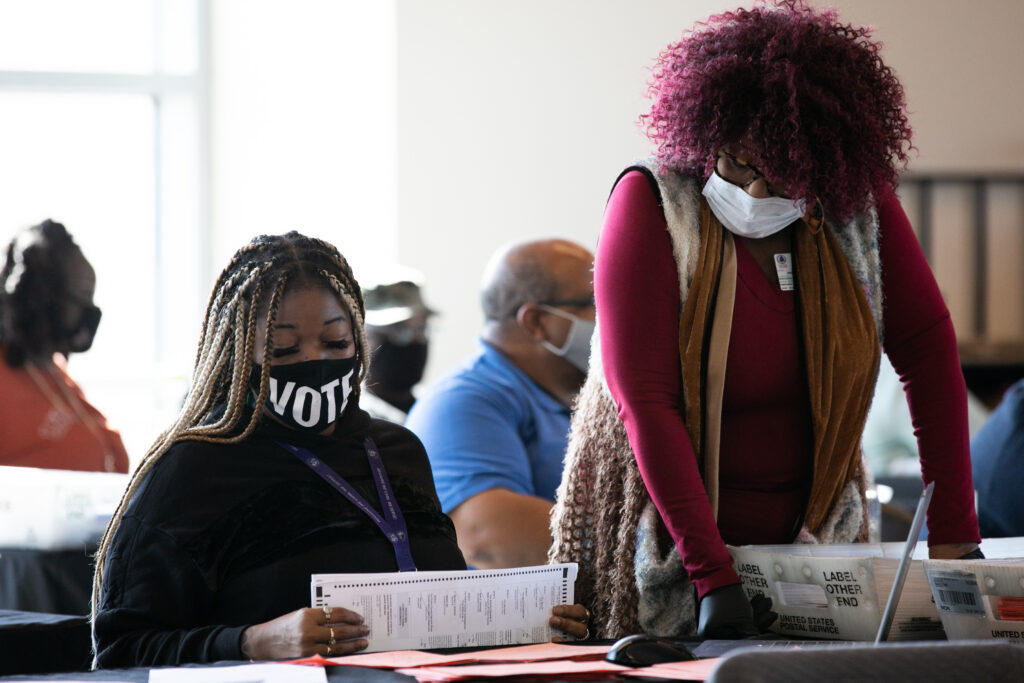
A federal judge blocked the Department of Justice’s (DOJ) demands for the identities and personal information of thousands of people who helped run the 2020 election in Georgia’s Fulton County, calling the request “unreasonable.”
U.S. District Judge William Ray II, an appointee of President Donald Trump, said the DOJ’s attempt to force Fulton County to divulge the election workers’ names, home addresses, emails and phone numbers through a subpoena was “staggering.”
The judge found that the subpoena was clearly motivated by Trump’s repeated false claims that widespread voter fraud led to his 2020 loss in Georgia.
“In this Court’s view, the DOJ does not possess a need to enforce the Subpoena greater than the burden of disclosure on Fulton County, and as such, the Court will not enforce it,” Ray wrote.
“Fulton County is under no obligation to comply,” he added.
Get updates straight to your inbox — for free
Join 350,000 readers who rely on our daily and weekly newsletters for the latest in voting, elections and democracy.
The DOJ sought the subpoena months after the FBI raided Fulton County’s main election facility and seized 2020 election materials, including original 2020 ballots, as part of a criminal investigation.
In response, the Fulton County Board of Registration and Elections asked a federal court to quash the subpoena, arguing it was overly broad and represented another attempt to harass the president’s political opponents.
The DOJ argued the personal information would be used to investigate potential criminal actions in the years that followed the election.
The major rejection comes after the FBI has taken steps to ramp up its election probe in Fulton County, including reassigning hundreds of FBI analysts to assist with the Atlanta Field Office’s review of the seized election materials.
In his order Tuesday, Ray said the information sought by the DOJ couldn’t be used to charge anyone because “the statute of limitations for any possible crime arising from the 2020 Election has long expired.”
“An investigation of alleged criminal conduct of anyone that may have led to the certification of the 2020 Election in Georgia would not be a legitimate use of the Grand Jury and its subpoena power, in that no valid indictment could issue from said Grand Jury due to the expiration of the applicable statutes of limitations,” the judge wrote.
Beyond being unusable for the DOJ’s investigation, the judge added that disclosing the election workers’ personal information at this time would “surely impact Fulton County” by chilling election workers’ participation in future elections.
“Those who work to run elections (particularly those who volunteered their time during the COVID-19 pandemic) should be valued and are necessary for successful elections in Fulton County going forward.”
Ray noted that, although the subpoena was issued by a grand jury, the grand jury process does not allow the DOJ “to do whatever the DOJ wants” because it ultimately “operates under the auspices of the District Court.”
“So, is there anything wrong with the DOJ using the Grand Jury to subpoena these records from Fulton County? In this Court’s view, yes,” he added. “Everyone, whether you support the President or you do not, or whether you believe the 2020 Election was fair or believe that it was not, should be concerned about the DOJ’s ability to utilize the power of the Grand Jury to appropriate your private information without a legitimate purpose.”
The subpoena was purportedly approved by a grand jury in the Northern District of Georgia, the federal judicial district governing Fulton County. However, it was issued by Dan Bishop, a staunch Trump ally who became U.S. attorney for the Middle District of North Carolina last year and was later tapped to pursue elections-related probes across the country.
In a footnote, Ray pointed out that, so far, he hasn’t seen any evidence indicating that the grand jury in northern Georgia actually sought the information. Instead, it appears to have been pursued by “out-of-district prosecutors who the DOJ has appointed to lead this inquiry who have served this Subpoena in the name of the Grand Jury,” he said.
This is a breaking news story. Please check back for additional information.