Trump’s Use of the Military in Los Angeles Goes to Trial – What to Know
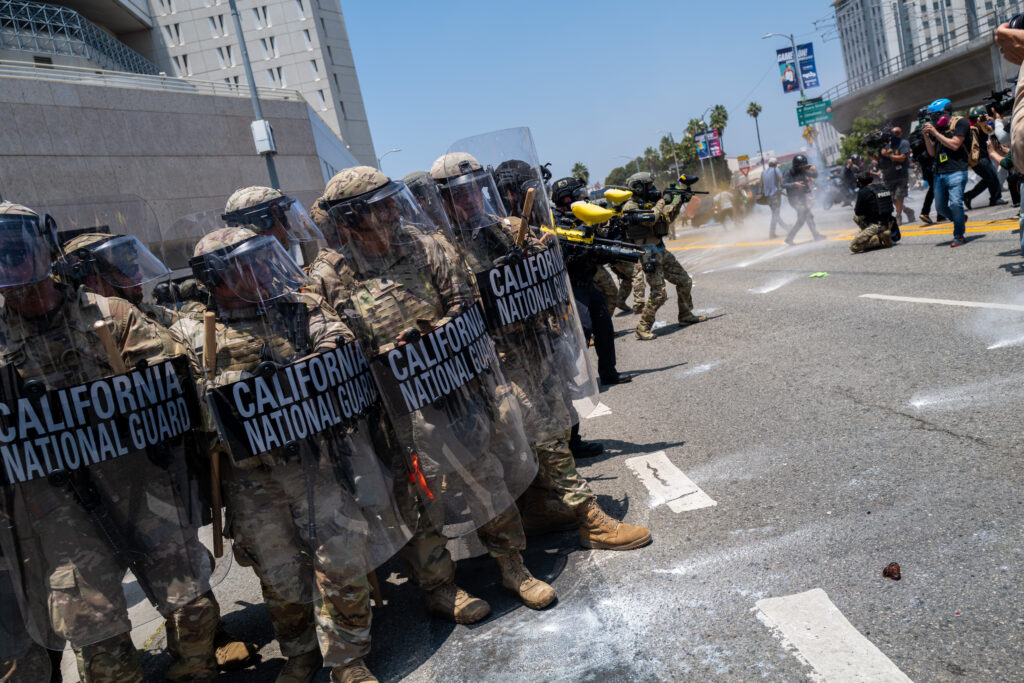
Just hours after the president announced the deployment of National Guard troops to D.C., a trial convened in San Francisco to determine whether President Donald Trump’s use of the military in California earlier this year violated federal laws.
The three-day, non-jury trial before Judge Charles Breyer stems from a June lawsuit California Gov. Gavin Newsom (D) filed against Trump after he federalized California’s National Guard and deployed hundreds of Guard troops and Marines to Los Angeles in response to protests over aggressive immigration raids earlier this year.
At issue is whether Trump allowing soldiers to accompany federal agents on law enforcement operations and temporarily detain civilians violated the Posse Comitatus Act, which prohibits the armed forces from enforcing civilian laws under normal circumstances.
“The factual question which the court must address is whether the military was used to enforce domestic law, and if so, whether there continues to be a threat that it could be done again,” Breyer said at the opening of the trial.
Trump federalized California National Guard troops and sent them to the second-largest city in the U.S. over the objections of Newsom using an obscure, archaic federal statute. California sued, alleging that Trump’s mobilization order violated the statute.
Breyer agreed with the state and granted a temporary restraining order blocking Trump’s seizure of California troops, though an appeals court days later stayed Breyer’s order and allowed Trump to keep using the troops.
California also asked Breyer for a court order blocking the troops from being used in immigration raids or other law enforcement operations, saying such arrangements violate Posse Comitatus.
In addition to authorizing soldiers to accompany Immigration and Customs Enforcement (ICE) officials on raids, the Trump administration has also used troops to assist with routine Drug Enforcement Administration counter-drug operations hundreds of miles away from the city.
In total, the Trump administration deployed over 5,000 National Guard soldiers and Marines to southern California.
The troops took part in “more than 170 missions in over 130 separate locations from nine federal agencies, including the Drug Enforcement Agency, the US Marshal Service, ICE and the Department of Homeland Security,” according to the Pentagon.
The missions included a bizarre multi-agency operation, codenamed Operation Excalibur, in MacArthur Park, a recreation area nearby a neighborhood with a large immigrant population. Around 90 California National Guard troops using 17 military Humvees took part in the operation.
Military personnel detained at least one person while operating in southern California: A 27-year-old Army veteran who was attempting to pick up paperwork at a Department of Veteran Affairs office in Los Angeles.
Experts have previously told Democracy Docket that the Trump administration’s desire to use military units alongside police undermines Posse Comitatus.
Breyer, an appointee of President Bill Clinton and the brother of former Supreme Court Justice Stephen Breyer, has been hesitant to make a determination on Posse Comitatus violations and set the trial to consider evidence on potential defiance.
During the trial’s first day, California’s lawyers and Department of Justice officials questioned Maj. Gen. Scott Sherman, the head of Task Force 51, which oversaw the National Guard troops and Marines involved in the military mission to Los Angeles.
Sherman, who has been in the military for over three decades, testified that Gregory Bovino, a senior Department of Homeland Security official, questioned Sherman’s loyalty to the country after the commander objected to a request for military assistance for the MacArthur Park operation.
Sherman said the original request asked for over 50 military vehicles to be involved in the park raid.
Ultimately, the assistance request went to Secretary of Defense Pete Hegseth.
In a press conference just hours before the trial started, Trump announced the deployment of National Guard troops to D.C., which he claims is out of control and overwhelmed by crime and homelessness — an account disputed by city officials and police data.
During the press conference, Hegseth heavily blurred the lines between military personnel and police, calling them “partners.”
“They will be strong. They will be tough. And they will stand with their law enforcement partners,” Hegseth said of National Guard troops.
Since the start of his second term, Trump has issued several executive orders meant to increase the military’s role in law enforcement and to militarize police departments.
In one of his first orders of his second term, Trump told the Departments of Defense and Homeland Security to recommend whether he should invoke the Insurrection Act and deploy military forces on American soil to assist with his mass deportation efforts.
The Insurrection Act, one of the president’s most powerful emergency authorities, overrides Posse Comitatus and allows military forces to help civilian authorities suppress insurrections, quell civil unrest or domestic violence and enforce the law.
The departments did not recommend an invocation of the Insurrection Act. However, Trump has repeatedly threatened to use the act.
In another order detailing plans to militarize law enforcement, Trump ordered Attorney General Pam Bondi and Hegseth to determine “how military and national security assets, training, non-lethal capabilities, and personnel can most effectively be utilized to prevent crime.”