Trump administration signals push to limit mail voting is on shaky ground
 Prefer us on Google
to see more of our voting rights news coverage when you search.
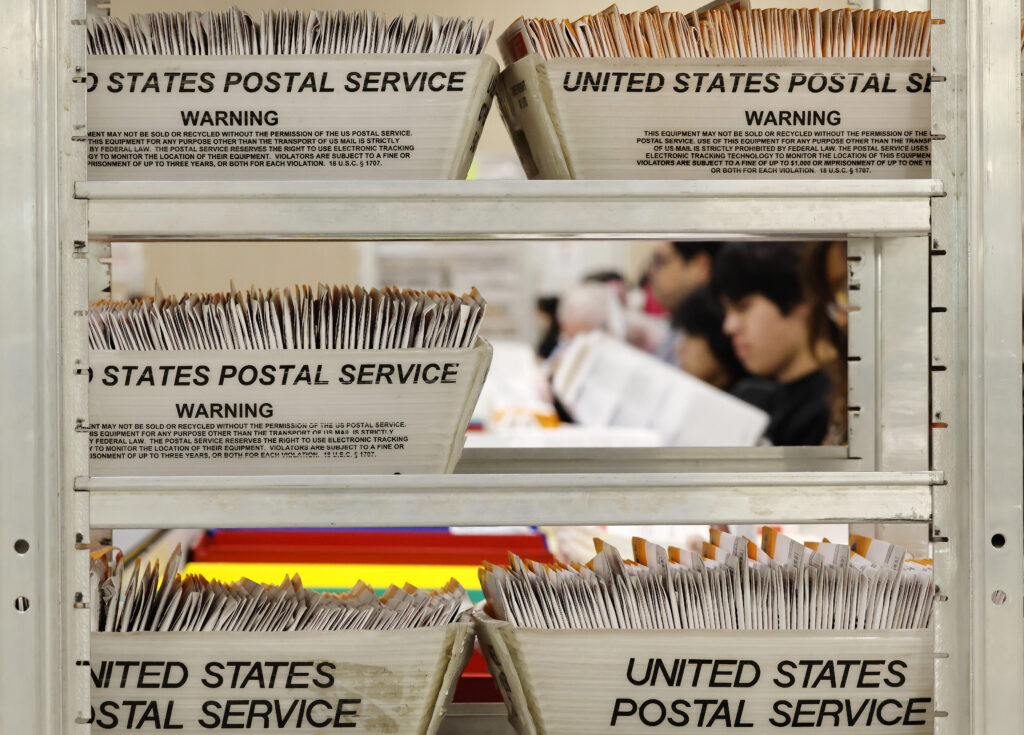
There are signs that the Trump administration may back away from one of its most overreaching attempts to exert more federal control over elections: trying to curb mail voting.
The Department of Justice (DOJ) has missed or pushed back several key deadlines in its defense of President Donald Trump’s executive order directing the U.S. Postal Service to make changes to its regulations for mail ballot envelopes. One-third of Americans routinely vote by mail, with many states conducting elections entirely by mail.
In Massachusetts, where 24 Democratic states and the District of Columbia are challenging the USPS rule, the DOJ recently told the district court it needed an extension to respond to blue states’ complaint because it’s actively “discussing the future of this litigation” and “ to the extent necessary, a schedule for further proceedings.”
“Those conversations have been productive, but Defendants require additional time for internal discussions on those subjects,” the administration said. It asked for an extension to Nov. 23 to respond to the blue states’ complaint arguing that the rule is an unconstitutional overreach by the executive branch.
The DOJ also noted in that filing that it needed the extension because its attorneys “currently face several other significant and time-sensitive litigation deadlines in other matters.”
Get updates straight to your inbox — for free
Join 350,000 readers who rely on our daily and weekly newsletters for the latest in voting, elections and democracy.
Trump’s mail voting order was one facet of a full press assault on voting. The administration demanded states turn over unredacted voter rolls for inspection to identify potential noncitizens registered to vote. The administration also sued California and Washington when those states refused to purge alleged noncitizens from their voter rolls after ballots had already been mailed. More alarmingly, the administration preemptively sued Alaska to block the certification of its U.S. Senate race in the event the Republican incumbent lost.
The overreach forced blue states, Democrats and pro-voting groups to file a flood of lawsuits to beat back the Trump administration’s attempts to interfere with voting and ballot counting.
In its request for an extension, the DOJ acknowledged its own losing streak so far on the USPS rule, which two federal district courts and eventually the U.S. Supreme Court blocked from taking effect before the midterms.
The USPS rule, ordered by Trump in a March executive order, would require states to upload a list of approved mail voters to a new government portal. It also demanded that states redesign ballot envelopes with trackable barcodes. If states did not meet the requirements, USPS said it would not deliver ballots to voters in those states.
“That Final Rule is now enjoined in whole or in part in five different cases—two before this Court, and three in the District of Columbia,” the administration noted.
In one of those other cases, filed by the Democratic Senatorial Campaign Committee and other Democratic organizations*, the DOJ missed a deadline and forfeited a critical appeal of a preliminary injunction blocking the USPS rule indefinitely. The injunction was issued by a Trump appointee, Judge Carl Nichols. His was the only block on the rule that extended beyond Election Day.
While a dozen red states filed an appeal at the last moment, the DOJ missed the deadline altogether. The decision not to pursue an appeal, coupled with the ongoing internal discussions highlighted in the lawsuit brought by blue states, hints that the administration might abandon a key provision of Trump’s EO attacking mail voting.
The DOJ didn’t immediately respond to Democracy Docket’s request for comment.
*The Elias Law Group (ELG) represents the plaintiffs in this case. ELG Firm Chair Marc Elias is the founder of Democracy Docket.