The GOP Attack on Mail-Ballot Grace Periods Is Also an Attack on Early Voting
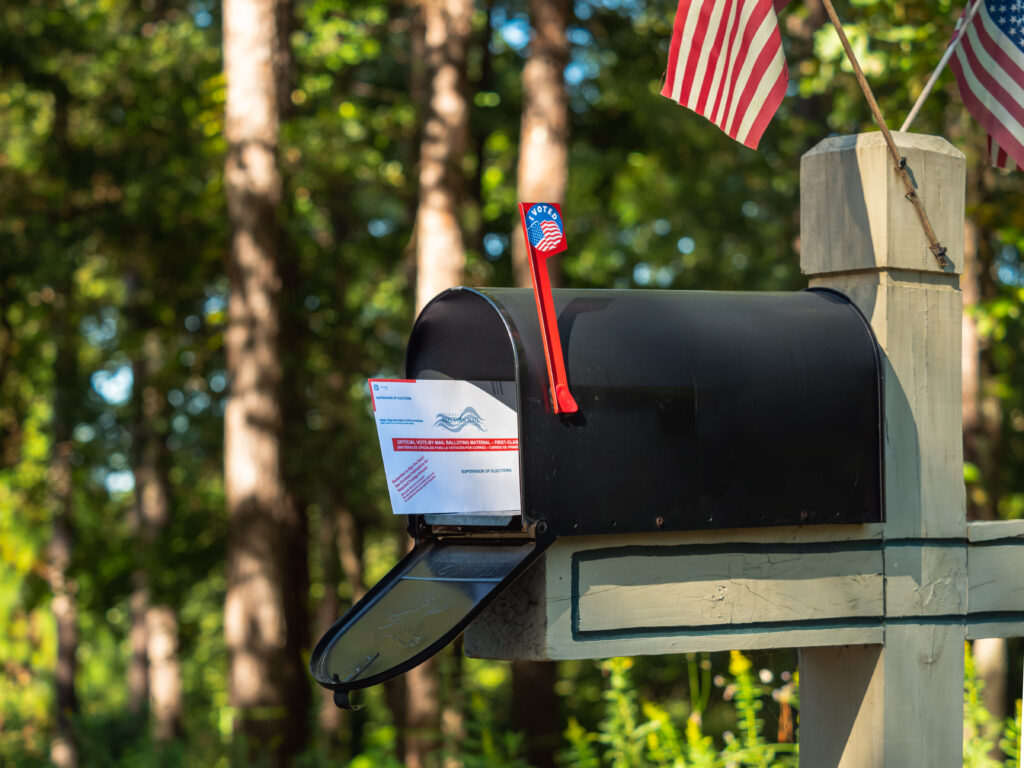
The U.S. Supreme Court announced this week it will consider a challenge to Mississippi’s grace period for mail ballots. A ruling to ban grace periods nationwide could upend mail voting.
But the case’s importance doesn’t stop there. Republicans are also using it to lay the foundations for an attack on their next target: early in-person voting.
Assistant Attorney General for Civil Rights Harmeet Dhillon posted a screenshot of the court’s certiorari grant from her Department of Justice (DOJ) account. “Election Day means Election DAY! Stay tuned!” Dhillon wrote.
Get updates straight to your inbox — for free
Join 350,000 readers who rely on our daily and weekly newsletters for the latest in voting, elections and democracy.
Kari Lake, the election denier that President Donald Trump nominated to lead the U.S. Agency for Global Media, echoed that sentiment.
“No more of this election month nonsense,” she tweeted. “It’s time we make Election Day a DAY again.”
After the SCOTUS announcement, the Democratic National Committee warned early voting might be next.
“This case… appears to be part of a multi-prong strategy by Trump and his Republican allies at the RNC and U.S. Department of Justice to lay the groundwork to eliminate all early and mail voting — a grave threat to the rights of working people and to military voters and their families,” the DNC said in a press release.
In Watson v. Republican National Committee, the Supreme Court will consider whether Mississippi’s grace period for mail-in ballots postmarked by Election Day but received up to five days after violates federal law — that is, the 1845 and 1872 statutes designating the “Tuesday next after the 1st Monday in November,” as the “day of the election” for presidential and congressional races.
“Text, precedent, and historical practice confirm this “day for the election” is the day by which ballots must be both cast by voters and received by state officials,” the 5th Circuit Court of Appeals wrote in its opinion last year, holding that federal law preempted Mississippi from accepting late-arriving ballots.
While the 5th Circuit went on to argue that early voting — which that court had blessed in a 2000 decision — didn’t run into the same problem, “because election results would not be decided or consummated before federal election day.”
But, as a dissent in the 5th Circuit’s denial of an en banc rehearing argued, that distinction isn’t really all that different. Left to stand, the 5th Circuit’s opinion would also put at risk post-Election Day ballots from military and overseas voters, and early voting. “If the panel was correct that consummation was strictly linked to ballot receipt, a state could comply with federal election laws by only receiving absentee ballots on Election Day, while also barring in-person voting itself,” the dissenters argued.
In recent weeks, Trump has repeatedly demanded an end to early voting, often in the same breath as lies about the 2020 election, as he did on Truth Social last month. “We now know everything. I hope the DOJ pursues this with as much ‘gusto’ as befitting the biggest SCANDAL in American history! If not, it will happen again, including the upcoming Midterms. No mail-in or ‘Early’ Voting, Yes to Voter ID!” Trump wrote.
While Trump has certainly been one of the loudest — if inconsistent — opponents of early voting, Republican opposition to early voting predates his takeover of the party. After Barack Obama’s Presidential Commission on Election Administration released its report on how to improve voting in 2014, conservatives like the Public Interest Legal Foundation’s J. Christian Adams took particular issue with its recommendation to expand early voting.
Even before that, GOP lawmakers in states like Florida and Ohio had cut back access to early voting, which tended to boost Democratic turnout more than Republican.
In the years since, the GOP has tried to enact state laws to ban or shorten early voting or curb the use of ballot drop boxes, while also challenging early voting in court.
In some states, those efforts have been strategically selective, like pushes to stop ballot casting on Sundays — when many predominantly Black churches conduct “souls to the polls” voter drives after services — or closing early voting sites on college campuses.
Early voting is broadly popular, with 80% of U.S. adults — including 71% of Republicans — supporting in-person voting at least two weeks before Election Day, according to a Pew Research Center poll conducted in August.
Some Republican operatives have lamented their party’s obsession with making it harder to vote. Those calls to can the anti-voting campaign were renewed in the wake of last week’s electoral rout.
An attack on early voting would have a much larger impact than just banning mail-in ballot grace periods. Sixteen states and the District of Columbia allow grace periods; that number grows to 29 states if you include grace periods for military and overseas voters. But 47 states (and D.C.) offer early in-person voting to all voters.