California Again Asks Court to Block Trump’s ‘Never-Ending’ Military Occupation of Los Angeles
 Prefer us on Google
to see more of our voting rights news coverage when you search.
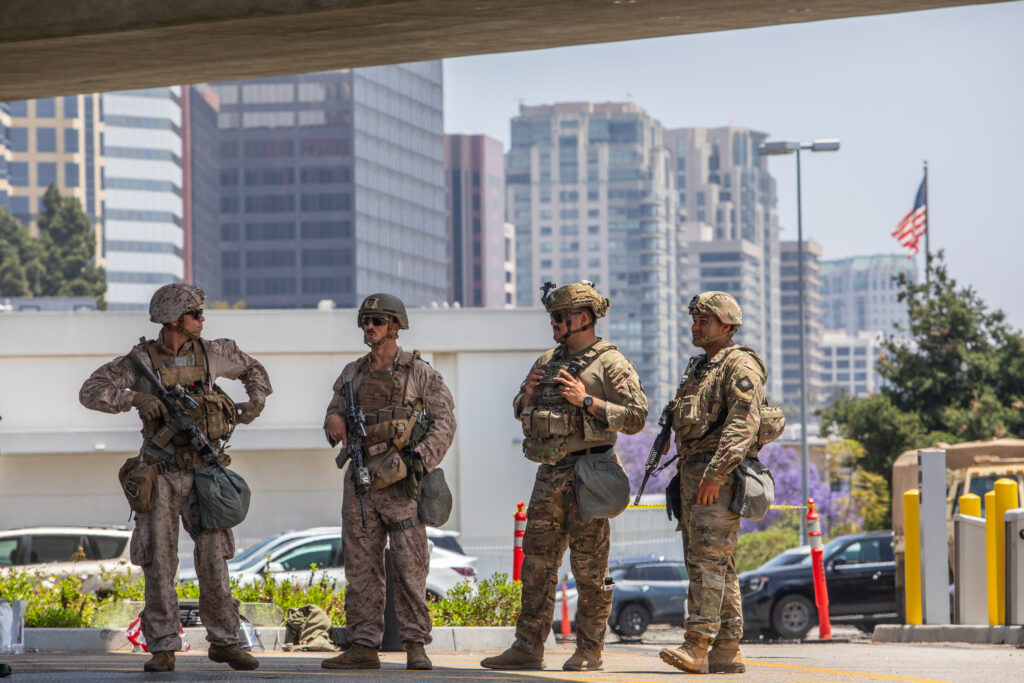
California Attorney General Rob Bonta (D) called on a federal court to end President Donald Trump’s National Guard deployment in Los Angeles, arguing that the Trump administration is carrying out an “unlawful” and “never-ending” military occupation in the city.
California’s new filing marks the second time the state has asked a federal court to block Trump’s Los Angeles deployment, which the president initiated through an early June memo in response to protests against his aggressive immigration raids throughout the city.
At the peak of the Los Angeles deployment over the summer, the Trump administration maintained around 5,000 troops — roughly 4,000 federalized California National Guard troops and 700 Marines — in the city. Even though protests have long since subsided, the Trump administration still has around 101 soldiers deployed in the city, California said.
Get updates straight to your inbox — for free
Join 350,000 readers who rely on our daily and weekly newsletters for the latest in voting, elections and democracy.
“Defendants are treating the President’s June 7 memorandum as a blank check that allows them to federalize state National Guard troops in any number and for any duration they please and to send those troops anywhere in the country, even to places that were not part of their justification for the original federalization,” California argued in its filing Thursday evening.
“The Court should grant Plaintiffs’ motion, enjoin any continued federalization and deployment of National Guard troops in and around Los Angeles, and end this unlawful federalization now,” it stated.
To federalize members of California Guard — who are normally controlled by Gov. Gavin Newsom (D) — Trump invoked 10 U.S.C. 12406 (Title 10), an archaic, rarely used law. It allows the president to take control of Guard forces during a foreign invasion, when the U.S. government faces rebellion or when the president is unable to execute laws with regular forces.
“Whatever 10 U.S.C. § 12406 permits, it certainly does not authorize the sort of broad-ranging, never-ending federalization and military occupation of American cities that Defendants are perpetrating,” California argued.
Trump also attempted to use Title 10 to federalize soldiers from the Oregon and Illinois Guard for deployments in those states. After courts halted those federalizations, the Trump administration transferred California Guard troops to Oregon and Illinois in an effort to put out-of-state troops on the streets of Portland and Chicago.
In its new filing, California argued that the Trump administration’s willingness to move California Guard troops out of the state proved that there was no longer a need for a military presence in Los Angeles.
“Defendants continue to keep soldiers federalized based on a remote and unsubstantiated risk that they might be needed at some point in the future, but that is simply not what § 12406 permits,” California said.
Though Trump initially claimed that Guard soldiers and Marines were needed in Los Angeles to protect federal property and personnel from protests against immigration operations, the soldiers’ mission expanded to encompass broad-ranging law enforcement-adjacent activities outside of the city.
For example, in late June soldiers participated in routine Drug Enforcement Administration raids on marijuana farms hundreds of miles away from the city in the Coachella Valley.
Charles Breyer, the federal judge overseeing California’s lawsuit against the Los Angeles deployment, determined in September that Trump’s use of the military violated a federal law that prohibits using soldiers as a domestic police force.
But the Ninth Circuit Court of Appeals blocked Breyer’s finding. It also stayed the judge’s initial order barring Trump from seizing the California Guard.
A federal judge last week permanently barred Trump from carrying out his Portland deployment, finding that it violated the Constitution and Title 10.
Trump’s attempted deployment in Chicago reached the Supreme Court last month through his emergency appeal of a lower-court block. In a surprise move, the high court said it needed more information on Title 10 before it acted on Trump’s appeal.
Specifically, the Supreme Court said it wanted to know whether the formal U.S. military — such as members of the Army, Navy and Air Force — is considered part of the “regular forces” referenced in Title 10.
In a filing earlier this week, the Department of Justice argued that the “regular forces” phrase in Title 10 does not refer to the standing military but instead to the “civilian forces that regularly ‘execute the laws.’”
The department also asserted that courts have no authority to question the president’s ability to deploy troops domestically — an argument that the Ninth Circuit rejected earlier this year.
Illinois, which is challenging Trump’s Chicago deployment, argued that the phrase does include the standing military.
Because he never attempted to use traditional soldiers to assist or protect federal immigration agents in Chicago, Trump couldn’t have determined that he was unable to execute federal law in the city and therefore lacked the authority to federalize and deploy the Guard there, the state argued.
Legal experts have noted that the Supreme Court’s question could undermine almost all of Trump’s domestic military deployments.