Supreme Court appears skeptical of Trump’s ouster of Fed governor Lisa Cook
The Supreme Court appeared reluctant to immediately uphold President Donald Trump’s attempt to arbitrarily dismiss Federal Reserve governor Lisa Cook during oral arguments in the case Wednesday.
Throughout the hearing, both conservative and liberal justices seemed skeptical — if not openly alarmed — by the Department of Justice’s expansive defense of Trump’s move to fire Cook.
Get updates straight to your inbox — for free
Join 350,000 readers who rely on our daily and weekly newsletters for the latest in voting, elections and democracy.
The hearing comes after the court’s Republican-appointed majority last year largely greenlit Trump’s efforts to assert control over the federal bureaucracy by dismissing the leaders of other independent agencies without cause.
But even that vision of executive power appears to have limits. While granting Trump this unprecedented control over independent executive branch agencies, conservative justices have attempted to insulate the Federal Reserve from the president’s influence by citing the central bank’s structure and history.
At times during Wednesday’s hearing, even conservative justices appeared taken aback by the government’s logic — including an argument that the president alone had the right to determine what constitutes wrongdoing meriting removal.
In August, Trump tried to fire Cook by raising allegations that she committed mortgage fraud during the purchase of an Atlanta home in 2022. It marked the first time in the Federal Reserve’s 111-year history that a president has attempted to fire a sitting board governor.
Cook, who was appointed by former President Joe Biden, sued in response, arguing that Trump did not show sufficient cause to dismiss her, a violation of the Federal Reserve Act. While the act gives the president the power to remove a Federal Reserve governor, he can only do so “for cause,” meaning serious misconduct like inefficiency, neglect of duty or malfeasance in office.
Lower courts, including a panel for the U.S. Court of Appeals for the D.C. Circuit, blocked the dismissal after concluding that Trump didn’t have sufficient authority to dismiss Cook. Courts also found that Cook was denied basic due process protections since Trump tried to oust her without first giving her notice or a hearing.
In October, the Supreme Court temporarily headed off Cook’s dismissal by deferring Trump’s request to lift lower court rulings until after it heard oral arguments in the case.
While defending Cook’s attempted dismissal in Wednesday’s hearing, Solicitor General D. John Sauer, a former personal lawyer for Trump, claimed that the president has near-limitless authority to remove Fed governors for cause.
Though he acknowledged that governors have for cause removal protections, Sauer claimed that the president should be given wide discretion to determine what cause looks like. He further argued that those targeted by the president should not be granted notice or afforded due process and that courts should not have the authority to review removal decisions.
Sauer’s arguments appeared to alarm conservatives and liberal justices alike.
After pressing Sauer to acknowledge the importance of removal protections for insulating Fed governors from direct political pressure, Justice Brett Kavanaugh stated that the solicitor general’s characterization of the president’s removal power would likely “weaken if not shatter” the central bank’s independence.
Kavanaugh said he feared that upholding Cook’s dismissal would set off a cycle of “search and destroy” Fed dismissals each time the presidency switched parties.
“No judicial review, no process, nothing. You’re done,” Kavanaugh, who was appointed during Trump’s first term, said.
Justice Amy Coney Barrett, another Trump appointee, was concerned about Sauer’s claim that governors shouldn’t be given an opportunity, such as a hearing, to respond to the allegations against them.
“It just wouldn’t be that big a deal, it seems,” Barrett said.
Sauer disagreed, claiming that giving governors such an opportunity would be “an intrusion on the executive branch to dictate” the procedures it follows.
Chief Justice John Roberts and Justice Sonia Sotomayor both expressed sympathy for Cook, saying that errors within mortgage documents could be the result of an inadvertent mistake and didn’t automatically arise to the level of a major crime.
Sotomayor said Cook’s appointment to the Fed, which required her to move from Michigan to Atlanta, reminded her of her move from New York to Washington, D.C., after her appointment to the Supreme Court.
After recognizing the complexity of buying real estate, Roberts asked, “So it doesn’t make a difference whether this was an inadvertent mistake or whether it was a devious way to get a better interest rate — doesn’t matter for you, right?”
Sauer agreed, implying that determining whether such an incident was a simple mistake or an attempt at fraud meriting removal should be left to the president.
Before Wednesday’s hearing, the Supreme Court’s conservative majority had already signaled it would seek to preserve the Fed’s independence from the president. That sharply differs from its approach to other independent agencies.
In a separate case over Trump’s dismissal of members of two independent governmental boards, the court said that the Fed should be insulated from executive influence because it is “a uniquely structured, quasi-private entity.”
During his time before the justices Wednesday, Cook’s lawyer, veteran Supreme Court litigator Paul Clement, framed Trump’s dismissal as an existential risk to the Fed’s independence. If it accepted Sauer’s theory on the president’s removal power and upheld Cook’s ouster, the court would destroy the Fed’s independence, he argued.
Clement also argued that Trump used the mortgage fraud allegations as a pretext to fire Cook over policy disagreements in order to gain more control over the central bank and its monetary decisions.
Despite being under investigation for months, Cook has not been charged with a crime and has denied wrongdoing. Loan records and other documents revealed throughout Cook’s lawsuit have also largely undercut Trump’s claims that she committed mortgage fraud.
The allegations against Cook were dug up by William Pulte, a Trump loyalist who heads the Federal Housing Finance Agency and who has made similar allegations against other enemies of the president.
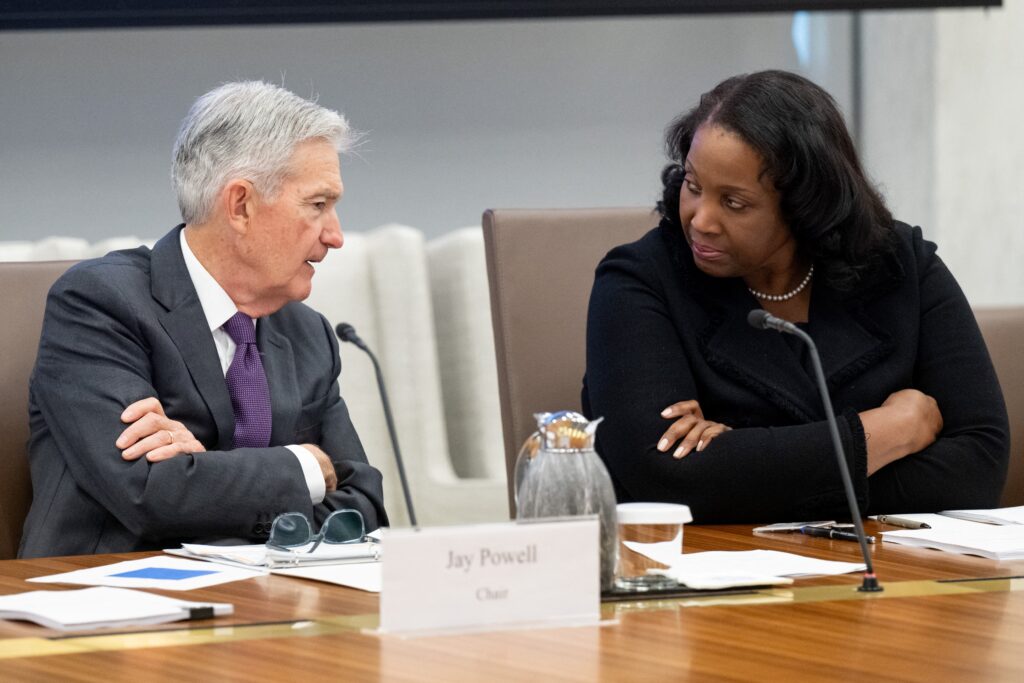
The court’s hearing of Cook’s lawsuit came just over a week after Federal Reserve Chair Jerome Powell warned in a rare public statement that Trump was attempting to pressure the central bank into cutting interest rates through the threat of criminal prosecution.
Just before the hearing began, Trump said in a speech in Davos, Switzerland that he wanted the U.S. to be “paying the lowest interest rate of any country in the world” and attacked Powell as showing “disloyalty.”
“We have a terrible chairman right now,” Trump said. “Jerome ‘Too Late’ Powell. Always too late with interest rates.”