Sotomayor: Supreme Court just gave Trump ‘far greater power than ever before’
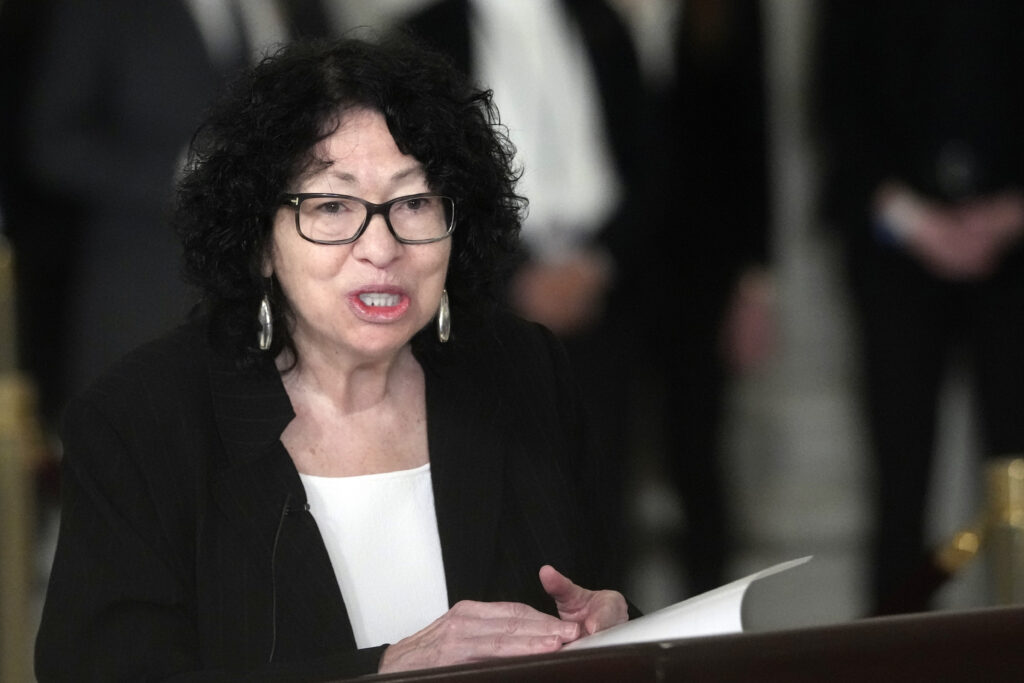
In a dissenting opinion Monday, Justice Sonia Sotomayor denounced the Supreme Court for upending almost a century of legal precedent while granting President Donald Trump power to shape the federal government through arbitrary dismissals.
Paired together, the Court’s two decisions on Trump’s dismissal of the last Democrat on the Federal Trade Commission (FTC) and his attempted removal of a Federal Reserve governor “distorts the structure of Government to fit the majority’s theory of unitary, total executive control,” Sotomayor warned.
“The result is a President who emerges with far greater power than ever before. It is a power, however, that neither the People, nor Congress, nor the Constitution bestowed upon him,” she wrote. “In granting the President this unbridled authority, the Court upends its precedent, misconstrues our history, and sheds any pretense of judicial modesty.”
Get updates straight to your inbox — for free
Join 350,000 readers who rely on our daily and weekly newsletters for the latest in voting, elections and democracy.
Sotomayor warned that dozens of independent agencies would now likely become “purely executive agencies, shifting tremendous power over broad swaths of American life into the President’s hands.”
“I respectfully dissent,” she concluded.
The Court Monday ruled that Trump could dismiss FTC Commissioner Rebecca Kelly Slaughter for no reason even though the Federal Trade Commission Act specifies that commissioners could only be removed for an explicit reason.
The for-cause provision in that law violated the separation of powers between Congress and the executive branch by limiting the president’s ability to remove his subordinates, the Court found.
While siding with Trump, the Court overruled Humphrey’s Executor v. U.S., a 90-year-old ruling that for decades largely protected independent agencies from undue political interference from the White House.
In a separate ruling, however, the Court rejected Trump’s attempt to halt a lower court opinion blocking him from dismissing Federal Reserve Governor Lisa Cook. It found that Trump violated the removal protections Cook enjoys under the Federal Reserve Act, which founded the central bank.
The Court held that the removal protections in the Federal Reserve Act were constitutional because of the U.S’ “long tradition of independent central banking” and the Founders’ recognition that political manipulation of monetary policy could result in “calamities.”
In her dissenting opinion in Slaughter’s case, Sotomayor slammed the two opinions as contradictory. Though she agreed with the Court siding with Cook and partly agreed with its reasoning, she said she did not understand why the Court didn’t evenly apply that rationale to Slaughter.
In relying on “ad hoc historical exceptions” to its expansive view of the president’s removal power to protect the Fed, the Court created a multitude of other problems, she wrote. As an example, she asked if members of an independent agency would suddenly receive removal protections if Congress charged that agency with regulating monetary policy.
“These line-drawing problems are the inevitable result of the majority’s ruling, yet never arose under Humphrey’s,” Sotomayor wrote. “Today, the majority replaces 90 years of proven, workable practice with a half-baked theory of executive power that is simultaneously all encompassing yet also subject to necessary but undefined exceptions.”
“The one thing that does appear to be clear going forward is that chaos will follow,” she continued.
Sotomayor wasn’t the only justice to highlight this contradiction. In his dissent to the Court’s decision in Cook’s case, Justice Clarence Thomas flatly called the majority “incorrect” because it upheld removal protections for some officials and struck them down for others.
“The Court makes many policy arguments for an ‘independent’ banking agency that exercises executive power free from accountability, but those are ultimately arguments against the Constitution,” Thomas wrote.
Sotomayor added that the Court’s ruling in Slaughter will put other structural elements of independent agencies at risk.
Some agencies, for example the Federal Election Commission, require that members are evenly divided between political parties.
But in light of Slaughter, “Bipartisan-appointment requirements can easily be evaded
simply by firing all Commissioners of the opposite party,” she wrote.
Through arbitrary dismissals, she added that presidents can circumvent fixed terms for commissioners, who were created to ensure stability, continuity and expertise within agencies.
“With the most extreme exercises of at-will removal, the multimember structure itself could be eliminated, by executive fiat, with sufficient arbitrary firings to winnow a commission down to a sole remaining chair,” she added.
“Put simply, today the majority reshapes our Government,” Sotomayor wrote.