In Court Filings, Oregon Police Slam Trump’s Portland Takeover
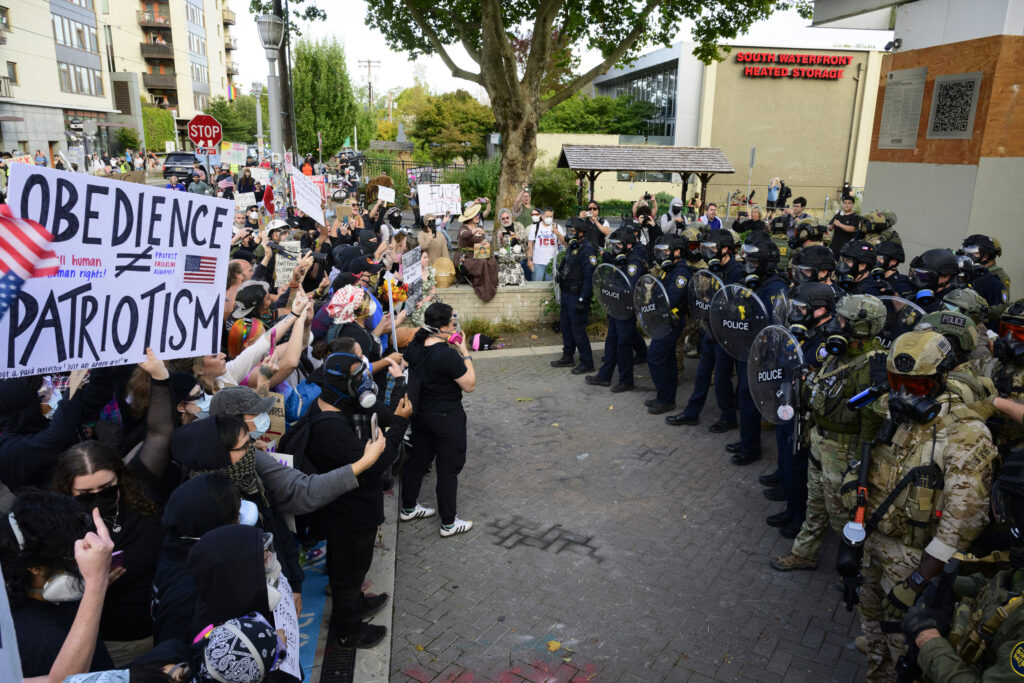
Top law enforcement officials in Oregon said in court filings Monday that President Donald Trump’s deployment of National Guard troops to Portland was unwarranted and could undermine public safety by provoking larger protests.
Trump ordered troops to the City of Roses after falsely asserting that “domestic terrorists” had Immigration and Customs Enforcement (ICE) facilities in the “War ravaged” city “under siege.”
“I am also authorizing Full Force, if necessary,” Trump said in a social media post announcing the deployment.
In response to the president’s post, Secretary of Defense Pete Hegseth signed a memo claiming to federalize 200 members of the Oregon National Guard for at least 60 days.
The law enforcement officials’ testimony were filed as part of Oregon and Portland’s lawsuit challenging Trump’s deployment.
In a declaration Monday, Craig Dobson, a Portland police official, testified that the president’s characterization of Portland and protests outside of an ICE facility in southwest Portland did not match reality.
While there have been protests outside the facility, Dobson said demonstrations have been largely peaceful and have only amounted to a few people gathering outside of the ICE facility on a nightly basis.
The protests began in June after federal officials arrested asylum seekers in Portland’s immigration court, Dobson noted.
“For the most part, nightly ICE-Facility protests since July 18, 2025, have been limited to fewer than thirty participants. The protests have been largely sedate during this time,” Dobson said. “Certainly, these protests bear no resemblance to the sustained, large protests of 2020.”
Dobson added that since the demonstrations started, the PPB has intervened to protect public safety only a few times. The bureau made 25 arrests at protests outside the facility in mid June but hasn’t made any arrests since then, despite nightly monitoring.
“The notion that the ICE-Facility protests cannot be adequately managed by those local and federal resources already present before September 27, 2025, when the federal government ordered the deployment of federal troops into the area, cannot be squared with the facts on the ground,” Dobson testified.
The assistant chief also warned that the Trump administration’s deployment could undermine public order by inciting larger demonstrations.
“The contemplated federal troop deployment is unnecessary and counterproductive. Rather than improve public safety at the ICE-Facility protests, or in Portland more generally, the deployment is likely to provoke a larger protest.”
In a separate declaration, Cameron Bailey, a captain with the Oregon State Police, said the PPB in recent months made no request for additional law enforcement assistance, indicating that the bureau believed it had sufficient resources to maintain order.
Thousands of people peacefully marched through downtown Portland Sunday to protest Trump’s deployment and ICE activity in the city. The PPB said that no reports of injuries and no arrests were made in relation to the march.
In an interview with NBC News Sunday, Trump appeared to question his own perception of Portland after speaking with Oregon Gov. Tina Kotek (D).
“I spoke to the governor, she was very nice,” Trump said. “But I said, ‘Well wait a minute, am I watching things on television that are different from what’s happening? My people tell me different.’ They are literally attacking and there are fires all over the place … it looks like terrible.”
Hours after Trump gave the interview, however, Hegseth issued the memo claiming to federalize the Oregon National Guard troops.
The memo cited 10 U.S.C. 12406, an archaic statute that allows the president to mobilize the Guard when the country faces foreign invasion or rebellion, or when the president is unable to execute laws with regular resources.
Trump used the same statute over the objections of California leaders earlier this year to federalize thousands of National Guard troops in response to unrest in Los Angeles, which the president claimed was a “rebellion” against the federal government.
After California challenged the deployment, a three-judge panel for the Ninth Circuit Court of Appeals determined Trump was within his authority to federalize Guard troops because conditions in LA were sufficient for use of the statute.
However, the panel rejected the Trump administration’s argument that judges could not review a president’s decision to federalize the National Guard, ruling that a president could not federalize Guard troops “based on no evidence whatsoever.”
Trump’s deployment to LA eventually swelled to around 4,000 California National Guard members and 700 active-duty Marines.
Oregon and Portland’s lawsuit was assigned to U.S. District Judge Michael Simon, who was appointed by former President Barack Obama.
The Ninth Circuit could soon again confront whether Trump’s use of 10 U.S.C. 12406 was legal, as appeals from the District of Oregon are heard by the Ninth Circuit.