North Carolina Restricted Student Voting After ‘Influence Campaign’ by Cleta Mitchell
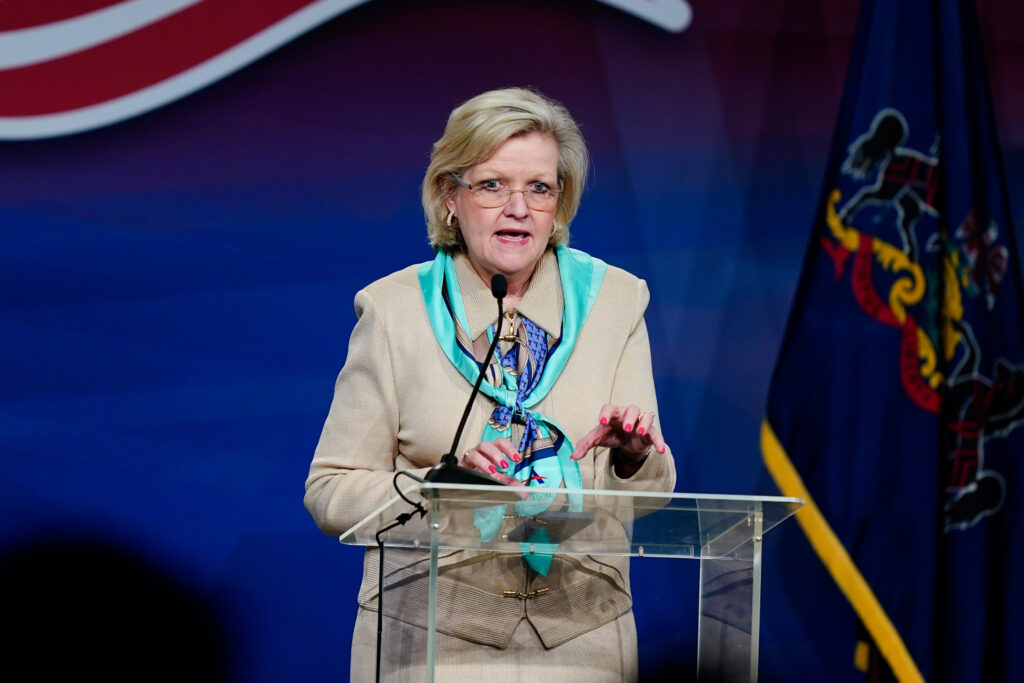
A restrictive North Carolina law targeting student voting came after an intense “influence campaign” from Cleta Mitchell, pro-voting advocates challenging the measure charged Friday in a court filing.
“The legislative record and the testimony elicited at trial demonstrate that SB 747’s restrictions on same-day registration were delivered in response to a monthslong influence campaign by election integrity activists Jim Womack… and Cleta Mitchell, who publicly espoused anti-student rhetoric and sought a corresponding legislative crackdown on youth voting,” the brief reads.
Mitchell is a close ally of President Donald Trump — she played a key role in his bid to subvert the 2020 election — and a leader of the right-wing push to restrict voting access. Womack leads the North Carolina Election Integrity Team — the local chapter of Mitchell’s Election Integrity Network.
At issue is a North Carolina law that changed the rules for same-day voter registration, allowing election officials to throw out a ballot if just one piece of mail sent to verify the voter’s address is returned as undeliverable.
The pro-voting plaintiffs who sued over the law argued that it was designed specifically to keep young people from voting. Same-day registration is especially popular among students, who change their address more often than older voters.
In a “post-trial brief” — a summary of all the evidence, testimonies, and legal arguments submitted by each party to the judge to consider before making a ruling — filed Friday, the plaintiffs highlighted Mitchell’s history of advocating against student voting. They also pointed to records showing that Mitchell and Womack coordinated with Republican lawmakers to push SB 747 through the legislative process.
Get updates straight to your inbox — for free
Join 350,000 readers who rely on our daily and weekly newsletters for the latest in voting, elections and democracy.
The details of Mitchell and Womack’s “influence campaign” were revealed at trial last month, but are just now becoming public through legal filings. A ruling in the case could come at any time.
Womack proposed the anti-student provisions of SB 747 to the bill’s co-sponsor, Sen. Warren Daniel (R), according to records from the case.
In May 2023, Mitchell and Womack met with Daniel and other GOP lawmakers to push for eliminating same-day voter registration during early voting, or requiring these voters to use provisional ballots, to allow for voter challenges.
“These proposals were motivated by a desire to remove what they saw as special privileges from youth voters, a basis which has been repeatedly asserted, including at trial, by both Womack and Mitchell,” the plaintiffs claimed.
Mitchell, who previously testified in a deposition prior to trial, was “highly critical of policies that promote voting access for youth and student voters,” according to the plaintiffs.
“According to Mitchell, it ‘make[s] it easy [to cheat] when you have the polling locations where [students] live on the campus; you have same-day registration; you can use student IDs,’” the brief reads. “You create a continuum where you’re just breaking little bones all along the arm. Pretty soon you’ve got a broken arm.”
Mitchell testified that a vast majority of student voters will vote for Democrats. Because of this, Mitchell said that “Democratic operatives” changed voting laws — citing policies like same-day voter registration and adding polling places to campuses — to make it easier for students to vote.
“College students can just roll out of bed, vote, and get back into bed,” Mitchell said at the deposition, falsely claiming that “students are going to vote 95 percent [for] one party.”
But when Mitchell was called to testify at trial, she softened her views.
“For example, in her deposition, she testified unequivocally that the ‘participation of college students contribute[s] to the manipulation of election outcomes’ because the Democrats seized upon that voting bloc,” the plaintiffs wrote.
At trial, Mitchell backtracked on that assertion and acknowledged that student participation in elections “can” contribute to voter manipulation.