Maryland House committee approves redistricting plan aimed at countering GOP gerrymanders
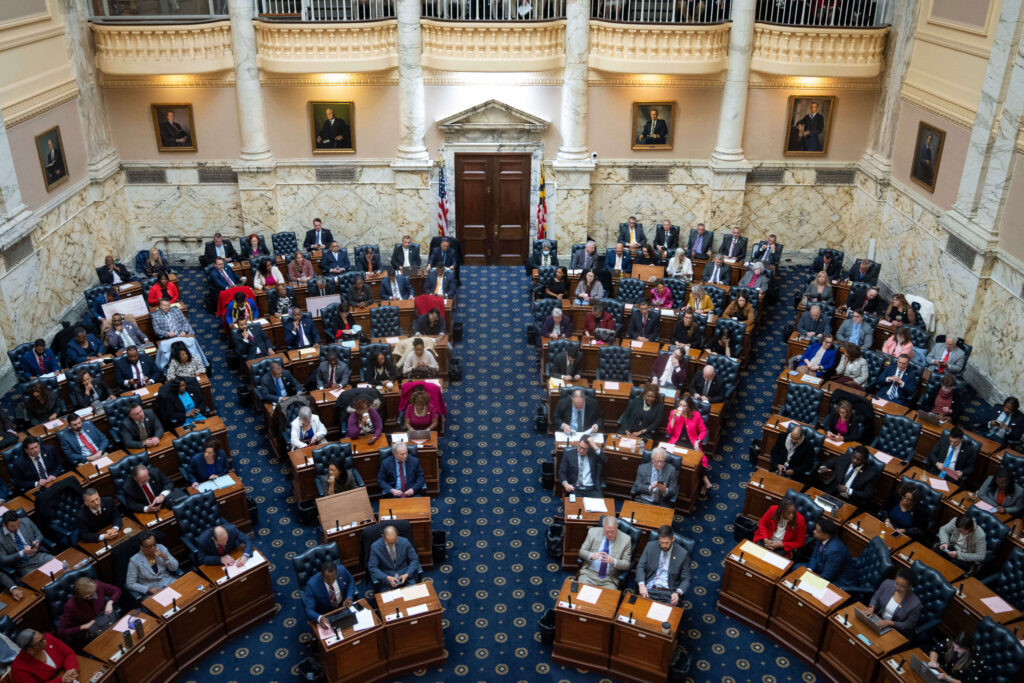
Maryland Democrats moved closer to redrawing the state’s congressional map Tuesday, as a key House committee approved legislation that would eliminate the state’s last GOP-held U.S. House seat and position Maryland as a counterweight to Republican gerrymanders nationwide.
The House Rules and Executive Nominations Committee voted 18-6 to advance House Bill 488, sending the redistricting legislation to the full House of Delegates for consideration. The bill would enact a new congressional map recommended by the governor’s redistricting advisory commission — a plan that would shift Maryland’s delegation from 7–1 Democratic to entirely Democratic-leaning.
Get updates straight to your inbox — for free
Join 350,000 readers who rely on our daily and weekly newsletters for the latest in voting, elections and democracy.
Supporters — most prominently Gov. Wes Moore (D) — say the move is a direct response to Republican-led efforts in other states to redraw congressional districts mid-decade to secure partisan advantage ahead of the 2026 midterms, a strategy pushed by President Donald Trump.
With the U.S. House narrowly divided, Democrats argue that allowing those efforts to go unanswered would distort national representation.
“What the President of the United States is doing right now is political redlining,” Moore said during the committee hearing. “It is imperative that Maryland do its part to ensure that Congress is able to function as a meaningful check on executive overreach.”
Moore framed Maryland’s action as both defensive and urgent, arguing that congressional representation itself is at stake as redistricting battles escalate across the country.
“Donald Trump and J.D. Vance and their allies are doing everything in their power to silence the voices and trying to eliminate Black leadership,” Moore added.
The committee hearing stretched more than five hours, with lawmakers hearing testimony from administration officials, advocates and members of the public as they weighed the bill’s advancement. Throughout the hearing, Democrats backing the legislation emphasized that the proposed map was developed through a public process.
“The Commission’s recommendation was shaped by public submissions,” Moore said. “It was shaped by public hearings. It was shaped by public feedback.”
If enacted, the bill would immediately establish new congressional district boundaries for the 2026 election.
But House Bill 488 also includes a referendum provision that would give voters a direct say in whether the new map remains in effect for the 2028 and 2030 elections. In practical terms, the map would be used in 2026 regardless, but its longer-term use would depend on voter approval — a safeguard lawmakers included as the plan is likely to face court challenges.
With committee approval secured, House Bill 488 now heads to the full House of Delegates this week, where Democrats hold a large majority. If the House passes the bill, it would move to the Senate for consideration. Approval by both chambers would send the legislation to Moore for his signature.
If signed into law, the new map would eliminate Maryland’s lone Republican congressional seat, potentially netting Democrats an additional U.S. House seat even as GOP redistricting efforts in other states threaten Democratic incumbents elsewhere.
The bill’s advancement marks one of the most consequential developments yet in a rapidly intensifying national redistricting fight — with control of Congress hanging in the balance.