Kalshi locks horns with Wisconsin after state warns voters about betting on elections
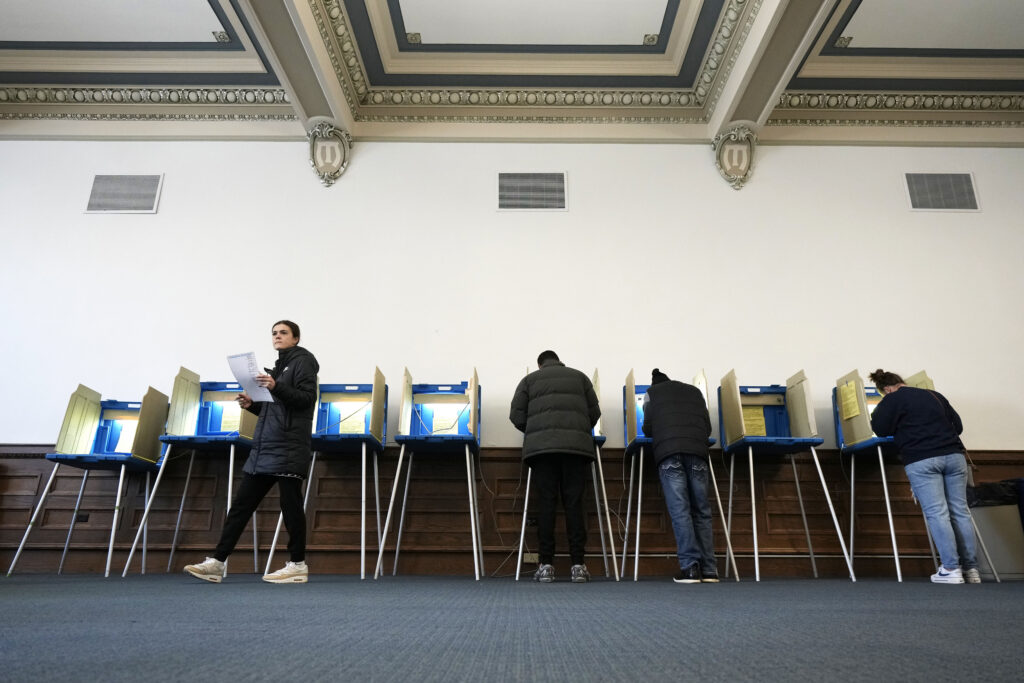
When the prediction market Kalshi accused the state of Wisconsin of “voter suppression,” it wasn’t referring to gerrymanders, proof-of-citizenship measures, or other methods of restricting the vote that President Donald Trump’s Republican Party has frequently promoted.
Instead, the betting platform — which has links to the Trump family and supporters in the administration — was referring to a state law that makes it a felony to vote in any election you’re also betting on.
This week, the Wisconsin Elections Commission issued a sharp warning to state voters ahead of next month’s primaries: “Wisconsin law is clear: a voter cannot, even indirectly, make a bet or wager on the outcome of an election and then vote in that same election.”
Kalshi, which allows Americans to bet on everything from the weather to election outcomes, quickly fired back.
“THIS IS INSANE,” Benjamin Freeman, a leader of Kalshi’s politics team, wrote on social media.
Get updates straight to your inbox — for free
Join 350,000 readers who rely on our daily and weekly newsletters for the latest in voting, elections and democracy.
“Not only is the Commission’s statement illegal and dishonest, it’s active voter suppression!” he continued. “I hope the Commission understands their mistake and retracts their statement, because this is really dangerous for democracy. It’s dystopian frankly. I’m still having a hard time processing how insane and harmful this rhetoric is.”
And Robert J. DeNault, an attorney at Kalshi, posted that Wisconsin officials “should retract this guidance before courts are required to force them to do so.”
“The Wisconsin Elections Commission threatening to prosecute Wisconsin voters and strip away their voting rights for engaging in legal trading activity is unconstitutional and illegal,” he claimed.
Dystopian it wasn’t. Contrary to Kalshi’s claims, the Wisconsin Elections Commission wasn’t threatening voters. It was only explaining a longstanding law.
In its warning, the commission cited two Wisconsin statutes that quite clearly place restrictions on election betting. The first states: “No person shall be allowed to vote in any election in which the person has made or become interested, directly or indirectly, in any bet or wager depending upon the result of the election.” The second states that it is a felony to intentionally vote in an election without being qualified to do so.
Election officials also warned that voters who violate the prohibition could face voter qualification administrative challenges that could prevent them from being able to cast their ballot and even result in a referral to the district attorney.
“We want voters to understand that they cannot legally make a bet on an election and cast a ballot in that same election,” WEC Administrator Meagan Wolfe said in a statement. “We are not able to police someone placing a bet on these platforms, but it’s important for voters to understand the consequences if they bet on an election outcome.”
While it’s not surprising that Kalshi would disagree, the company’s tough talk raised more than a few eyebrows — particularly given its ties to the Trump administration.
Kalshi counts the president’s son, Donald Trump Jr., among its strategic advisors. And the administration has also taken an increasingly laissez-faire attitude towards the prediction markets, which have grown into a multi-billion-dollar industry over the last several years.
Evidence of prediction markets’ growth? Americans are betting millions of dollars on 2026 elections, and Kalshi users have already wagered more than $2 million on Wisconsin’s upcoming Aug. 11 Democratic primary race for governor.
Kalshi’s aggressive response suggests it may believe it has the upper hand.
This wasn’t the first time Wisconsin tangled with betting companies this year. In April, the state sued five prediction markets, including Kalshi and Polymarket, arguing that betting and commercial gambling have “long been illegal in Wisconsin.”
Remarkably, the federal government rushed to sue Wisconsin in response, claiming that the state does not have the authority to sue prediction markets. The lawsuit was filed by the Commodity Futures Trading Commission (CFTC), the federal agency with oversight of prediction markets.
The CFTC — and its position on prediction markets, in particular — has undergone a striking transformation during Trump’s second term.
Under President Joe Biden, the CFTC formally prohibited election betting in 2023. Kalshi filed a lawsuit challenging that decision. A federal district judge ruled in Kalshi’s favor in September 2024, opening the door for Americans to bet on election outcomes — despite state laws that explicitly ban gambling. The CFTC appealed the ruling.
Trump, then in the final weeks of his 2024 campaign, welcomed the federal judge’s ruling, boasting that prediction market odds favored him to win.
“They have a new thing, a new phenomenon,” he said. “A gambling poll, as they call it… I don’t know what the hell it means, but it means we’re doing pretty well.”
Trump Jr. is now an advisor to both Kalshi and Polymarket.
At Kalshi, he was given roughly $300,000 in equity for that role — a stake that has only grown in value since then. And 1789 Capital, an investment firm where Trump Jr. is a partner, made a “strategic investment” in Polymarket when he joined the company’s advisory board.
Even more alarmingly, since Trump took office, the CFTC has dropped its appeal in the Kalshi lawsuit and the U.S. Department of Justice has closed an investigation into Polymarket. And the regulator is now led solely by Trump appointee Mike Selig, an outspoken advocate for prediction markets. The other four commissioner seats at the CFTC are vacant.
Selig has made no secret of the fact that he considers it his job to help grow prediction market betting.
“The days of regulation by enforcement are over,” Selig posted on social media in April. “Under POTUS and my leadership at the CFTC, we’re creating opportunities for new technology, like prediction markets, to develop here in the US without fear of prosecution from Washington.”