In major win for voters, judge blocks Indiana GOP’s student ID ban
 Prefer us on Google
to see more of our voting rights news coverage when you search.
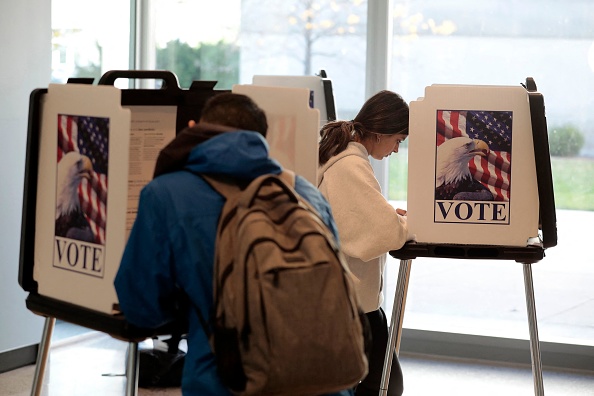
A federal judge Tuesday blocked Indiana’s ban on using student IDs for voter identification, a victory that will make it easier for students and young voters to cast ballots in the upcoming midterm elections.
In a sweeping decision issued Tuesday, U.S. District Judge Richard L. Young granted a preliminary injunction halting enforcement of Senate Bill 10 (SB 10), a Republican-backed law that eliminated student IDs as an acceptable form of identification at the polls.
The ruling means student IDs can once again be used in upcoming elections while the case works its way through court.
Get updates straight to your inbox — for free
Join 350,000 readers who rely on our daily and weekly newsletters for the latest in voting, elections and democracy.
Young found that the pro-voting plaintiffs* — Count US IN, Women4Change Indiana and a voter — were likely to win in court, a strong indication the law may ultimately be struck down as unconstitutional.
“On this record, SB 10 looks more like a solution in search of a problem,” the judge wrote. “Having determined that Indiana’s legitimate interests in protecting public confidence and orderly election administration are not strong enough to justify the moderate burden that SB 10 imposes on students and young voters, the court concludes that Plaintiffs have a reasonable likelihood of success.”
Just months ago, the same court refused to grant that state’s motion to dismiss, allowing the lawsuit to go forward.
Now, after reviewing evidence, it has blocked the law outright and restored access to the ballot for tens of thousands of students.
For nearly two decades, Indiana accepted student IDs that met standard requirements for use in voting. SB 10 changed that overnight, singling out student IDs as the only otherwise valid form of identification banned from the polls.
Young found that decision imposed a real burden on students, who are far less likely than other voters to have driver’s licenses or other qualifying IDs and to face significant obstacles obtaining them.
“There is no question about the legitimacy or importance of Indiana’s interest in ‘protecting the integrity and reliability of the electoral process,’” Young wrote. “But student IDs have qualified as proof of identification under Indiana’s voter ID law for nearly two decades. To eliminate the ID that students and young voters are far more likely to rely on, Defendants must better document the unique problems student IDs raise.”
The court estimated that roughly 40,000 students could be affected by the law. And for those voters, the consequences would be immediate.
“Even if Defendants are right that SB 10 does not make it impossible for [one of the plaintiffs] to vote, the moderate burden that it imposes on his right to vote still constitutes irreparable harm as a matter of law,” Young wrote. “Because an individual cannot vote after an election has passed, it is clear that the wrongful disenfranchisement of a registered voter would cause irreparable harm without an adequate remedy at law.”
That concept — irreparable harm — is key. It means harm that cannot be undone later. In voting cases, courts treat disenfranchisement as uniquely serious because elections don’t have second chances.
The court also rejected one of the most common arguments used to defend restrictive voting laws, that courts shouldn’t change election rules close to an election, also known as the Purcell principle. Young found the opposite — that restoring student IDs would be simple because voters in the state had already used them for years.
“The requested relief only requires Defendants to accept student IDs as a form of voter identification—something Indiana has already done for nearly two decades,” the court wrote, finding the change would not cause confusion or disruption.
While Indiana argued the ban was necessary to protect election integrity, the court found no evidence that student IDs had ever posed a problem.
“Although supporters of SB 10 described it largely as an election-integrity measure, there is no evidence that student IDs have been used to engage in voter fraud or any other voting-related misconduct,” the court concluded.
Instead, the judge concluded the state removed a widely used, previously valid form of ID without demonstrating any real need — a finding that echoes arguments from voting rights advocates, who have long warned SB 10 targeted younger voters.
“This ruling is a victory for every student in Indiana who could have lost their right to vote because of Senate Bill 10,” Jalyn Radziminski-Hooks, Executive & Lead Policy Director of Count US IN, said in a statement. “This law was never about election integrity — it was about silencing the voices of young Hoosiers who want to hold their elected representatives accountable at the ballot box. Count US IN will continue fighting to ensure that every young voter in Indiana has a chance to participate in the political process. Our voices matter, as today’s ruling demonstrates.”
The decision lands amid a broader push by Republican lawmakers across the country to restrict student voting access, often by tightening ID requirements or banning student IDs outright.
In Indiana, the Republican National Committee even stepped in to defend the law, arguing in court filings that banning student IDs was a neutral policy choice.
With the injunction now in place, Indiana must allow student IDs at the polls for the upcoming midterm elections. The case will continue, but the court has already sent a clear signal that laws that make it harder for young people to vote — without evidence or justification — may not withstand constitutional scrutiny.
*The Elias Law Group (ELG) represents the plaintiffs in this case. ELG Firm Chair Marc Elias is the founder of Democracy Docket.
This story has been updated.