Indiana Republicans Unveil Map to Eliminate Both Dem Congressional Seats
Republicans in Indiana’s State House released a draft congressional map that could eliminate both districts currently held by Democrats – though it remains unclear whether the GOP has enough votes in the Senate to pass the gerrymander.
Republicans published the map Monday in response to months of pressure to gerrymander from President Donald Trump and weeks of escalating threats and harassment.
The Indiana House could pass the map this week, teeing up a vote in the state Senate when it convenes Dec. 8. The House announced its election committee will hold a public hearing on the map Tuesday morning, giving Hoosiers who want to attend less than 24 hours notice.
Get updates straight to your inbox — for free
Join 350,000 readers who rely on our daily and weekly newsletters for the latest in voting, elections and democracy.
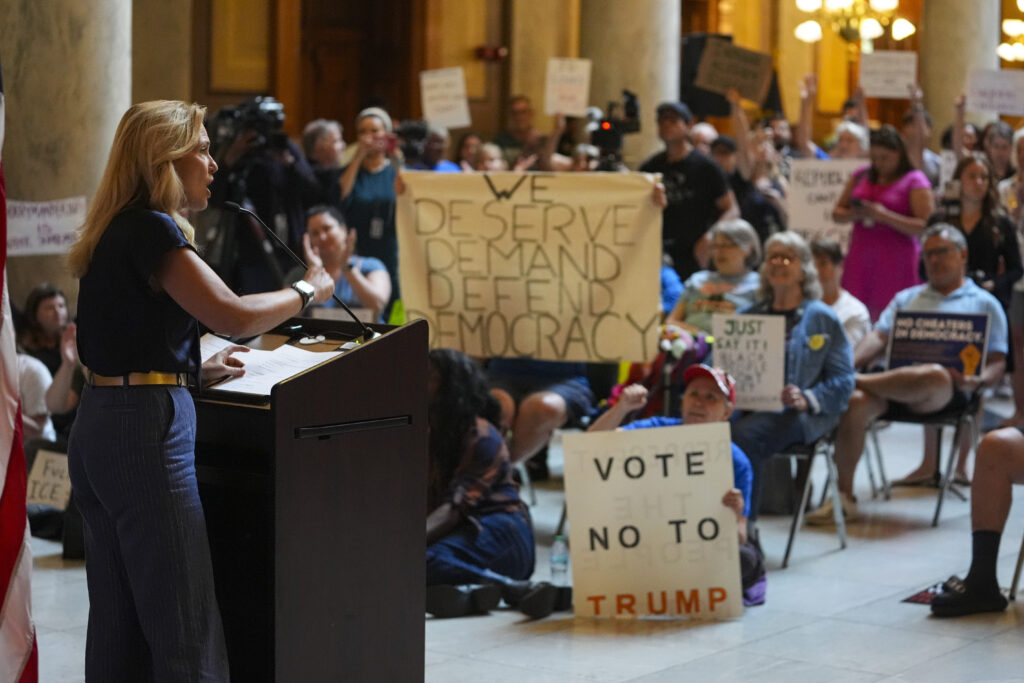
As the session’s first day began, protesters in the House chamber made their voices heard, shouting loudly enough to disrupt the proceedings.
Ultimately, Hoosiers “won’t stand for” the plan, U.S. Rep. André Carson, an Indianapolis Democrat whose district stands to be eliminated, said on social media Monday.
“Splicing our state’s largest city—and its biggest economic driver—into four parts is ridiculous. It’s clear these orders are coming from Washington, and they clearly don’t know the first thing about our community,” he said.
Democratic pushback
Indiana Democrats have been vocal in their rejection of the map, describing it as a racial gerrymander.
Indianapolis State Rep. Cherrish Pryor (D) slammed it for dividing up the county into four congressional districts.
“This is a gerrymandered bill on steroids,” Pryor said. “To divide Marion County into four districts – a community that has a significant minority population – and now we’re diluting the minority voices with this map, is telling the minority communities their voices don’t matter.”
State Rep. Blake Johnson (D), another Indianapolis legislator, said the map carves up the area into four districts “not because communities naturally fall that way, but because they don’t.”
Johnson added the proposed plan “dilutes Black and brown voting strength in Indianapolis, not by accident but by craven design” and is “beneath the standards of a functioning democracy.”
They also directed attention to Republicans’ efforts to evade judicial oversight. The redistricting legislation, filed by state Rep. Ben Smaltz (R), wouldn’t just redraw congressional districts. It also includes unusual language attempting to limit the public’s ability to challenge the map in court.
According to the bill, a “temporary restraining order may not be sought or issued.” It also appears to grant the Supreme Court “exclusive jurisdiction” over any appeals of the legislation.
State Rep. Edward DeLaney (D) blasted the provision as “flamingly unconstitutional,” saying it’s “sticking a finger in the eye of our judiciary.”
House Democrats tried to stop proceedings Monday by arguing that Republicans had violated a rule on convening the legislature, but their objections were rejected.
Uncertain outcome
States typically redraw their congressional districts once every decade after receiving new census data. But this year, ahead of the 2026 midterms, Trump has ignited a rare, mid-decade redistricting push across the country, demanding GOP-controlled states create more Republican congressional seats and inciting states run by Democrats to redraw their maps in response.
Lawmakers in Texas, Missouri and North Carolina quickly bent to Trump’s will, rushing maps through shortened redistricting processes and passing them into law despite opposition from voters. Voting rights advocates have fought back with litigation.
But the ultimate outcome in Indiana appears less certain than in many other states.
Indiana Senate Republicans have repeatedly insisted they don’t have the votes to pass a gerrymander.
After Trump released a message criticizing Republicans who opposed redistricting, at least five Indiana lawmakers were targeted in so-called “swatting” incidents, in which individuals submitted false emergency reports about them to local law enforcement. Others received bomb threats.
As threats escalated against lawmakers, Senate leader Rodric Bray (R) announced last week that they would convene to hold a redistricting vote.
While the threats may have succeeded in forcing the vote, it’s less clear whether they will change any lawmakers’ positions.
State Sen. Jean Leising (R) said her home was the target of a pipe bomb threat over the weekend.
“This is a result of the D.C. political pundits for redistricting,” she said on social media, adding that she “will not cave” on opposing redistricting.