Comey asks judge to 86 Trump DOJ’s seashell case

Former FBI Director James Comey asked a federal judge to throw out the felony charges against him over a social media post featuring seashells that the Department of Justice (DOJ) alleged was a threat to kill President Donald Trump.
In a filing Monday, Comey, one of Trump’s longstanding political enemies, argued that the DOJ was singling him out over his post, which included a photo of seashells on a North Carolina beach arranged to spell “86 47,” a common anti-Trump slogan.
In charging him over the post, Comey said the DOJ was targeting “protected speech at the heart of the First Amendment.”
Get updates straight to your inbox — for free
Join 350,000 readers who rely on our daily and weekly newsletters for the latest in voting, elections and democracy.
“Thousands of items featuring this slogan have been sold on the internet and are available to this day, and the slogan was commonly displayed at protests around the country in the months preceding Mr. Comey’s post,” the filing reads.
“The government now singles out Mr. Comey to prosecute one of the President’s most prominent critics for publishing another person’s statement of political opposition. That attempt to suppress core political speech contravenes both the statutes at issue and the First Amendment,” it continues.
Comey asked District Judge Louise Wood Flanagan, a George W. Bush appointee, to drop the charges because his anti-Trump post couldn’t constitute a serious expression of intent to commit harm, also known as a “true threat,” against the president.
The DOJ charged Comey with one count of making threats against the president and another of transmitting those threats through interstate communications over the post. He could face up to 10 years in prison and a maximum criminal fine of $250,000 if convicted.
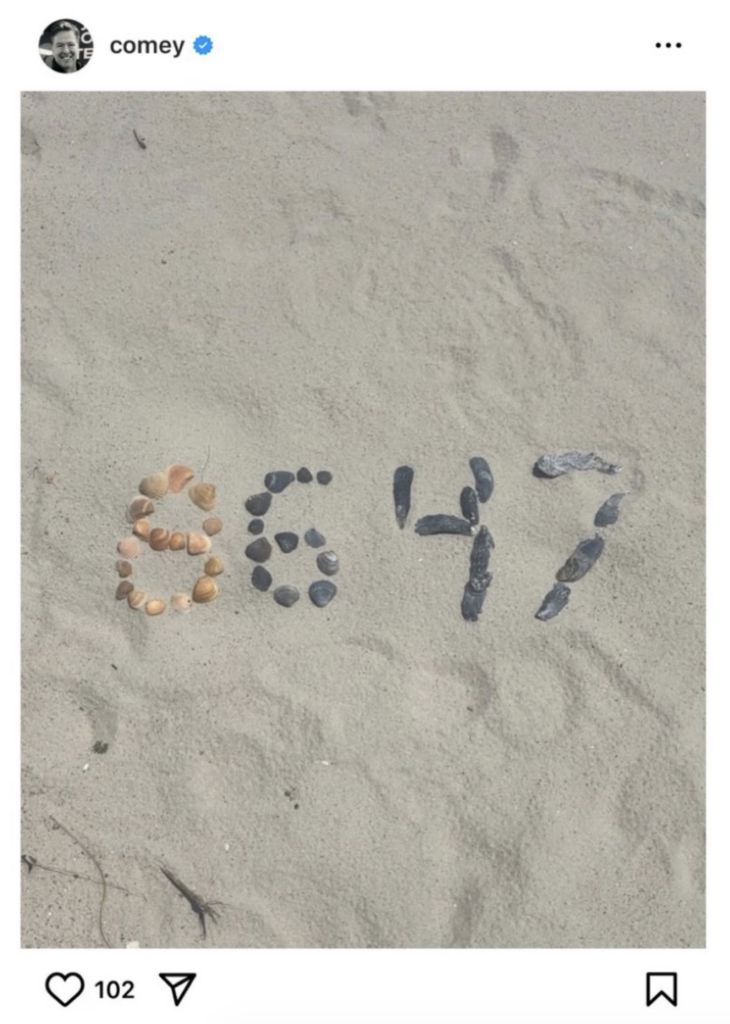
After Comey’s post, Trump officials and many of the president’s congressional allies claimed the former FBI chief was calling for the president’s assassination.
Comey removed the post, saying he came across the shells while walking along the beach and assumed the message was political. He said he didn’t realize that some associate “86” with political violence, which he denounced.
In his filing, however, Comey pushed back on the claim that “86” could imply violence. He noted that “86” can mean to eject, dismiss, or remove someone or something.
Further, he said the phrase “86 47” is a political slogan widely used by those opposed to the Trump administration. In fact, usage of the slogan exploded after Comey’s most recent indictment.
“Thus, in this context, no reasonable observer would understand the phrase “86 47” to connote violence at all—let alone to threaten that Mr. Comey personally would commit violence against the President,” the filing read.
Even though Comey removed the post and apologized, the Trump administration had him physically and digitally trailed, while the Secret Service also questioned him.
“This should be one of the most easily and swiftly granted motions ever,” Martin Lederman, a former DOJ deputy assistant attorney general who’s now a professor at the Georgetown University Law Center, said in a social media post Monday.
“The indictment is an embarrassment,” Lederman added.
Even though Comey removed the post, the Trump administration had him physically and digitally trailed, while the Secret Service also questioned him.
The dismissal motions mark the second time Comey has asked a court to drop federal charges against him.
Comey filed similar motions to dismiss last year in response to another politically motivated indictment from the DOJ accusing him of lying to Congress and obstructing a congressional proceeding. A federal judge dismissed those charges after finding that the Trump loyalist who brought them was unlawfully appointed.
The DOJ brought the seashell case against Comey just weeks after Trump elevated Todd Blanche, the president’s former personal defense attorney, as acting attorney general following the dismissal of Pam Bondi.
Trump fired Bondi in part because he was frustrated with her failure to prosecute his political enemies aggressively enough.
Comey is set to be arraigned on the charges in a federal court in New Bern, North Carolina, on Sept. 30. He is expected to plead not guilty. If the charges survive until he issues a not guilty plea, he will face a jury trial starting Oct. 21.
If the case ultimately goes to trial, the charges run up against long-standing free speech protections promulgated by the Supreme Court.
In its landmark 1969 ruling Watts v. U.S., the Court distinguished between actual threats to the president — which are prohibited by federal law — and crude and hyperbolic political speech, which is protected.
Comey cited that case in his dismissal motion Monday. Even if the court adopted the DOJ’s argument that the post should be read as a veiled call for other people to act violently, it would still be considered protected political hyperbole under Watts, he said.
This story has been updated with new details throughout.