GOP candidate for Ohio House seeks to throw out ballots weeks after Election Day
 Prefer us on Google
to see more of our voting rights news coverage when you search.
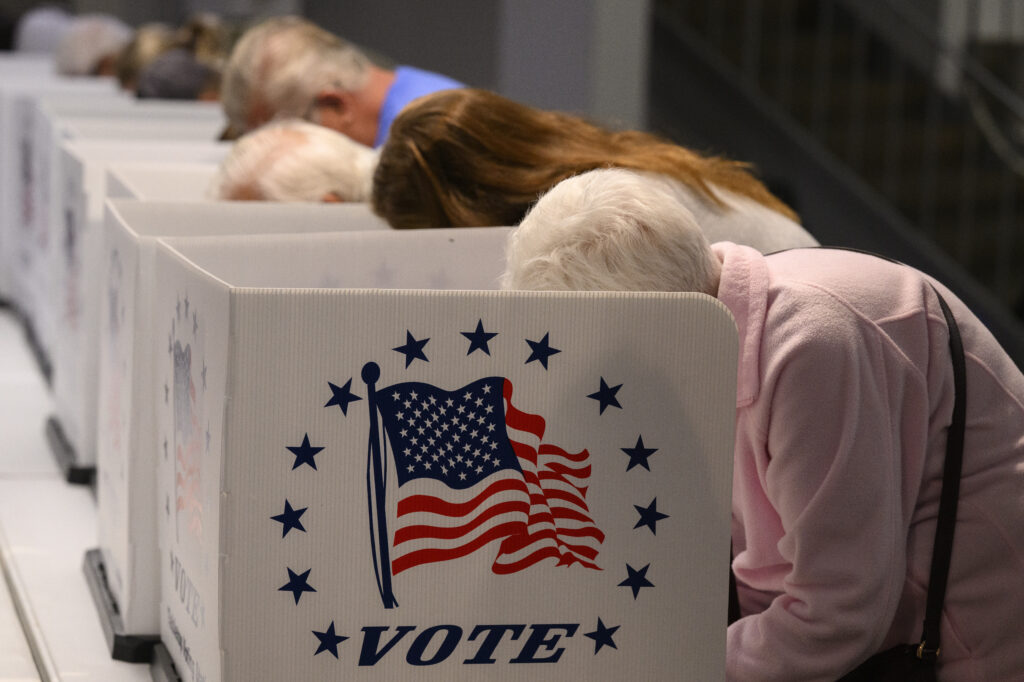
A Republican candidate for Ohio’s House of Representatives sued a county board of elections nearly two weeks after Election Day to disenfranchise voters who recently moved within the state.
Edward Schimmel filed suit in the Ohio Supreme Court against the Lucas County Board of Elections, challenging ballots from people who moved from outside the county but did not update their registration address before the Nov. 3 midterm elections.
It’s unclear exactly how many ballots could be affected by Schimmel’s suit. But any number could make a difference in the extremely close Ohio House District 44 race between him and David Fournier*, his Democratic opponent.
As of noon Thursday, Schimmel led Fournier by only 33 votes.
Get updates straight to your inbox — for free
Join 350,000 readers who rely on our daily and weekly newsletters for the latest in voting, elections and democracy.
Ohio election law allows voters who recently moved counties without updating their registrations to cast provisional ballots at their new polling location, which election officials count only after verifying that the voters were indeed eligible to vote.
Schimmel alleged in his suit that voters who recently moved to Lucas County should not have been allowed to cast a provisional ballot at polling locations. Instead, they should have cast their provisional ballots at a board of elections office, his suit claimed.
Schimmel asserted Ohio law doesn’t authorize recent movers to cast provisional ballots at the polls. But guidance that Ohio Secretary of State Frank LaRose (R) sent election officials this year clearly stated otherwise.
The guidance said that “voters who have moved outside of their county (but still in Ohio) and didn’t update their address by the deadline” can still cast provisional ballots at polling locations.
Schimmel, however, claimed that LaRose’s directive violated state law and that, as a result, Lucas County should set aside any ballots cast by recent movers at polling places. Lucas County contains Ohio’s fourth-most-populous city, Toledo.
The Lucas County Board of Elections has asked the Ohio Supreme Court to dismiss Schimmel’s lawsuit, arguing that his claims are moot because it has already verified, accepted and counted provisional ballots. It did that in a special session Monday, during which it accepted 2,375 provisionals and rejected another 350.
On Wednesday, Fournier filed a motion to intervene in the case. Contingent on his intervention being granted, Fournier also filed a motion to dismiss. He strongly criticized Schimmel for waiting until weeks after the election to challenge LaRose’s guidance, which was published in August.
“Simply put, Schimmel seeks to change the rules of the game after it has already been played,” Fournier’s motion to dismiss read.
The suit comes after the law firm representing Schimmel, Taft Stettinius & Hollister LLP, sent multiple counties letters demanding that they set aside ballots from recent movers.
The Ohio branches of the League of Women Voters and the ACLU sent county officials their own letters warning that setting aside such ballots would violate voters’ First and Fourteenth Amendment rights.
Responding to Schimmel’s suit, the civil rights and voting groups filed an amicus brief Wednesday arguing that throwing out the challenged ballots would disenfranchise voters through no fault of their own. They also noted that courts have generally held that voters should not be penalized for errors made by election officials.
“The burden on voters here is severe,” they wrote. “[Schimmel] asks the Court to prohibit the Board of Elections from counting ballots cast on Election Day with no opportunity for voters to cure their ballots. The inevitable result—indeed, the intended result—is disenfranchisement.”
*Elias Law Group (ELG) represents Democratic candidate David Fournier in his motion to intervene. ELG Chair Marc Elias is the founder of Democracy Docket.