Appeals court lays out a roadmap to kill DOJ bid to block California ballots
 Prefer us on Google
to see more of our voting rights news coverage when you search.
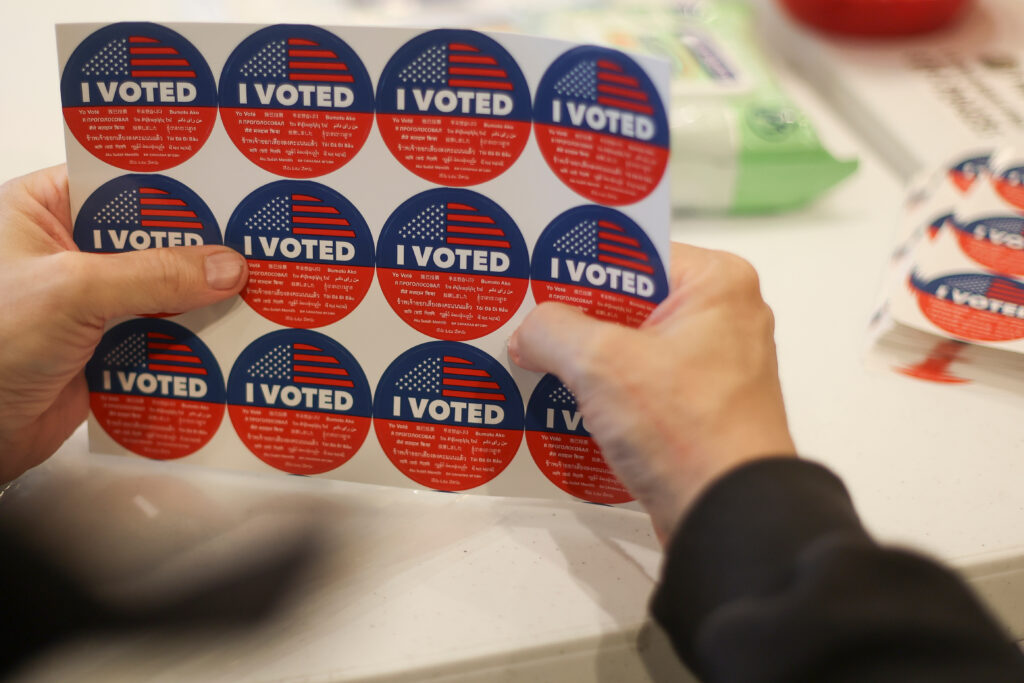
Two federal appellate judges suggested paths for a lower court to shut down the Department of Justice’s dangerous attempt to force California to set aside 20,000 ballots in a decision rejecting the rushed appeal as premature.
While the Ninth Circuit Court of Appeals on Monday ruled 2-1 that it could not hear the case because U.S. District Judge David O. Carter has yet to issue a ruling, two judges went further to lay out why the lawsuit should fail on other grounds.
Those portions of the opinions will likely loom over a Tuesday hearing on the case before Carter.
Conflicts with the Elections Clause
Judge Mark Bennett, an appointee of President Donald Trump, made clear he believed the DOJ’s arguments conflict with the U.S. Constitution and its Elections Clause, which gives states the authority to set federal election rules subject to laws passed by Congress.
Bennett said he had “serious doubts” about the DOJ’s claim that a federal criminal statute that makes noncitizen voting a misdemeanor – 18 U.S.C. § 611 – preempts those constitutional powers, especially when California has laws requiring each voter to attest their citizenship and a process for challenging questioned ballots.
“Notably absent from the statute is any express preemption provision; language setting forth standards for election administration that might, explicitly or implicitly, prohibit a state from mailing and tabulating ballots; or text regulating how a state deals with challenges to ballots,” Bennett wrote.
There is “no hidden provision authorizing the Department of Justice (“DOJ”) to superintend or intervene in a state’s election administration,” Bennett added.
Bennett pointedly said the DOJ should ask Congress to make the changes it wants.
“If Plaintiff believes requiring additional confirmation of citizenship is necessary for vote-by-mail ballots, I believe the appropriate audience for that suggestion, in full accord with the plain language of the Elections Clause, is Congress, not the courts,” he wrote.
Get updates straight to your inbox — for free
Join 350,000 readers who rely on our daily and weekly newsletters for the latest in voting, elections and democracy.
Purcell applies with voting already underway
Bennett and Judge Gabriel Sanchez, appointed by former President Joe Biden, both raised concerns about the Trump administration’s demand to set aside ballots after voting has already begun.
In this instance, they said, the Purcell principle should apply. Purcell, which stems from a 2006 U.S. Supreme Court order, is the idea that federal courts should not intervene to change voting or election rules too close to an election to avoid confusing voters and election officials.
“I believe this principle is another reason showing that the law does not clearly favor Plaintiff’s position,” Bennett wrote. “California’s election has already begun, and Defendants have rules in place to process vote-by-mail ballots.”
Sanchez went further, admonishing the Trump administration for “a delay entirely of the United States’ own making.”
“When voters have already received ballots and begun voting, late-breaking federal court intervention risks not only voter confusion but also resource strain and chaos in the administration of elections,” Sanchez wrote.
Questions on accuracy of DOJ’s data
The two judges also highlighted ongoing concerns about the reliability of the DOJ’s data and methodology for flagging alleged noncitizens on California’s voter roll.
California officials have vigorously pushed back on DOJ’s claims that there are 20,000 potential noncitizens illegally registered to vote. In Los Angeles County, a review of a sample of voters found 1 in 4 people flagged were born in the U.S. and that nearly half were already canceled or inactive registrations.
Sanchez worried some would interpret any ruling in favor of the administration “as an endorsement of the United States’ currently unsubstantiated allegation that roughly 20,000 noncitizens are on California’s voter rolls.”
Bennett said without more concrete evidence, the court can’t adequately determine if the DOJ is suffering a real harm that requires remedy.
“Moreover, at this preliminary stage—given the conflicting evidence about whether the October List accurately identifies noncitizens and with no factual findings by the district court—we cannot determine that [the DOJ] will likely suffer irreparable harm,” Bennett wrote.