Appeals Court Keeps Block on Trump’s Chicago Military Takeover
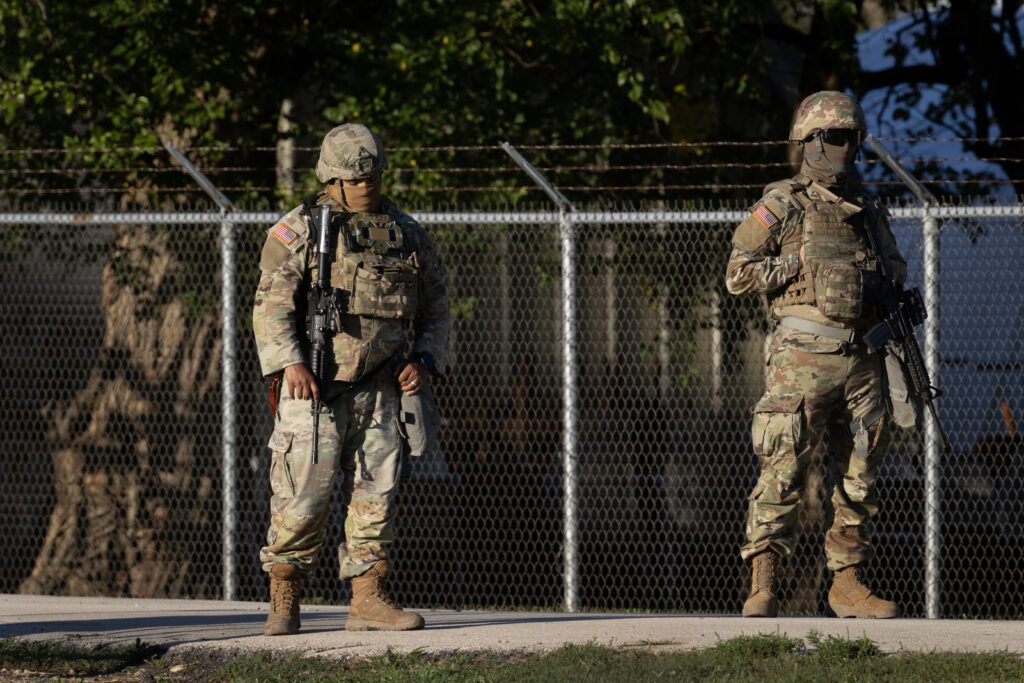
A three-judge federal appeals court panel Thursday rejected President Donald Trump’s request that it overturn a lower court ruling barring his attempted military deployment in Chicago.
The Seventh Circuit Court of Appeals panel’s unanimous decision will for now partially halt Trump’s military intervention in the Windy City. The panel said the administration has offered “insufficient evidence” to justify the attempted takeover.
Get updates straight to your inbox — for free
Join over 350,000 readers who rely on our daily and weekly newsletters for the latest in voting, elections and democracy.
“We conclude that the district court’s factual findings at this preliminary stage were not clearly erroneous, and that the facts do not justify the President’s actions in Illinois,” the panel wrote.
The ruling was a major win for Illinois and Chicago, both of which sued earlier this month arguing that the deployment infringes on the state’s sovereignty and its right to self-governance. It also marked the first time an appeals court officially blocked one of Trump’s National Guard deployments in a major U.S. city.
It’s only a partial block, however. The panel did allow the president to call members of the Illinois and Texas National Guard into active-duty military service — an action that was barred by a federal district court last week.
The panel was made up of judges appointed by Trump, former President Barack Obama, and former President George H. W. Bush.
After threatening to send troops into Chicago for months, Trump last week federalized Illinois and Texas Guard troops and deployed them into the city over the repeated objections of local and state officials.
Trump did so under 10 U.S.C. 12406 (Title 10), an archaic and rarely used statute that allows the president to federalize state Guard troops when the country faces foreign invasion, when the U.S. government faces rebellion or when the president is unable to execute laws with regular resources.
Though it was not officially announced to the public, Trump also sent to Illinois members of the California National Guard that he federalized using the same statute earlier this year, according to court documents.
The Trump administration claimed the troops were needed to protect federal property and law enforcement officials from Immigration and Customs Enforcement (ICE) and other agencies, who it claimed have been unable to carry out immigration arrests in the city due to protests.
The panel found that U.S. District Court Judge April Perry, an appointee of former President Joe Biden, was justified last week when she halted the deployment after finding the Trump administration’s account of recent protests in Chicago dubious.
Perry found that contrary to the government’s claims, ICE and other agencies have been able to conduct extensive immigration operations throughout Chicago.
The panel agreed with Perry’s assessment that recent demonstrations in the city could not amount to a “rebellion” against the federal government.
But the trio of judges allowed Trump to maintain control over Illinois and Texas Guard troops after finding that the harm of the federalization to Illinois and Chicago “appears to be relatively minimal.”
“We acknowledge, however, that circumstances might arise that could increase plaintiffs’ potential harm, including if Illinois needs its Guard members who have been commandeered by the federal government to assist with state matters,” the panel wrote.
In response to Illinois and Chicago’s lawsuit, Department of Justice attorneys have argued that courts cannot question the president’s decision to federalize and deploy National Guard troops under Title 10.
The panel strongly rejected that argument, saying that nothing in the statute “makes the President the sole judge” of whether conditions exist to merit the use of Title 10.
“It follows that the President’s decision to federalize and deploy the National Guard under the statute is reviewable,” the panel wrote while also citing a separate Ninth Circuit Court of Appeals ruling from earlier this year.
This story has been updated with additional details throughout.