A GOP-Backed Ballot Measure Could Radically Restrict Mail Voting in Maine
Neva Allen, 65, moved to Belfast, Maine from Arizona in 2000, two years after she was struck by a progressive neurological condition.
A wheelchair user ever since, Allen subsequently lost her husband and now relies on an aide to help her with basic functions. Despite these hardships, she has started a nonprofit to help support homeless children, and led a push to provide wheelchair access to the city’s public sidewalks and buildings.
Allen also has voted in every local, state and federal election for as far back as she can remember. She’s always been able to call the city clerk’s office and request that a mail-in ballot be mailed to her home. On occasions when her condition had her racked with pain and deeply fatigued, she would rely on her aide to make the call. She recently signed up to be on Maine’s permanent absentee voter list, which means a mail ballot is sent to her automatically for every election. That makes it much easier to ensure she doesn’t miss an election, she said, compared to when she had to call her city clerk’s office to request a mail ballot each time.
Maine has the oldest population in the nation, and it’s the least densely populated state east of the Mississippi River, with harsh and unpredictable weather, especially in November. All those factors have made mail voting an invaluable resource for Mainers. Over a quarter of Maine voters cast a mail ballot last year, according to numbers the state reported to a federal election agency.
But voting by mail in Maine could be about to get much harder.
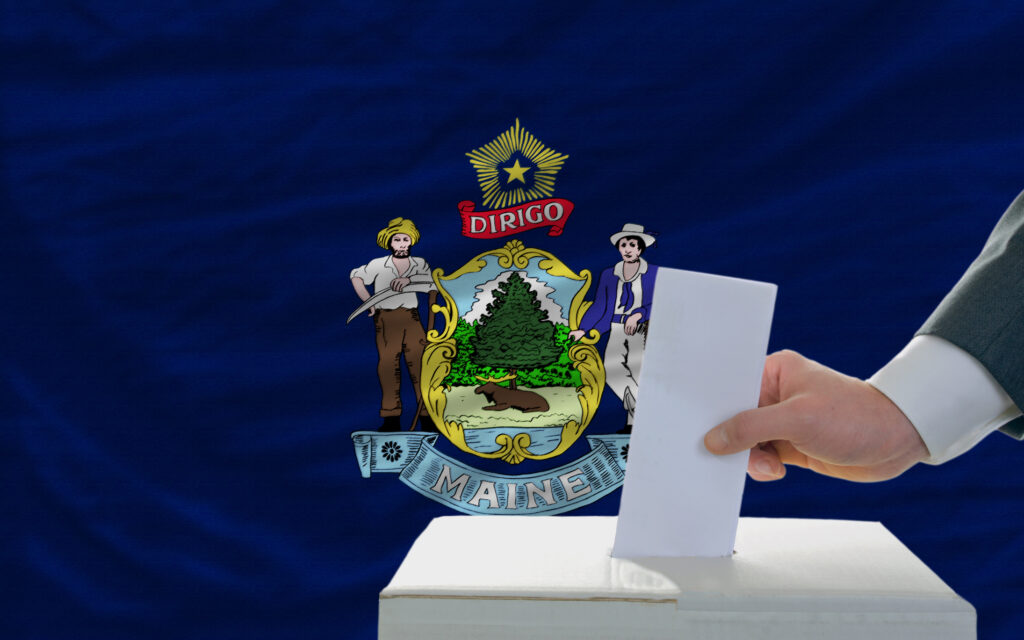
In a November 4 special election, voters will consider whether to adopt Voter ID For ME, a Republican-backed ballot measure, also known as Question 1. Part of a far broader GOP war on mail voting nationwide, Question 1 contains 25 different provisions affecting voting rules, many of them restricting access to mail voting.
As well as requiring a photo ID for both mail and in-person voting, Question 1 would eliminate the permanent absentee ballot list that makes voting easier for Allen and many others; prevent Mainers from requesting a ballot by phone; scrap the two busiest days to request an absentee ballot; put restrictions on allowing others to pick up or drop off a mail ballot; and ban local governments from providing postage for returning a mail ballot.
Another dangerous provision, advocates say, would limit the number of ballot dropboxes to one per town — meaning Portland’s 68,000 residents would have the same number of dropboxes as the town of Beddington’s 60 residents. With the U.S. Postal Service delivery slowing in recent years due to funding cutbacks, clerks in Maine towns and cities like Portland say dropbox use has steadily increased. Reducing Portland to one box would create a chokepoint and likely impact turnout, they say.
Taken together, voting advocates say, Voter ID For Maine’s provisions could significantly imperil access to the ballot in the Pine Tree State — especially for voters who are elderly, poor, or, like Allen, live with disabilities. Maine consistently ranks near the top among states for voter participation.
According to a tracker run by the conservative right-wing Heritage Foundation, Maine has had only two voter fraud convictions in 46 years. In an interview with Democracy Docket, Alex Titcomb, the executive director of Dinner Table Action, which leads the campaign for the ballot measure, acknowledged that voter fraud wasn’t the impetus for the referendum. Instead, Titcomb argued, the measure is needed to fix growing voter mistrust in election integrity, driven largely by errors and inaccuracies in the state’s voter rolls. (Secretary of State Shenna Bellows (D) said her office conducts ongoing voter list maintenance.)
Allen sees a different motive.
“Question 1 has nothing to do with election integrity like they say it does,
and everything to do with eliminating certain people from voting,” Allen said. “People who are disabled like me, there’s so many of us. It’s so bothersome to me that they would try to do this!”
‘They never gave me the full story’
Maine voters must provide a photo ID when they register to vote, but Maine is one of 13 states that do not require an ID at the polls. Over the last decade, Republicans have unsuccessfully submitted numerous bills requiring voters to present government-issued ID at the polls.
From the start, the leaders of the effort to pass the ballot measure — state Rep. Laurel Libby (R), and Dinner Table Action, a conservative PAC she founded — have sought to downplay the impact it would have on mail voting, which is broadly popular with voters across the political spectrum, and focus instead on the voter ID provision.
Bella Sturtevant, 19, a student at Thomas College in Waterville, said she stood next to a Voter ID for ME table for at least three hours as volunteers gathered signatures to get the measure on the ballot last November.
“They provided very little information to people to get them to sign. I never heard them mention absentee voting the whole time I was there, and trust me, I was paying attention,” Sturtevant said.
A friend of Sturtevant, Megan McDaniel, also a Thomas College student, said she was pressured by the Dinner Table Action volunteers to sign the petition, and eventually relented.
“Every time I backed away, they kept pressuring me more and more, saying it was no big deal, it was just about IDs,” McDaniel said. “I shouldn’t have given in, but I did. I was so upset when I heard what I signed. They never gave me the full story. Not even close.”
Joyce Maker, a former GOP member of the Maine House and Senate agreed.
“The sad thing about this referendum is that it was sold to us as being about Voter ID, not any of the other things it changes in Maine election law,” Maker said in an October 16 statement. “After reading Question 1, I don’t think the ‘yes’ side would have gotten the signatures if they had been truthful.”
In response, Titcomb said most of the signatures gathered came on Election Day, when, he said, Dinner Table Action volunteers only had a few seconds to connect with exiting voters. He disputed that anyone was coerced into signing, and said that Dinner Table Action removed a number of names from the petition when asked later by signatories.
The description of the measure that voters will see on the ballot, produced by Bellows’ office, is broader — and more informative.
“Do you want to change Maine election laws to eliminate two days of absentee voting, prohibit requests for absentee ballots by phone or family members, end ongoing absentee voter status for seniors and people with disabilities, ban prepaid postage on absentee ballot return envelopes, limit the number of drop boxes, require voters to show certain photo ID before voting, and make other changes to our elections?” it asks voters.
A lawsuit filed by Dinner Table Action’s executive director against Bellows over the ballot language was rejected by Maine’s highest court in July.
Some of Question 1’s backers may have gone even further to boost the measure. Maine Republicans have seized on the Sept. 30 discovery of 250 blank mail ballots in an Amazon delivery box to claim that the state’s election system is dangerously insecure. But, as Democracy Docket recently reported, opponents of the measure say the episode may have been a scheme trick designed to spur fear about illegal voting just before voters decide on Question 1 — a notion that’s supported by a close look at how the story emerged.
Bellows is leading a probe of the discovery, and she, too, suggested at a press conference that “bad actors” looking to “shake our faith in free and fair elections” may have been behind it.
The extremism of the ballot measure is in line with shifts in the state’s politics. University of Maine Professor Emeritus Amy Fried said that in recent years, Maine Republicans have moved away from their traditional moderation — starting with the election of Paul LePage, the two-term GOP governor first elected in 2010.
“LePage likes to call himself ‘Trump before Trump,’ and I don’t doubt that there’s been a change in the state’s GOP since then,” Fried said. “It used to be moderate and had an independent bent, but it has shifted to the right and has gradually become more in step with the MAGA movement.”
‘This is targeting people for a specific reason’
It’s not hard to find voters, like Neva Allen, who would find it much more difficult to cast a ballot should the measure pass.
Kitty Hartford, an 82-year old political activist, lives in Boothbay Harbor on Maine’s mid-coast. Her mobility is limited and she uses an electric wheel-chair. She’s been an absentee voter for the last eight years.
“There’s no voter fraud in Maine. If there is, let’s see the evidence,” Hartford says. “This is targeting people for a specific reason. Elderly, working people, people with disabilities, people who can’t drive or get around. This is voter suppression, plain and simple, and it’s not who we are as Americans!”
Shirley Savage, 72, might be even more at risk of disenfranchisement. Savage, who lives in Bath, about a half-hour down the coast, said her husband has suffered from dementia for the last six years and requires round-the-clock attention. As a result, she’s relied on absentee voting to cast her ballot.
She does that in every election without fail, a promise she made to herself in the early 90’s when she was unable to vote because of a work obligation.
“I swore I wouldn’t let that happen again,” Savage says adamantly. “It’s a privilege to vote and it’s very important to me. These restrictions they’re proposing pose a threat to me and other people who rely on absentee voting.”