Democrats cracked Texas Supreme Court’s red wall, ushering in new era for voting rights
 Prefer us on Google
to see more of our voting rights news coverage when you search.
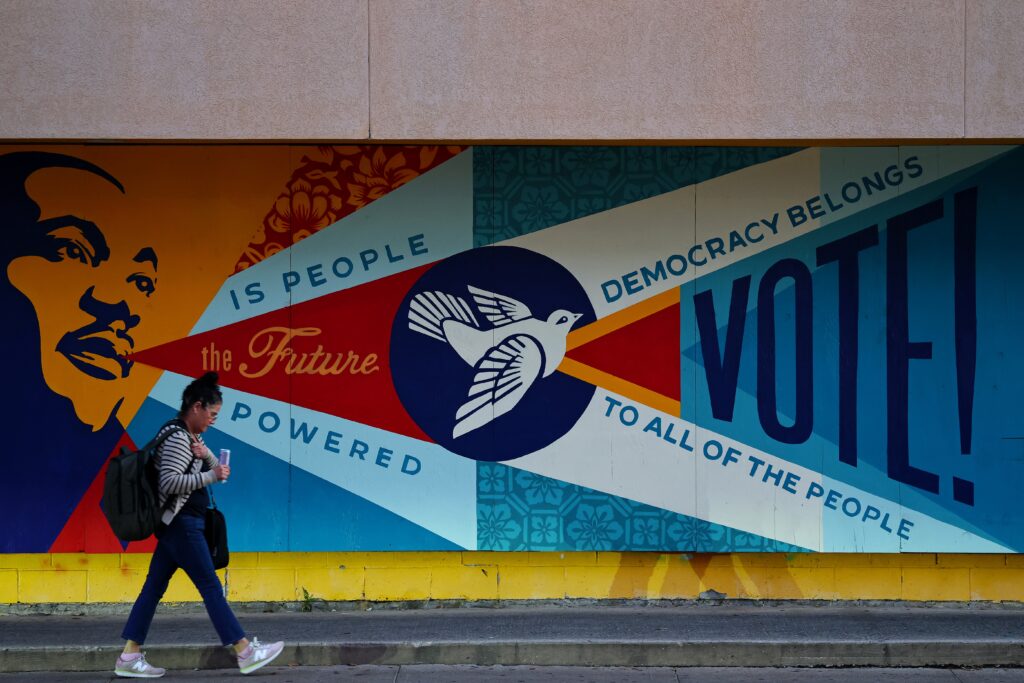
Texas Democrats stunned the country by sweeping every statewide office this year — including four seats on the Texas Supreme Court, which often has the final word on state voting laws, public accountability and other major democracy issues.
The Texas Supreme Court has been a solid wall of Republican justices since the 1990s. While Democrats still won’t have a majority on the new 5-4 court, they won the chief justice race, giving them more say on the court’s operations. This election could prove to be a watershed moment for a state judiciary that has frequently shown itself to be hostile to voting rights.
The all-GOP court has handed down pro-democracy rulings such as blocking a county’s attempt to swap voting maps between the primary and general election this year and shutting down Republicans’ attempts to remove Democratic state lawmakers who fought the GOP’s gerrymander.
Get updates straight to your inbox — for free
Join 350,000 readers who rely on our daily and weekly newsletters for the latest in voting, elections and democracy.
However, it has also ruled against democracy time and time again. During the COVID-19 pandemic, it allowed Gov. Greg Abbott (R) to limit mail ballot drop-off locations to just one per county and blocked Harris County from sending mail ballot applications to all registered voters. In 2023, it upheld an unprecedented state law that abolished the elections office only in Harris County, the state’s most populous blue county.
On the campaign trail, the incoming Democratic justices made the case that the court has become a partisan rubber stamp for GOP leaders. Even though Texas elects its judges, seven of the nine current justices were originally appointed by Abbott, who has the power to fill vacancies when justices step down between election cycles. Two of the GOP justices who lost re-election this year previously served as Abbott’s general counsel.
Now, voters have sent Abbott packing, along with Texas Attorney General Ken Paxton (R) and half of the Supreme Court.
The balance of power on the court could shift entirely by 2028 when three of the remaining five GOP justices will be up for re-election, including Justice Debra Lehrmann (R), the court’s most senior member.
Democrats focus on democracy
The new court will be led by Maggie Ellis, the first woman elected chief justice and the first openly LGBTQ+ candidate elected to statewide office in Texas. While most judicial candidates tend to be circumspect in their messaging, Ellis launched her bid by centering her support for the LGBTQ+ community.
Ellis, who currently serves on the Texas Third Court of Appeals, also made democracy a top issue in her campaign.
“The rule of law and the separation of powers are the foundation of our democracy,” she told attendees at the Texas Democratic Party convention over the summer. “And right now, they are under attack and they need defending.”
In a post-election interview, Ellis said she would like to rescind a unanimous order the Texas Supreme Court issued earlier this year ending the American Bar Association’s power to accredit law schools.
At least two of the incoming Democratic justices already have a record of holding powerful state leaders accountable.
Chari Kelly and Gisela Triana, who serve with Ellis on the Texas Third Court of Appeals, were part of a three-judge panel in 2021 that ruled that a lawsuit brought by Paxton’s former deputies could move forward, rejecting Paxton’s argument that he was exempt from the state’s whistleblower law.
Kelly was also part of a panel that ruled that a lawsuit could move forward seeking the release of years of Abbott and Paxton’s communication records, including Paxton’s emails related to his trip to Washington, D.C., during the Jan. 6 attack on the Capitol. Ultimately, the Texas Supreme Court ruled in Abbott and Paxton’s favor in an opinion written by Chief Justice Jimmy Blacklock, one of the two former general counsels for Abbott who just lost their seats on the court.
In her campaign, Kelly made no secret of her opinion of the state’s highest court.
“The Texas Supreme Court has become a rubber stamp for the executive branch and has failed to live up to its purpose of independently interpreting the law,” she wrote on her website. “Texans deserve a court that holds everyone accountable – including those in power.”
Triana, who flipped a third seat on the court, centered judicial independence in her campaign, as well, calling for the judiciary to “do better at reclaiming our independence and worry less about keeping our jobs by placating political pressure.”
Kristen Hawkins, a judge of the 11th District Court, won the fourth seat, completing Democrats’ judicial sweep of open seats.
Senior GOP justice could be pivotal
Of the five remaining Republicans on the court, Lehrmann — who recently said she was considering early retirement, only to immediately backtrack — could be a swing vote to watch when the new justices take office.
Lehrmann was the sole dissenter in a 2024 Texas Supreme Court ruling that upheld a state law banning gender-affirming care for minors.
“The law is not only cruel — it is unconstitutional,” she wrote in a blistering opinion.
Lehrmann was also one of two justices to dissent in the court’s consequential 7-2 ruling that blocked the State Bar of Texas from disciplining First Assistant Attorney General Brent Webster for his role in filing a lawsuit challenging four other states’ election results in the 2020 presidential race. The court then blocked the State Bar from disciplining Paxton, citing the conclusions in its Webster ruling.
Along with Lehrmann, two more GOP justices, Rebeca Aizpuru Huddle and Evan A. Young, have terms ending in 2028. The remaining GOP justices, John Devine and Jane Bland, will be up for re-election in 2030.