Missouri voters enact landmark direct democracy protections after GOP crackdown
 Prefer us on Google
to see more of our voting rights news coverage when you search.
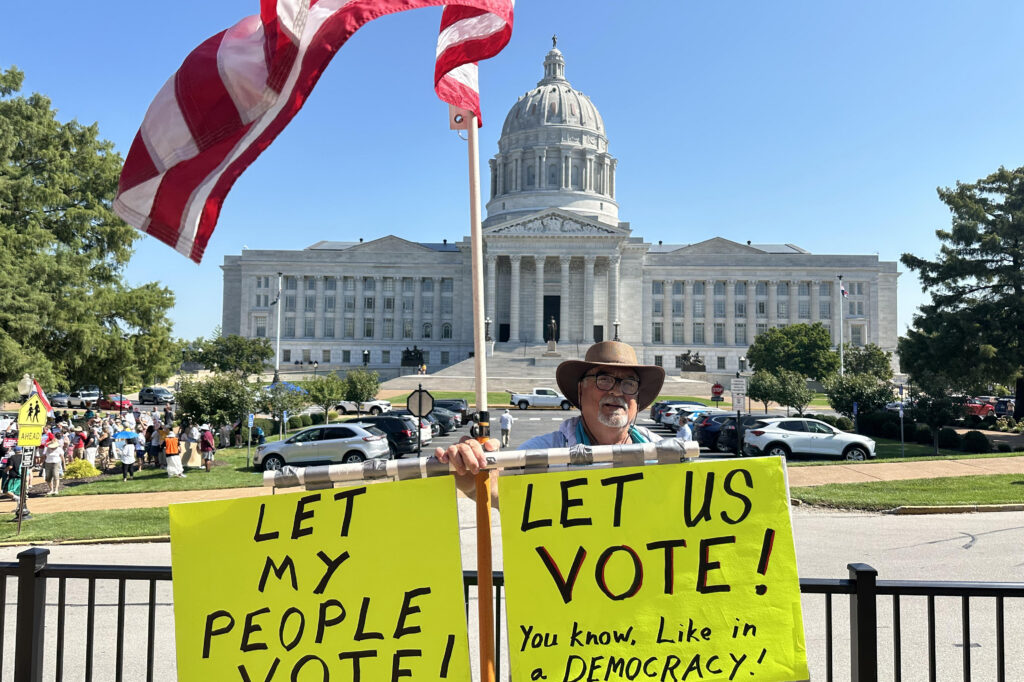
Unlike in many states, Missouri voters can enact their own laws and change the state constitution by gathering signatures to put a ballot measure to a simple majority vote. State Republicans, however, have repeatedly ignored and overturned laws and amendments passed directly by voters.
But this November, Missourians overwhelmingly approved a landmark constitutional amendment that will sharply limit state lawmakers’ ability to undermine or override the will of the voters — provided the amendment survives possible post-election legal challenges.
Approved by nearly 60% of voters, the amendment will make it far easier for citizens to exercise their direct democracy rights after legislators and state officials spent years attacking the state’s initiative and referendum process.
Get updates straight to your inbox — for free
Join 350,000 readers who rely on our daily and weekly newsletters for the latest in voting, elections and democracy.
Known as Amendment 6, the initiative significantly raises the threshold for lawmakers to amend or repeal citizen-initiated laws. Under the new requirement, 80% of legislators in both chambers must approve any changes — and voters must also ratify those changes during a future election.
The amendment also enshrines the initiative and referendum process as a fundamental constitutional right, bars lawmakers from arbitrarily weakening or restricting the process, and gives courts more authority to rewrite misleading ballot language set by the secretary of state.
For state organizers, Amendment 6’s passage represents a fundamental shift in the balance of power between Missourians and their legislature.
“The overwhelming approval of Amendment 6 is a testament to those Missourians who are tired of having their voices ignored or their votes overturned and demanded that we restore voters as the final check and balance on the politicians we elect,” said Jack Cardetti, a spokesman for the campaign that backed the amendment. “The historic victory makes it abundantly clear that the ability to petition our own government is not a political issue, it’s a deep-rooted Missouri value that millions are willing to protect.”
Missouri’s initiative and referendum process has been crucial to the state’s democracy, according to experts and advocates. In 2024, voters enshrined abortion rights into the state constitution against the Republican legislature’s objections.
But lawmakers have long sought to claw back their policymaking authority by placing rival amendments on the ballot just years later or passing laws that counteract citizen referendums.
While they approved Amendment 6, voters also rejected legislators’ attempt to overturn Missouri’s abortion-rights law with a rival amendment. And under Amendment 6’s new ballot-measure rules, that anti-abortion proposal would likely never have made it onto the ballot.
An earlier example of lawmakers undermining voters came in 2011, when the legislature weakened a voter-approved bid to regulate puppy mills. Simmering resentment from that battle helped kick-start the campaign for Amendment 6, according to organizers.
In many ways, Amendment 6 amounts to a rebuke of Republicans’ long-held legislative monopoly in Missouri politics. Voters approved it at the same time that Democrats gained ground across the state.
However, Republicans could try to overturn Amendment 6 in the courts.
In an interview with a local radio station Thursday, Missouri Lt. Gov. David Wasinger (R) said he expects it to be challenged. He also acknowledged the amendment will make it harder for the legislature to amend Missouri’s constitution or revise laws enacted through the initiative process, including the 2024 pro-abortion amendment.
“There’s going to be probably some litigation to see whether or not that is constitutionally viable because, assuming it stands there, that will make it problematic to both amend the Constitution and for the state legislature to go back and revise this pro-abortion amendment that was passed, you know, a year or so ago,” Wasinger said.
The new amendment came as multiple states weighed direct democracy’s role in their elections.
Montana voters approved an initiative that enshrined the right to citizen referendums into the state constitution. North and South Dakota, meanwhile, proposed raising the threshold for ballot measures to pass to 60% of voters — but the amendments failed in both states.
In an October interview, Chris Melody Fields Figueredo, executive director of the Ballot Initiative Strategy Center, said ballot measures ensure voters feel heard.
“In a time where people feel incredibly disenchanted or disconnected from democracy and government, ballot initiatives allow the people to directly engage and make those tangible impacts on their day-to-day lives,” Fields Figueredo told Democracy Docket at the time.
At the same time as Missouri voters approved Amendment 6, they also overwhelmingly rejected a countermeasure — called Amendment 4 — that was designed to concentrate more power in the legislature and ensure most citizen initiatives fail.
It would have required any amendment to pass in all eight of Missouri’s congressional districts, instead of by a statewide majority. In other words, if a single district voted against the initiative, it would fail. Crucially, Amendment 4 would have only applied to initiatives proposed by citizens — not those proposed by the legislature.
Missouri House Minority Leader Ashley Aune (D) said in August that ballot initiatives hold legislators accountable.
“Voters like having access to the ballot,” she said. “They especially like it when the Republican-led legislature isn’t listening to them.”