‘Not a side quest’: Empowered Georgia Democrats have chance to repeal state’s draconian voting laws
 Prefer us on Google
to see more of our voting rights news coverage when you search.
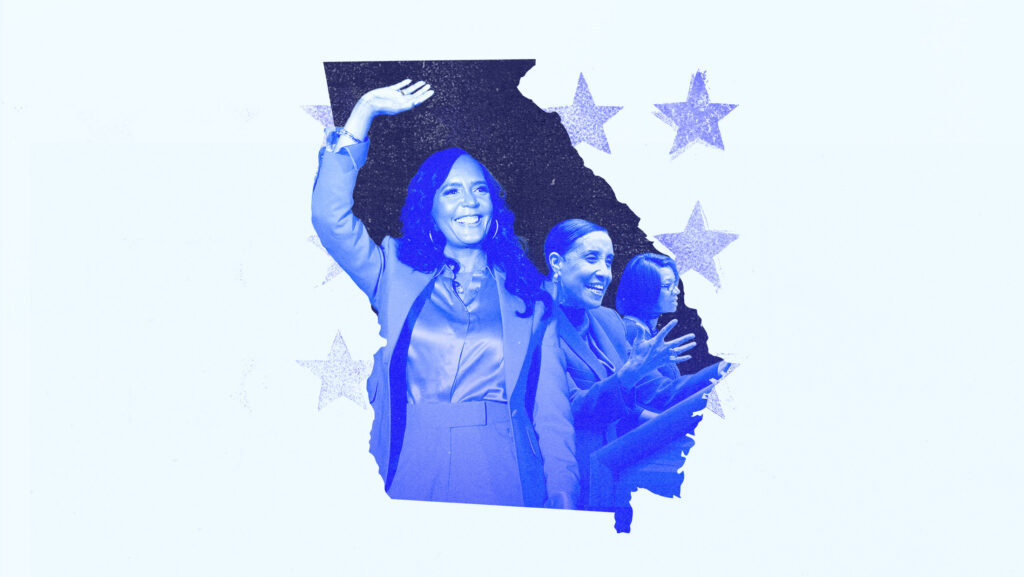
After a historic blue wave in Georgia flipped statewide offices up and down the ballot, Democrats are now in position to do the unthinkable: Repeal the state’s many voter suppression laws, which are among the most draconian in the country.
Since 2020, Peach State Republicans jammed through a slew of laws to make it harder to vote — particularly for the state’s Black residents. The state has strict voter ID rules, harsh restrictions for mail voting, and makes it easy for anyone to challenge another voter’s eligibility.
Dismantling these measures, like the sweeping anti-voting law S.B. 202 — which includes a provision that bans distributing food and water to voters waiting in line — has long been the final boss for pro-voting advocates.
Come January, Democrats will control most of the state’s government: Gov.-elect Keisha Lance Bottoms will make history as the first Black woman to govern a state. She’ll have allies in Lieutenant Gov. Josh McLaurin (D), Attorney General Tanya Miller (D), Secretary of State Penny Brown (D) and, crucially, a Democratic majority in the state House.
Voting advocates want Georgia Democrats to prioritize voting rights and democracy reform when they take power next year.
“This is not a side quest; this is a central quest.” Fair Fight Action CEO Lauren Groh-Wargo told Democracy Docket. “We know that the [U.S. Supreme Court] and MAGA forces have really eviscerated basically the core American consensus on how we do fair representation in this country. So it’s on state leaders and our new majorities in D.C. to address structural democracy reform and voting rights with the new power we have on Capitol Hill and states like Georgia.”
Get updates straight to your inbox — for free
Join 350,000 readers who rely on our daily and weekly newsletters for the latest in voting, elections and democracy.
Groh-Wargo hopes Democrats will fight for voting rights on the federal level, but she wants state leaders in newly flipped southern states like Georgia to take the lead.
“There’s a lot of work to do in Georgia, from looking at how we do redistricting to looking at what we do with the mini-MAGA Georgia State Election Board (SEB) members, along with S.B. 202 and other bills that have been brutally racially targeted and suppressive,” she said.
At the top of the list: passing a state-level voting rights act, provided Democrats can peel off enough Republican votes in the state Senate
In February, Georgia Democrats introduced the Henry McNeal Turner Voting Rights Act, named after a Reconstruction-era Georgia legislator, in the state Senate. The bill would protect the voting rights of Black residents whose franchise has been targeted by the state’s GOP majority in recent years.
Key elements of the bill would require certain counties with a history of racial discrimination to get approval before changing voting practices, expand voting language access, prohibit vote dilution, and allow both citizens and local governments to bring a case in state court alleging vote discrimination.
“It’s a comprehensive state-level framework,” Brian Nunez, a senior policy associate at the Southern Poverty Law Center, told Democracy Docket. “It’s pretty much designed to counteract both the historical and recent efforts that we’ve seen in Georgia, with legislation like S.B. 202 and S.B. 189 to suppress the vote — especially for Black and Brown Georgians.”
Nunez said that the SPLC is already in talks with lawmakers in the House and Senate to introduce a new version of the state-level VRA next year. Despite Republicans maintaining a slim majority in the state Senate, Nunez believes the VRA still has a good chance of passing.
“We’ll get the entire [Democratic] caucus on the Senate side, and we’re already in talks with some Republicans,” Nunez added. “So it’s bipartisan legislation because I think we’re pretty comfortable in the House.”
Then there’s the SEB. The state’s GOP-controlled election board has pushed legislators to pass some of the most anti-voting policies in recent years — and has been marred by controversy.
Democrats have long pushed to remove Trump-backed members of the board who’ve used election conspiracy theories to drive election policy. Lance Bottoms now has the opportunity to reform the controversial board, something she proposed on the campaign trail.
Lance Bottoms doesn’t hold the sole power to hire or fire SEB members, but her campaign proposed working with lawmakers to pass legislation that would dismantle the board and replace it with a new, independent oversight structure to guide the state’s election policy free from partisan manipulation. However, that would also require convincing enough Republican senators to sign on to the bill.
“The State Election Board has become mired in political games, conspiracy theories, and partisan interference,” the governor-elect’s platform said. “Georgia’s election system should not be run by people trying to undermine confidence in elections, intimidate local officials, or change the rules to benefit one political party.”
Nunez wants Lance Bottoms to fulfill that campaign promise.
“I think there’s a growing consensus that the current structure is fundamentally broken,” he said. “Because the board unfortunately has become like a vehicle for partisan interference, conspiracy theories, election deniers. We’ve seen how it has enabled mass voter challenges as well as restricting drop boxes, which makes it harder for people to vote.”
He added: “In a perfect world, I would want the state election board to once again become boring.”