Meet the Christian nationalist Trump ally and election denier who could run Texas elections
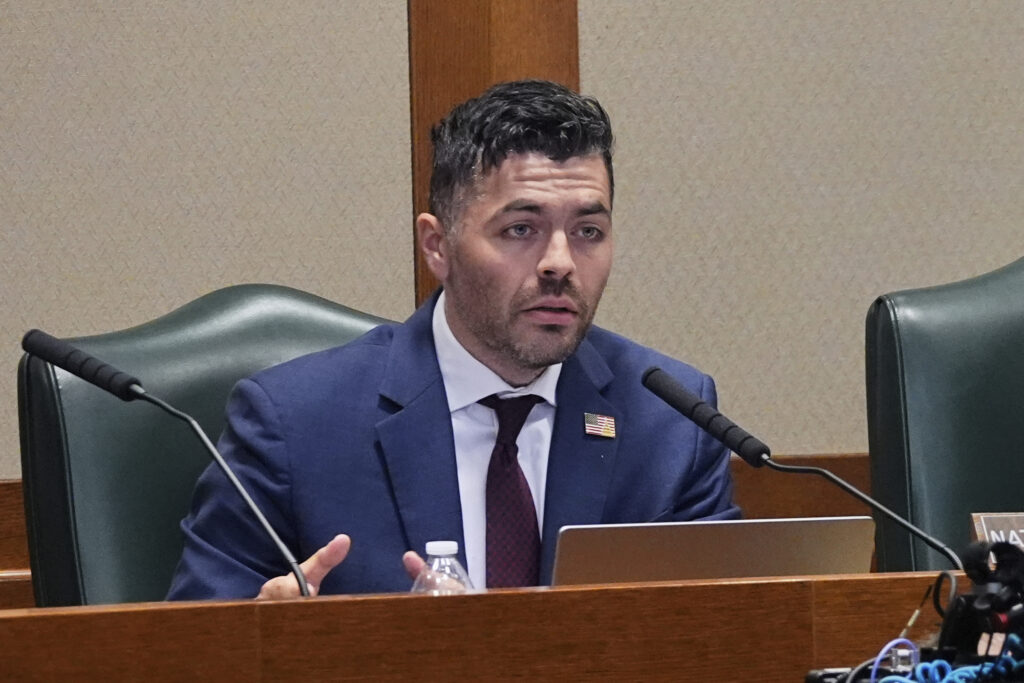
Rumors are swirling in Texas.
Last month, Secretary of State Jane Nelson unexpectedly announced she will leave office July 17, just three months before early voting begins in the 2026 midterms.
Since then, Gov. Greg Abbott (R) hasn’t named his pick to replace her. But the top choice being floated is Nate Schatzline, a young Christian nationalist pastor and former member of the state House who allies with President Donald Trump and has claimed the 2020 election was stolen.
The “open secret” in Austin is that the White House is behind the switch up.
Get updates straight to your inbox — for free
Join 350,000 readers who rely on our daily and weekly newsletters for the latest in voting, elections and democracy.
Last week, Abbott appointed the 34-year-old, two-term state lawmaker as his advisor on election integrity. In that role, he “will lead policy development and legislative strategy efforts related to election integrity,” the governor’s office said in a statement.
That means that even if Schatzline doesn’t replace Nelson, he will still play a key role in shaping Texas’ elections policies.
And it raises the acute danger that — with Texas playing host to a key Senate race involving Attorney General Ken Paxton (R), another Trump ally, as well as several pivotal congressional races — an election denier who may be willing to put a thumb on the scale for the GOP could help shape the rules for casting and counting ballots.
Texas election officials have — cautiously — signaled their reluctance to see Schatzline take over administering the state’s elections.
They believe he would be “highly ideological, responsive to grassroots activist demands, and comfortable using the office as an active enforcement agency,” according to a report prepared by Chris McGinn, executive director of the Texas Association of County Election Officials, that was shared with NPR.
Democracy watchdogs are also concerned. Swapping out the state’s top elections official this close to November feels like the ground is suddenly shifting, Emily Eby French, policy director at Common Cause Texas, told Democracy Docket.
“This whole summer of ‘will they or won’t they’ with the secretary of state is so unstable,” French said, adding that she finds it hard to believe that Nelson would resign by choice.
French said Schatzline is the only candidate she’s heard seriously floated for secretary of state — and she was surprised that he’s being considered.
If she were looking for a far-right secretary of state, she said, “there are more experienced legislators I would pick.”
Perhaps Schatzline’s most important qualification for the job is his willingness to claim that the 2020 election was stolen from Trump.
At a December memorial for far-right political activist Charlie Kirk, Schatzline thanked community members for “stepping up as election judges, making sure that the election is not stolen like it actually was in 2020 when Trump was winning,” the West Texas Tribune reported.
Unclear qualifications
It remains to be seen whether Schatzline will become secretary of state. Nelson — a nearly 38-year veteran of Texas GOP politics — is reportedly considering staying in office rather than handing the reins to an extremist election denier, according to the Texas news outlet Quorum Report.
But Schatzline’s recent appointment by Abbott is a troubling prospect in itself.
Schatzline has never served on an election-related legislative committee or passed relevant legislation. And despite his comments on the 2020 election, he isn’t — by Texas standards — even that deeply involved in Republican election denial.
Asked about his qualifications for the role, Abbott spokesperson Andrew Mahaleris said the governor appointed Schatzline because of “his proven conservative record fighting for election security.”
“As the Governor stated: his experience in the Texas House will be a tremendous asset as we protect the voices of Texas voters,” Mahaleris said. “Governor Abbott was proud to sign into law the nation’s strongest election integrity laws and will continue advancing policies that strengthen election security and public confidence in Texas elections.”
The office did not respond to a follow-up request for examples of the former state legislator’s record. Democracy Docket was unable to reach Schatzline for comment.
Schatzline’s resume also provides little clarity on his qualifications: He’s served as a pastor at a North Texas church, a member of Trump’s National Faith Advisory Board and a rookie state House representative whose only legislative achievement was criminalizing “child-like sex dolls.”
Schatzline wasn’t planning on running for reelection in November and resigned his Texas House seat to take on the new election integrity policy role.
But once his appointment went public, praise quickly poured in from MAGA-aligned Republicans — including Paxton, whom Schatzline voted against impeaching in 2023.
That could be important: Paxton is now the Trump-endorsed GOP candidate for the U.S. Senate. His impeachment proceeding was a cataclysmic political clash in the Texas Legislature, one that still continues to define the separate wings of the state Republican Party three years later.
When Paxton supported primary challengers to the GOP House members who voted to impeach him, Schatzline backed the Paxton slate, earning an official censure from the Texas Republican Party for campaigning against his fellow GOP incumbents. Paxton dismissed the censure decision as “cowardice” from establishment Republicans.
Schatzline has also firmly aligned himself with a Christian nationalist political movement that has declared there is no separation of church and state.
“We’re going to give this space back to the Holy Spirit. We give you this room… The 89th Legislative session is yours, Lord,” Schatzline told attendees of a prayer service kicking off the 2025 legislative session at the Texas Capitol. “The members of this body are yours, Lord. This building belongs to you, Jesus.”
Election uncertainty
It’s not clear whether Schatzline’s new advisor role is a stepping stone to the secretary of state’s office or a consolation prize.
Further muddying the water, Nelson hasn’t offered details explaining her abrupt decision to leave the office in the runup to a critical election with high-stakes races on the ballot — including Paxton’s run for U.S. Senate against state Rep. James Talarico (D), which could come down to a remarkably close margin.
If Paxton wants an ally in place at the Texas secretary of state’s office, Schatzline’s willingness to deny election results could be one of his key qualifications for the job.
Nelson has, for the most part, served the GOP’s far-right agenda in Texas. In December, she turned over the state’s unredacted voter roll to Trump’s Department of Justice, an unprecedented request that even some red states — like Utah, Idaho and West Virginia — have pushed back against.
But a seemingly obscure division among Texas Republicans has put Paxton and Nelson on opposite sides this past year in a court case where it was Paxton’s job to defend Nelson’s office.
The Republican Party of Texas sued the secretary of state’s office last year, asking a judge to allow the party to close its primaries. Under state law, Texas uses an open primary system that allows any eligible voter to cast a ballot in either party’s primary election. That is widely seen as advantageous to more moderate candidates like Sen. John Cornyn (R), although he ultimately lost to Paxton in this year’s GOP primary.
Nelson’s office argued that Republicans must close the primary by passing legislation, not using the courts to change the law.
Remarkably, instead of defending Nelson’s office, Paxton sided against the agency, filing a motion in support of the GOP lawsuit — a move Nelson’s office called “brazen and misguided.”
The case is still ongoing. It’s not hard to guess that Schatzline, who has repeatedly stated his support for a closed primary, might take a different approach than Nelson.
But in the short term, French, the policy director with Common Cause, said that Abbott’s choice of secretary of state is unlikely to matter much in November — as long as the results are a blowout.
“Where the secretary of state will matter is in the margins,” French said. “In close races, will a county get support? Will a county have somebody to call when something goes wrong?”
Regardless of what happens with Schatzline, his elevation to election integrity advisor — and maybe even secretary of state — signals an alarming shift in how Texas handles elections.