Black voters urge Supreme Court to reject Alabama’s last-minute bid to revive racist map
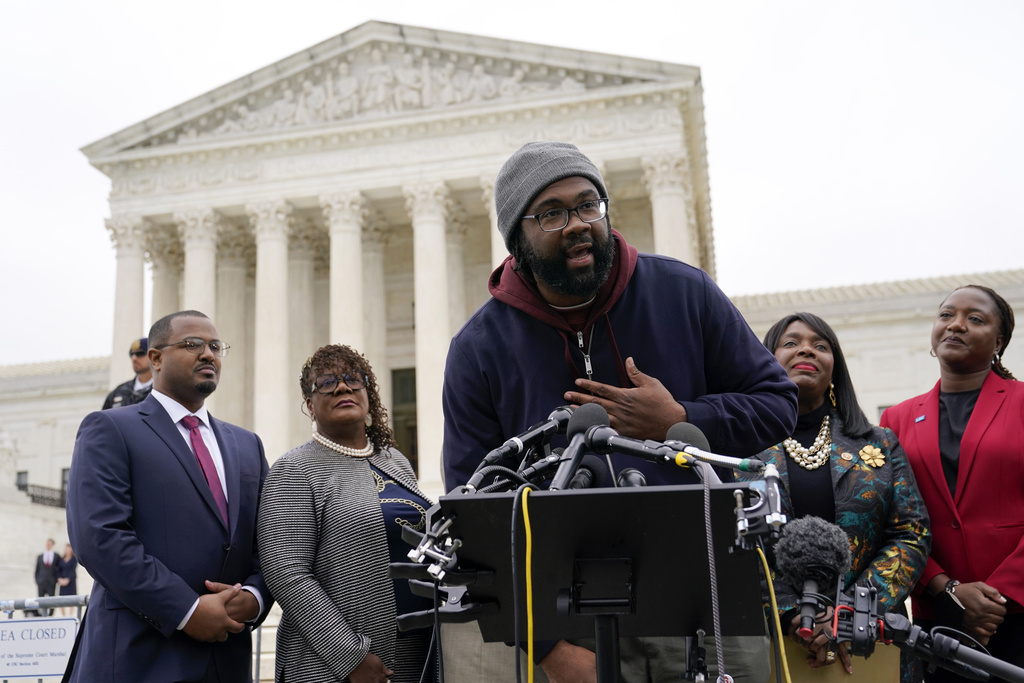
Black voters in Alabama urged the U.S. Supreme Court Monday to reject the state’s emergency request to use a congressional map with only one majority-Black district in the midterms — a move they warn would reward Alabama for trying to revive a map that lower courts have repeatedly found intentionally discriminatory.
Alabama is asking the justices to pause a lower court’s ruling that blocked the state from using the 2023 map and let it move forward with that map for the 2026 midterms.
Get updates straight to your inbox — for free
Join 350,000 readers who rely on our daily and weekly newsletters for the latest in voting, elections and democracy.
The filing comes in the latest chapter of Alabama’s yearslong fight to avoid drawing a congressional map that gives Black voters a fair opportunity to elect candidates of their choice in two districts. Black residents make up more than a quarter of Alabama’s population, but the state’s Republican-controlled Legislature has repeatedly tried to lock in a map with just one majority-Black district out of seven.
After the Supreme Court ruled against Alabama in 2023, the state enacted another map that still included only one majority-Black district. A federal court rejected that map and ordered Alabama to use a court-drawn plan with two districts where Black voters have an opportunity to elect their preferred candidates.
Alabama now wants the Supreme Court to step in on an emergency basis after the justices’ recent decision in Louisiana v. Callais, a case that Republicans have seized on to attack Black voters and fair representation across the South.
But the voter plaintiffs argue that Callais does not rescue Alabama’s map because the lower court reaffirmed that the 2023 map was an unconstitutional racial gerrymander.
Plaintiffs say Alabama’s defense of the map — including its claim that it was merely trying to keep Gulf Coast communities together — was a pretext for diluting Black voting strength.
The brief argues that the plaintiffs are still likely to win their Section 2 claim under the Voting Rights Act, the landmark federal law that bans voting practices that weaken minority voters’ political power. They argue the lower court’s finding of intentional discrimination remains fatal to Alabama’s request.
“Black voters tend to vote for Black candidates because of a ‘general lack of responsiveness’ from White politicians, ‘regardless of party affiliation,’” the plaintiffs wrote. “This polarization is also evident in recent presidential and senatorial general elections, where White Democrats had supported White Republicans over Black Democrats.”
The plaintiffs also emphasized that the lower court found evidence of intentional discrimination not just in isolated corners of the redistricting process, but across Alabama’s government.
The court found a “strong inference of present-day intentional discrimination in voting,” according to the filing, and agreed that discrimination was present at “all levels of government.”
The filing also warns that Alabama is asking the Supreme Court to disrupt an election process that is already underway. The plaintiffs argue the state waited too long to seek emergency relief and that allowing Alabama to change maps now would confuse voters and burden election officials.
“The untimeliness of the State’s request is dispositive by itself,” the plaintiffs wrote. “Granting Alabama’s request would insert the Court into an ongoing election in a manner that upsets settled expectations, causes voter confusion, and creates chaos and unworkable deadlines for even the most diligent election officials.”
The plaintiffs added that granting Alabama’s request “would reward the state for an unexplained reversal of its prior litigation positions before this Court.”
If the justices deny Alabama’s request, the lower court’s order will remain in place and the state will have to use the court-approved map with two Black opportunity districts. If the justices grant the request, Alabama could use the 2023 map in the midterms despite the lower court’s findings that it was racially discriminatory.
For Black voters and voting rights advocates, the stakes are still immediate and immense.
Alabama is not simply asking for more time to litigate. It is asking the nation’s highest court to let it run congressional elections under a map that a lower court found unlawfully dilutes Black voting power and reflects intentional racial discrimination.
That would mark a major victory for Alabama Republicans, who have fought for years to preserve a congressional map that limits Black political power in one of the most racially polarized states in the country.