The Election Denier Script Trump’s Judicial Nominees Are Following
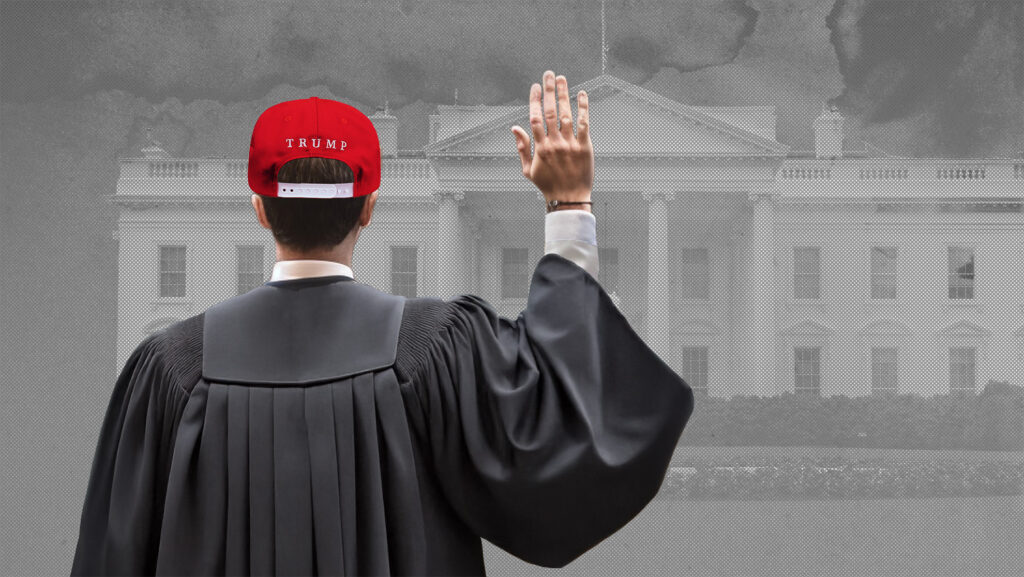
With all the chaos coming from the Trump administration, it’s important to remember that it also continues to advance judicial nominees — judges who will serve for the rest of their lives, long after Trump is no longer president. Senate Republicans have even been confirming these nominees throughout the government shutdown rather than make any effort to negotiate with their Democratic colleagues to open the government and prevent health care costs from skyrocketing.
These nominees are consistently more extreme in their views than their counterparts from Trump’s first administration. Not only do they have explicit records of opposing civil rights, workers’ rights, consumers’ rights and more, but they’ve also been making a point to demonstrate their loyalty to Trump throughout the confirmation process — including by promoting a dangerous brand of election denialism.
Get updates straight to your inbox — for free
Join over 350,000 readers who rely on our daily and weekly newsletters for the latest in voting, elections and democracy.
During the confirmation process, Democratic members of the Judiciary Committee have been asking the following question: Did Joe Biden win the 2020 election? It should be a simple answer: Yes. But Trump obviously doesn’t believe that, and he even invited his supporters to stage an insurrection on Jan.6, 2021 to overturn the results. Trump’s nominees know that “yes” is the wrong answer in the eyes of the president, and their extremely cautious answers demonstrate a troubling inability to contradict the president who nominated them, even when facts and truth are clear.
So far, they have circumvented this question by replying that Biden “was certified” as the winner. They speak of President Biden winning the election as a technicality rather than actually commenting on whether he won it outright. Here’s Sen. Peter Welch (D-VT) asking Jennifer Mascott — now confirmed as a judge on U.S. Court of Appeals for the Third Circuit — how Biden came to be certified. She refuses to answer.
Nominees to both the courts and other executive appointments have consistently used this “certified” answer to dodge admitting the simple fact that Biden won the 2020 election. It’s a dishonest response to an honest question that presents as election denialism.
It isn’t just on the 2020 election that Trump’s nominees have refused to disavow extreme and dangerous ideas.
Sen. Richard Blumenthal (D-CT) has asked nominees a series of questions in which they once again follow an almost-scripted response to demonstrate their loyalty.
First, he asks if Brown v. Board of Education was correctly decided. This was the case that ended racial segregation in the United States. And, of course, it’s reasonable to ask would-be judges if they understand and agree with existing law. Nominees typically have little problem agreeing Brown was correctly decided.
Then, Blumenthal asks if Loving v. Virginia, the case ending bans on interracial marriage, was correctly decided. Once again, the nominees routinely agree that the case was correctly decided.
But then Blumenthal asks about Obergefell v. Hodges, which required the legal recognition of same-sex marriages, as well. Suddenly, the nominees are no longer able to agree that Supreme Court precedents are correctly decided. At a Sept. 3 hearing, Robert Chamberlin, a nominee to the U.S. District Court for the Northern District of Mississippi, tried to explain that it’s “tradition” for nominees to agree with the first two cases but not the marriage equality case or Griswold v. Connecticut, the case upholding access to birth control. All five nominees pressed with that question refused to say Obergefell was correctly decided — only offering that they will follow precedent.
Earlier in the year, Rebecca Taibleson — recently confirmed as a judge on the U.S. Court of Appeals for the Seventh Circuit — similarly tried to distinguish between these cases. She insisted that the two racial equality cases were “monumental and foundational” and “solid,” but could not give a “thumbs-up or thumbs-down” to Obergefell or Griswold except to again confirm that it’s precedent and she would follow it. She could not explain why, and again simply justified her evasion by saying that previous nominees have done the same.
Perhaps the most damning response from these nominees is their inability to answer direct questions about how they can and should respond to Trump engaging in unlawful activity. Senate Democrats have peppered these nominees with questions throughout this year’s hearings about whether he can fire members of independent agencies, whether he can order SEAL Team 6 to assassinate a political opponent, whether he can strip citizenship from people born in this country, and so on. At Mascott’s hearing, Sen. Amy Klobuchar (D-MN) simply asked if Trump can do “anything he wants” as president. Mascott couldn’t bring herself to say no.
If these examples aren’t shocking enough, an exchange Sen. Cory Booker (D-NJ) had with Ninth Circuit nominee Eric Tung at his July 30 hearing speaks to how cowed these nominees are by Trump. Booker highlighted that Tung had been recommended for the position by his friend Mike Davis, who has been advising Trump on judicial selection and who has claimed that Democrats are “relentless and evil.” Could Tung say that he didn’t agree with Davis that all Democrats are “evil”? He could not, because it’s a “personal and policy-laden question.”
We cannot downplay the significance of these responses. These lifetime nominees to our federal courts are unwilling to answer simple questions because they would politically contradict Trump. Their answers, or lack thereof, forecast a huge threat to the impartiality of our justice system. These nominees — some already confirmed as judges — have made clear they are Trump loyalists and they cannot be trusted to protect the Constitution or the rule of law if and when he violates them.
Our courts are one of the last defenses against Trump’s encroachments on our democracy. The administration is already testing the limits to which it can circumvent court rulings against its unlawful behavior, and it feels almost inevitable it could openly defy the courts any day now. We need senators to continue to hold the line against allowing more Trump loyalists onto the federal bench. By the time they give Trump free rein to do “whatever he wants,” it will be too late.
Rachel Rossi is the president of Alliance for Justice and Alliance for Justice Action Campaign, bringing decades of experience as a public defender, policymaker, and advocate for civil rights and access to justice. She most recently served as director of the Office for Access to Justice at the U.S. Department of Justice and previously as deputy associate attorney general, where she became the first-ever Anti-Hate Coordinator. A proud daughter of immigrants from the Dominican Republic and Greece, Rossi’s career — from the courtroom to Capitol Hill — reflects her unwavering commitment to equity, reform, and defending democracy.