If the RNC has its way, counting your ballot may get harder
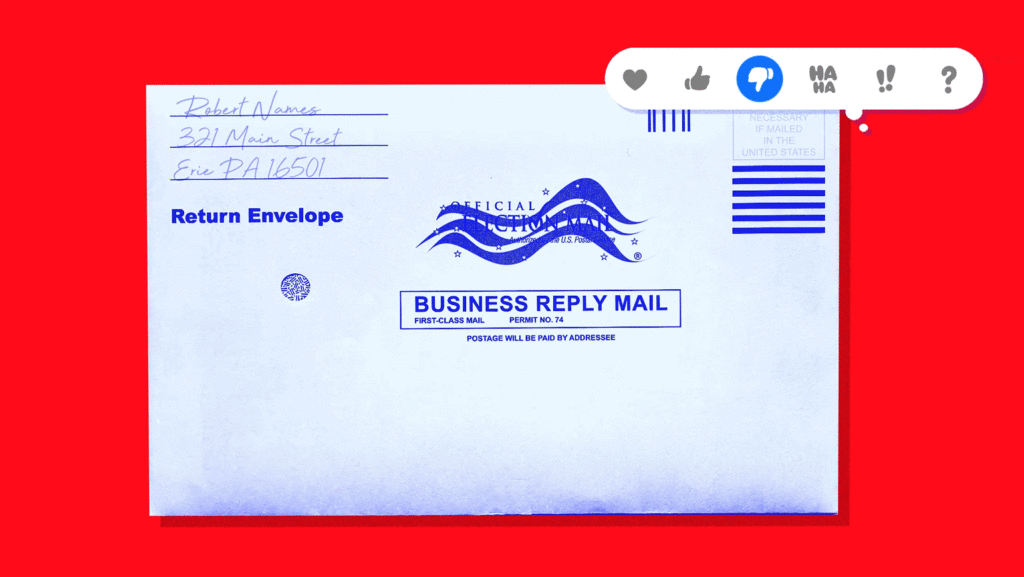
I must admit, I have not always been a big fan of mail-in voting.
Some of it is personal. I grew up going to the polling place with my parents. As a child, I remember seeing the tall gray machines with a big red arm used to set the machine and close the curtain.
My parents lifted me up to pull the small levers to select candidates. When we were done, we pulled that big arm back and the curtain reopened.
That is what voting has always been for me — a physical act requiring patience, movement and resolve. Voting by mail lacked the ritual and the communal sacrifice that I craved.
Get updates straight to your inbox — for free
Join 350,000 readers who rely on our daily and weekly newsletters for the latest in voting, elections and democracy.
That said, I never begrudged people who loved mail-in voting. If I viewed in-person voting as a near-religious act, they described mail-in voting as the ultimate expression of civic engagement.
They talked about sitting at their kitchen table, going through each race, researching candidates, ballot measures, and other items so they could make a truly informed decision — a far cry from walking in with the Democratic Party’s sample ballot, as my parents usually did.
Both conceptions of what it means to vote have flourished side by side because the Constitution grants states the right to set the time, place, and manner of elections. Yes, Congress can override those decisions through legislation, but it has generally treaded lightly on what is still considered a state prerogative.
Some states have moved entirely to voting by mail, while others have expanded in-person voting for weeks before Election Day. Many states have done a bit of both — making it easier to vote by mail while adding early voting days, including weekends, to the calendar.
From 1965 until roughly 2016, this progression carried little partisan baggage. Red and blue states alike expanded access to voting — western states like Utah focusing more on mail-in options, eastern states like Georgia and Florida adding in-person early voting days.
Like many of the advancements in our democracy, that all changed with the election of Donald Trump. For reasons that are not entirely clear, Trump chose to vilify mail-in voting well before he became famous for doing so after the 2020 election. His attacks continue to this day, as he now pressures the U.S. Senate to effectively ban voting by mail.
As the argument before the Court made clear, the stakes are national.
Along the way, Trump has attracted right-wing zealots and conspiracy theorists. But more insidiously, he has spawned a legal industry of well-funded lawyers who make their living attacking voting rights — and mail-in voting in particular.
Much of my work over the last decade has been fighting this growing group of well-financed lawyers in court. That is how I found myself defending Mississippi’s mail-in voting law in a case argued this morning before the Supreme Court.
The specific issue in Watson v. RNC is whether Mississippi’s law permitting the counting of mail-in ballots postmarked on or before Election Day — so long as they are received within five business days afterward — is preempted by the federal statute designating the Tuesday after the first Monday in November as the uniform national election day. This “postmark rule” allows otherwise lawful votes delayed by the postal service to still be counted.
Though this case is technically about Mississippi, it is clearly about something much bigger. After all, the RNC wouldn’t be spending millions of dollars litigating vote-counting rules in a reliably red state — one that already requires an excuse to cast a mail-in ballot — unless they had a very good reason.
As the argument before the Court made clear, the stakes are national. Approximately half of all states have some variation of this postmark rule, and the data strongly suggests that the voters most likely to be disenfranchised by requiring ballots to arrive by Election Day are disproportionately part of the Democratic coalition.
Predictably, the most conservative justices were critical of the postmark rule. Justice Alito went so far as to question early voting as well. But, as Justice Sotomayor reminded them, the Constitution grants states and Congress, not the courts, the right to set policy in this area.
In the end, it is difficult to know how the Court will rule. The Court should reject this effort to disenfranchise hundreds of thousands of lawful voters, but we have seen too many cases where the Court has failed democracy.
No matter what the court does, Trump and his party will continue to make voting harder and election subversion easier.
As the argument wore on, I found myself thinking of those gray machines from my childhood — the satisfying clunk, the curtain, my parents lifting me up to reach the levers. Voting felt enormous to me then. It still does.
Except now I am a lawyer with the burden of defending other people’s voting rights. People are counting on lawyers like me to protect their voice at the ballot box. Every child deserves the same faith in the system that I was given at my parents’ side.
That is why, no matter how the Court rules, or what Republicans do next, I will continue to fight for all Americans to be able to cast their ballots and have them counted.