Who is Aaron Reitz? Trump DOJ prosecutor says he’s working ‘with Main Justice’ as he threatens Democrats for conducting oversight
 Prefer us on Google
to see more of our voting rights news coverage when you search.
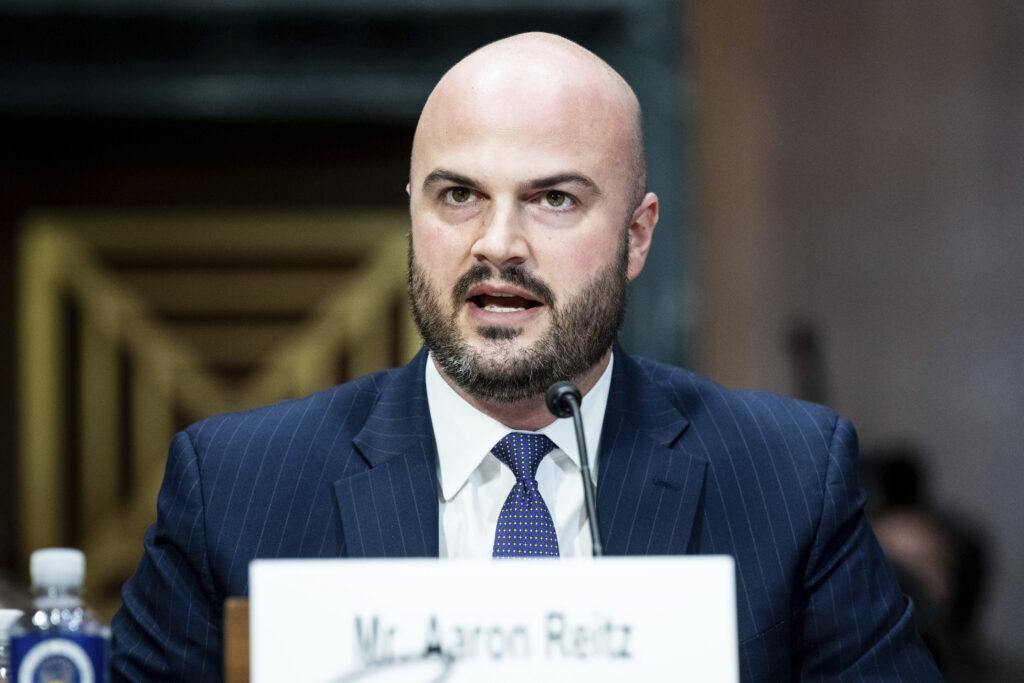
Aaron Reitz, the Trump-appointed federal prosecutor threatening Democratic lawmakers for preparing to exercise their constitutional oversight duties, once openly vowed to investigate his political opponents “into oblivion.”
Now, Reitz says he is working with the Department of Justice (DOJ) in Washington in his campaign against Democrats.
“As a U.S. attorney, I am free to do these things,” Reitz said Tuesday. “I did so in coordination with Main Justice.”
Get updates straight to your inbox — for free
Join 350,000 readers who rely on our daily and weekly newsletters for the latest in voting, elections and democracy.
On Wednesday, Reitz, the U.S. attorney for the Southern District of Texas, targeted Sen. Adam Schiff (D-Calif.), accusing him of threatening private citizens associated with President Donald Trump. Reitz demanded that Schiff preserve documents and communications related to his planned congressional investigations, citing federal criminal civil rights statutes.
Schiff became the fifth Democratic lawmaker targeted by Reitz in just over a week, joining Sens. Richard Blumenthal (D-Conn.), Elissa Slotkin (D-Mich.) and Elizabeth Warren (D-Mass.), as well as Rep. Robert Garcia (D-Calif.), the incoming chairman of the House Oversight Committee.
But Reitz’s increasingly aggressive campaign against congressional oversight is hardly his first foray into using the legal system against political adversaries.
Before becoming a federal prosecutor, Reitz helped lead an effort to overturn the 2020 presidential election, vowed to strip a Democratic lawmaker of their U.S. citizenship and openly described government investigations as a means of pressuring political opponents.
‘Investigate you into oblivion’
During a January 2026 appearance before the Montgomery County Tea Party in Texas, Reitz described his work under Republican Attorney General Ken Paxton as pursuing people he viewed as enemies of conservative values.
He then explained how he would target those opponents even when he couldn’t bring a lawsuit.
“If I couldn’t sue you, I’d investigate you into oblivion,” Reitz said, according to remarks uncovered by reporter Judd Legum.
It wasn’t an isolated comment.
During an October 2025 podcast appearance, Reitz discussed how simply launching an investigation could pressure a target into submission, even without an existing lawsuit. In an earlier appearance that August, he described using investigations and other legal procedures to financially overwhelm opponents.
Those remarks, made while Reitz was campaigning for Texas attorney general, take on new significance as he threatens Democratic lawmakers with potential criminal consequences for exercising congressional oversight powers.
Reitz has not announced criminal charges against any of the lawmakers. But on Monday, he confirmed that he was conducting a preliminary inquiry into whether their planned investigations could violate federal civil rights laws.
A history of attacking elections and political opponents
Reitz’s record stretches back to the aftermath of Trump’s 2020 election defeat.
As a senior attorney in Paxton’s office, he helped lead Texas’ extraordinary lawsuit seeking to invalidate Joe Biden’s victories in four battleground states. The U.S. Supreme Court rejected the challenge, which relied on claims about election irregularities that failed to establish a basis for overturning the results.
Rather than distancing himself from the effort, Reitz subsequently highlighted his participation while pursuing higher political office.
His hostility toward political opponents extended beyond election litigation.
In February 2026, while running for Texas attorney general, Reitz called for stripping Democratic state Rep. Gene Wu of his citizenship after a video circulated of Wu discussing the political power of nonwhite voters.
“As AG, I want to see [Rep. Gene Wu] de-naturalized,” Reitz wrote on social media.
Reitz suggested without evidence that Wu, a naturalized American citizen, had concealed anti-American views during the citizenship process.
The proposal would have subjected an elected political opponent to an extraordinary government sanction over his political speech.
Reitz was similarly unapologetic about his broader political objectives. During his unsuccessful attorney general campaign, he said that he wanted to “destroy the left.”
Then, on October 19, his rhetoric reached directly into election administration.
On the first day of early voting in Texas, Reitz posted a video warning voters and election officials that he would “hunt you down and prosecute you” if they allegedly committed fraud.
The warning came without specific evidence of widespread election crimes. Sen. Alex Padilla (D-Calif.) subsequently questioned whether the statements could intimidate eligible voters and interfere with election administration.
Reitz’s views on the limits of executive power have also attracted scrutiny.
During his February 2025 Senate confirmation hearing for an earlier DOJ position, he declined to embrace an unqualified rule that government officials must comply with every judicial decision. His response followed scrutiny of a deleted social media post appearing to encourage defiance of a federal court ruling.
Sen. Dick Durbin (D-Ill.) warned that Reitz’s position raised concerns about his commitment to the rule of law.
Why is a federal prosecutor in Texas targeting Congress?
Reitz’s current position makes his threats particularly unusual.
As U.S. attorney for the Southern District of Texas, Reitz oversees federal prosecutions in a jurisdiction stretching from Houston to the Mexican border. Yet the lawmakers he has targeted represent Connecticut, Michigan, Massachusetts and California, and their planned congressional investigations would principally take place in Washington, D.C.
That geographic divide does not automatically prevent a federal prosecutor from investigating conduct connected to another jurisdiction. But Reitz has not publicly identified a specific Texas-based crime committed by any of the lawmakers.
In an interview published Tuesday, Reitz argued that the lawmakers’ future investigations would likely affect people in his district. He acknowledged that his office would not lead a potential investigation if no jurisdictional connection emerged.
The same interview raised a more consequential question about whether Reitz is acting independently.
“I did so in coordination with Main Justice,” Reitz said, referring to DOJ’s headquarters in Washington.
The admission suggests that his campaign against Democratic lawmakers is not simply the work of an unusually combative local prosecutor. However, DOJ has not publicly identified which senior officials approved the letters or directed the strategy.
DOJ did not immediately respond to a request for comment.
Reitz previously served as Paxton’s deputy attorney general for legal strategy, chief of staff to Republican Sen. Ted Cruz and head of DOJ’s Office of Legal Policy. After losing the Republican primary for Texas attorney general, he became Southern District of Texas U.S. attorney in July through a judicial appointment rather than a separate Senate confirmation.
An ethics complaint — and mounting legal questions
Reitz’s threats have already prompted a formal challenge to his professional conduct.
On Monday, the watchdog group Campaign for Accountability filed an ethics complaint with the State Bar of Texas, alleging that Reitz violated professional rules by threatening lawmakers over constitutionally protected oversight activities.
The complaint cites rules prohibiting prosecutors from knowingly threatening charges unsupported by probable cause and lawyers from using legal processes primarily to burden or harass others.
Reitz discounted the complaint as “harassing” and “frivolous.”
Legal experts have also challenged the legitimacy of his threats, pointing to Congress’s broad investigative authority and the Constitution’s Speech or Debate Clause, which protects lawmakers performing legitimate legislative duties.
Reitz maintains that he is protecting Americans from potential violations of their constitutional rights, including their freedom to associate with the president without government retaliation.
But his preliminary inquiry concerns investigations the incoming Democratic congressional majority has largely not yet conducted. And his own prior statements raise questions about whether the prospect of an investigation is intended to deter political opponents before they exercise their constitutional authority.