Voters, Advocates Ask Court to Block Texas Gerrymander
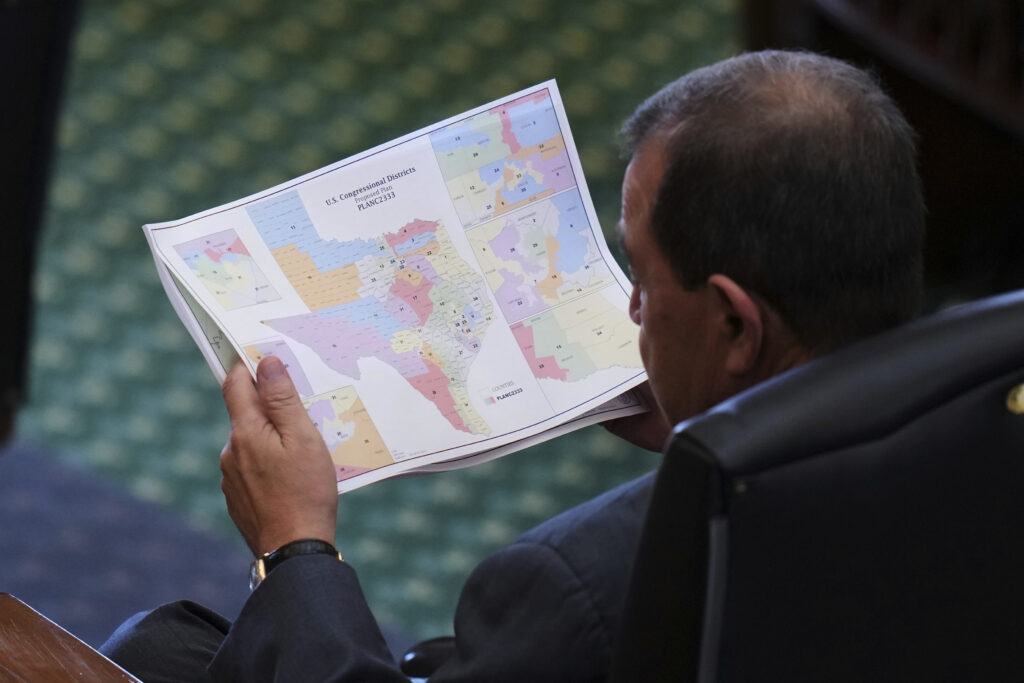
Two separate groups of plaintiffs filed motions Sunday and Monday in federal court seeking to block Texas’ new congressional map from going into effect.
To bolster its claim that the legislature intentionally discriminated against minority Texans, one filing offered evidence that a key GOP lawmaker used racial data to make the case for the map.
The filings came after state Republicans sped their gerrymander through a hasty redistricting process in hopes of winning more GOP seats in Congress in 2026. Lawmakers passed the new map early Saturday morning, sending it to the desk of Gov. Greg Abbott (R), who has said he will sign it.
Both filings were made in an ongoing consolidated lawsuit challenging the state’s 2021 map as a racial gerrymander.
On Sunday, a group of Black and Latino Texas voters* filed a motion asking the court to issue a preliminary injunction against the newly passed map, and use the 2021 map for next year’s election.
The Black and Latino voters argued that the Republican gerrymander is based on a misinterpretation of the 5th Circuit’s ruling in Petteway v. Galveston County last year.
“That opinion held only that multi-racial coalitions may not bring affirmative Section 2 claims for new districts – it did not license the intentional, race-motivated destruction of existing districts,” the motion said. “And in intentionally destroying majority-minority districts and replacing them with majority-Anglo districts, the legislature also engaged in unconstitutional racial gerrymandering…in violation of the Fourteenth Amendment.”
The plaintiffs also argued against Republicans’ decision to undergo an unnecessary redistricting process mid-decade, saying the new districts are “unconstitutionally malapportioned, because they do not reflect Texas’ uneven population growth since the 2020 census, and because the legal fiction of continued equal population between censuses exists to avoid constant redistricting, not to permit the unnecessary and premature replacement of legislatively-enacted districts.”
Monday’s filing, made by the other group of plaintiffs, including the League of United Latin American Citizens (LULAC) and the Mexican American Legislative Caucus, also asked the court for a preliminary injunction.
It cited a letter sent last month to Texas by the Department of Justice, urging the state to redistrict because of “constitutional concerns” over its existing map. The letter suggested that Texas had impermissibly used race in drawing that map. Abbott cited the letter in announcing the mid-decade redraw, even though multiple state officials had testified that they hadn’t used race in drawing the map.
“The resulting map does exactly what the DOJ letter demands, reducing from nine to four the number of districts lacking a single-race majority in the map and decimating Black and Latino electoral opportunities in the process,” the plaintiffs argued in the motion. “The map is egregiously unconstitutional under the Fourteenth and Fifteenth Amendments and must be swiftly blocked from taking effect.”
To block the map, the plaintiffs must demonstrate a substantial likelihood of success on the merits, among other things. In their joint motion, the groups argued they’re likely to succeed on the merits because the “direct evidence of intentional racial vote dilution is overwhelming and conclusive in this case.”
While the 2021 map had nine districts with a multiracial majority, the new map has just four, the motion said.
The plaintiffs argued the new district lines in the Dallas-Fort-Worth area are “especially egregious.” They fragment minority voters across multiple majority-white districts and consolidate two majority-minority districts into just one, repeating the same pattern a court found intentionally racially discriminatory in 2011.
The motion argued that state Rep. Todd Hunter (R), the author of the redistricting bill, made clear during the House floor debate that the gerrymander was based on race, not partisanship.
Hunter “spoke for over two minutes rattling off racial data — unprompted — about specific districts before claiming that political performance was a motivator,” the motion noted.
“So Chair Hunter provided members racial data to consider in how to cast their votes,” the motion concluded, “with an emphasis on HB 4’s dismantling of multiracial majority districts in favor single-race majority districts.”
The plaintiffs said they’re ready to move forward with preliminary injunction proceedings, and any delay caused by the state would entitle them to delay 2026 election deadlines – “something that should not be needed as things stand now,” according to the motion.
Over a decade ago, the Texas primary election was delayed due to redistricting litigation in 2012.
The LULAC plaintiffs filed their first supplemental complaint Monday, as well, asking the court to block the map’s implementation.
*The Texas voters are represented by the Elias Law Group (ELG). ELG firm chair Marc Elias is the founder of Democracy Docket.