Conservative Wisconsin Supreme Court justice won’t seek reelection, creating another high-stakes race
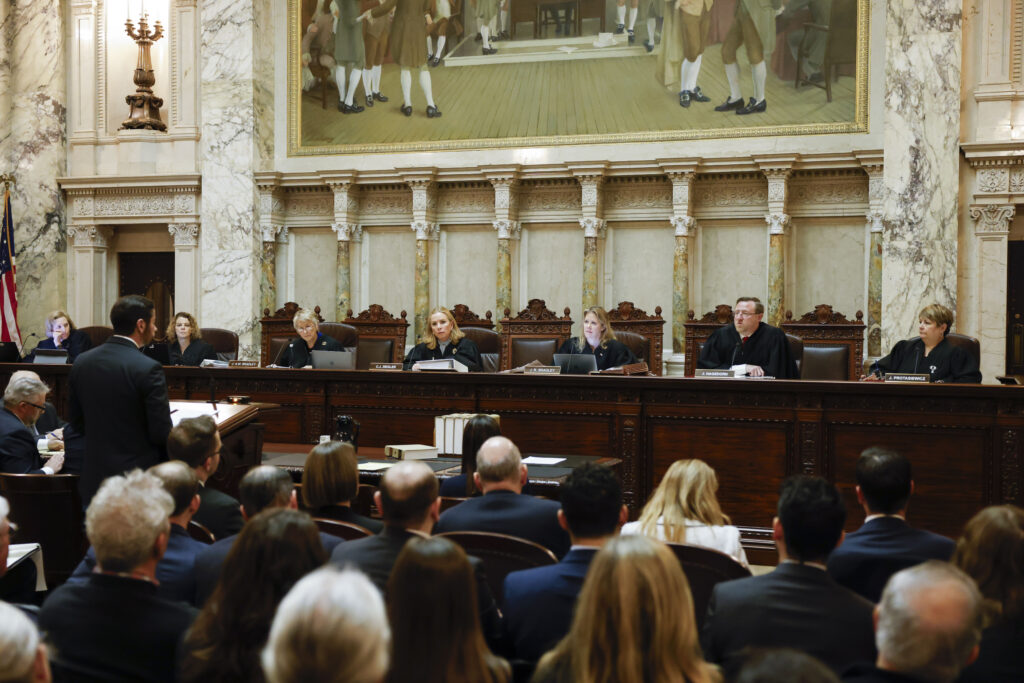
A surprise retirement from the Wisconsin Supreme Court could reshape the future of voting rights and redistricting in one of the nation’s most closely divided swing states — and potentially give liberals an opportunity to expand their majority on the court.
Justice Annette Ziegler, a conservative, announced in a statement Monday that she will not seek reelection when her term ends next year, ending nearly two decades on Wisconsin’s highest court. Ziegler, who joined the court in 2007 and served as chief justice from 2021 to 2025, said she plans to step away from the bench after more than 30 years in the judiciary.
Her departure will create an open seat in the April 2027 Wisconsin Supreme Court election — and could deepen the court’s current liberal majority at a moment when the justices are increasingly shaping the swing state’s rules over voting rights and redistricting.
Get updates straight to your inbox — for free
Join 350,000 readers who rely on our daily and weekly newsletters for the latest in voting, elections and democracy.
The Wisconsin Supreme Court currently has a 4-3 liberal majority, a shift that first occurred in 2023 when voters elected liberal Justice Janet Protasiewicz in a nationally watched race that broke spending records for judicial elections.
The court has remained under liberal control since then.
Another seat on the court is already on the ballot next month, when voters will choose a replacement for conservative Justice Rebecca Grassl Bradley, who is also not seeking reelection. That race will decide whether liberals expand their current majority before Ziegler’s seat even comes up.
If a liberal candidate wins next month’s race, the court’s balance could shift to a 5-2 liberal majority. Another liberal victory in the 2027 election for Ziegler’s seat could expand that advantage even further — potentially creating a 6-1 liberal supermajority court.
The stakes are unusually high in Wisconsin, one of the most evenly politically divided states in the country.
Presidential elections in Wisconsin are routinely decided by less than a percentage point, yet for much of the past decade Republicans maintained large legislative majorities due to district maps drawn after the 2010 census.
In late 2023, the Wisconsin Supreme Court struck down the state’s legislative districts, finding they violated the state constitution because many districts were made up of disconnected pieces of territory. In plain terms, the justices ruled the maps were drawn in a way that stitched together distant communities to secure a partisan advantage.
The court ordered new maps for the 2024 elections — dramatically reshaping the state’s political landscape and making many districts more competitive.
The ruling showed how much power the court now holds over Wisconsin’s democratic system.
When lawmakers and the governor cannot agree on election rules or district lines, the disputes often end up before the justices — who ultimately determine how elections will be conducted in the battleground state.
Advocates are currently challenging Wisconsin’s congressional map, which gives Republicans six of the state’s eight U.S. House seats despite the state’s nearly even partisan split. If the court orders new congressional districts, it could affect control of the U.S. House.
Voting laws are also likely to return to the court. In recent years, the justices have ruled on disputes involving absentee voting, drop boxes and other election procedures.
Because Wisconsin is a pivotal presidential battleground, those rulings could influence how elections are administered in 2028 and beyond.
Ziegler’s retirement also comes as state leaders continue to clash over how to prevent partisan manipulation of district lines.
Earlier this year, Wisconsin Gov. Tony Evers (D) called a special legislative session urging lawmakers to pass a constitutional amendment banning partisan gerrymandering.
But the proposal faces long odds in the Republican-controlled Legislature, which has repeatedly rejected structural redistricting reforms.
Without legislative action, Wisconsin’s courts remain the main venue where disputes over political maps are resolved.
That dynamic has transformed Wisconsin’s judicial elections into some of the most expensive and nationally watched court races, with tens of millions of dollars pouring into recent campaigns from political groups across the country.
Ziegler’s retirement means voters could reaffirm the ideological direction of the court yet again in 2027.
The timing could prove especially consequential. Justices elected in the next few years will likely still be serving when the next round of redistricting begins after the 2030 census — when states redraw congressional and legislative districts for the following decade.