Trump threatens to invoke Insurrection Act, deploy military to Minnesota
 Prefer us on Google
to see more of our voting rights news coverage when you search.
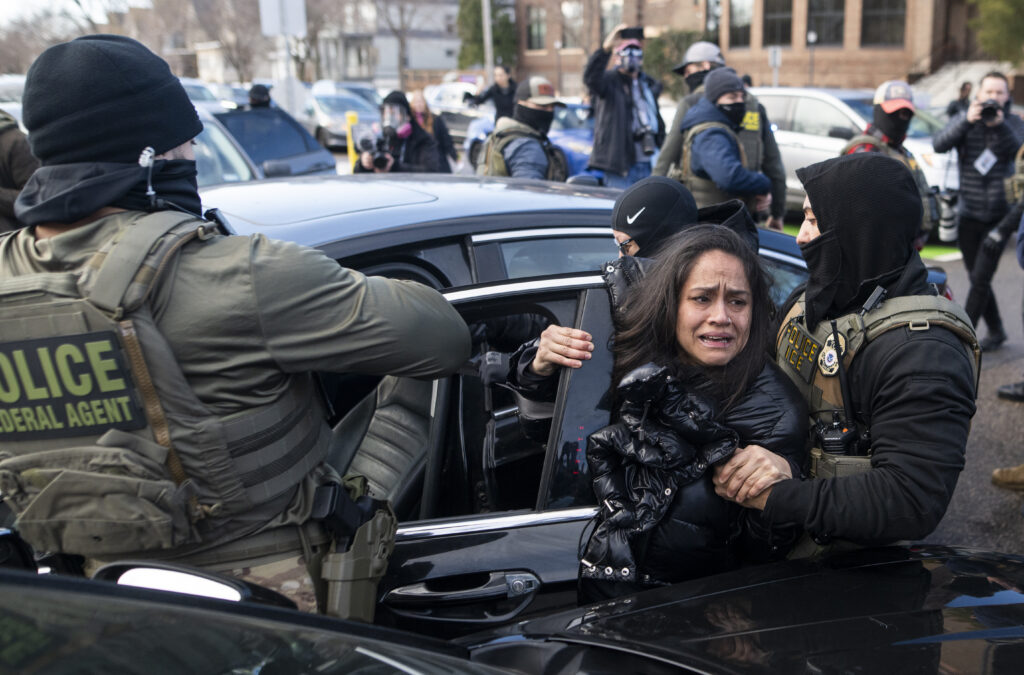
President Donald Trump has threatened to invoke the Insurrection Act and send the military to Minnesota to put down protests against Immigration and Customs Enforcement’s (ICE) killing of a Minneapolis woman.
Trump’s threat comes after his administration provoked chaos in Minnesota, flooding the state with thousands of federal law enforcement agents, who are conducting aggressive immigration raids across the Twin Cities region.
“If the corrupt politicians of Minnesota don’t obey the law and stop the professional agitators and insurrectionists from attacking the Patriots of I.C.E., who are only trying to do their job, I will institute the INSURRECTION ACT,” the president wrote Thursday on Truth Social.
Get updates straight to your inbox — for free
Join 350,000 readers who rely on our daily and weekly newsletters for the latest in voting, elections and democracy.
The Insurrection Act authorizes the president to deploy military forces domestically to suppress rebellion and violence or to enforce the law in certain situations.
Tensions in Minnesota reached a fever pitch on Jan. 7 when an ICE officer killed Renee Nicole Good, a U.S. citizen, as she attempted to drive away from federal agents. Her death has prompted daily demonstrations across the country — and particularly in the Twin Cities area — against the Trump administration.
Before Trump’s threat, Deputy Attorney General Todd Blanche characterized unrest in Minnesota as an “insurrection” and accused Minnesota Gov. Tim Walz (D) and Minneapolis Mayor Jacob Frey (D) of committing “terrorism” — an astonishing accusation from the second highest ranking official at the Department of Justice (DOJ).
“Walz and Frey — I’m focused on stopping YOU from your terrorism by whatever means necessary,” Blanche, one of Trump’s former personal attorneys, wrote on social media Wednesday night. “This is not a threat. It’s a promise.”
In an address to Minnesotans that same night, Walz warned that the Trump administration was terrorizing the state.
“Let’s be very very clear: this long ago stopped being a matter of immigration enforcement. Instead, it’s a campaign of organized brutality against the people of Minnesota by our own federal government,” Walz said.
Both Blanche’s and Walz’s statements came shortly after federal agents shot a man in the leg in northern Minneapolis, setting off hours of demonstration in the city.
In the days since Good’s death, Trump officials have ramped up their rhetoric against Minnesota and those protesting the administration.
On Tuesday, Trump wrote that “RECKONING & RETRIBUTION IS COMING” against the state.
Vice President JD Vance last week vowed to crack down on “a broader left-wing network” supposedly organized around attacking immigration enforcement agents. He offered no evidence that such a network exists, let alone that Good was a member.
Vance also claimed ICE agents are “protected by absolute immunity” — a sweeping claim that has been rejected by legal experts.
Federal judges in Minnesota are currently weighing the legality of ICE’s deployment and tactics.
On several occasions, federal agents have been seen indiscriminately releasing tear gas and flashbang grenades in the Twin Cities region.
Wednesday night, a resident said his children were taken to the hospital after a flashbang hit his vehicle. The man said he was attempting to evacuate his home because of clashes between federal agents and protesters in his neighborhood.
Residents and journalists have recorded agents making explicit threats against demonstrators, including one officer who pointed his sidearm at a person’s head hours after Good’s killing.
Though Trump has repeatedly hinted at using the Insurrection Act since returning to the White House, his post Thursday was his clearest threat yet.
Trump invoking the act would mark a major escalation in his efforts to integrate the military into routine law enforcement.
Trump has become increasingly focused on the Insurrection Act since the Supreme Court last month upheld a lower court ruling halting his bid to send hundreds of National Guard troops to Chicago using a separate statute.
Through his military deployment in Los Angeles and attempted deployments in Portland and Chicago, the president sought to claim Insurrection Act-like powers through an archaic and rarely used law.
After the Supreme Court’s ruling, Trump announced he was ending all deployments. However, he also vowed that he would send troops to cities “perhaps in a much different and stronger form.”
The Insurrection Act was last invoked over 30 years ago by former President George H.W. Bush after the governor of California requested federal assistance to help manage civil unrest in Los Angeles.