Trump admin will make states purge rolls or lose election security funding, DHS says
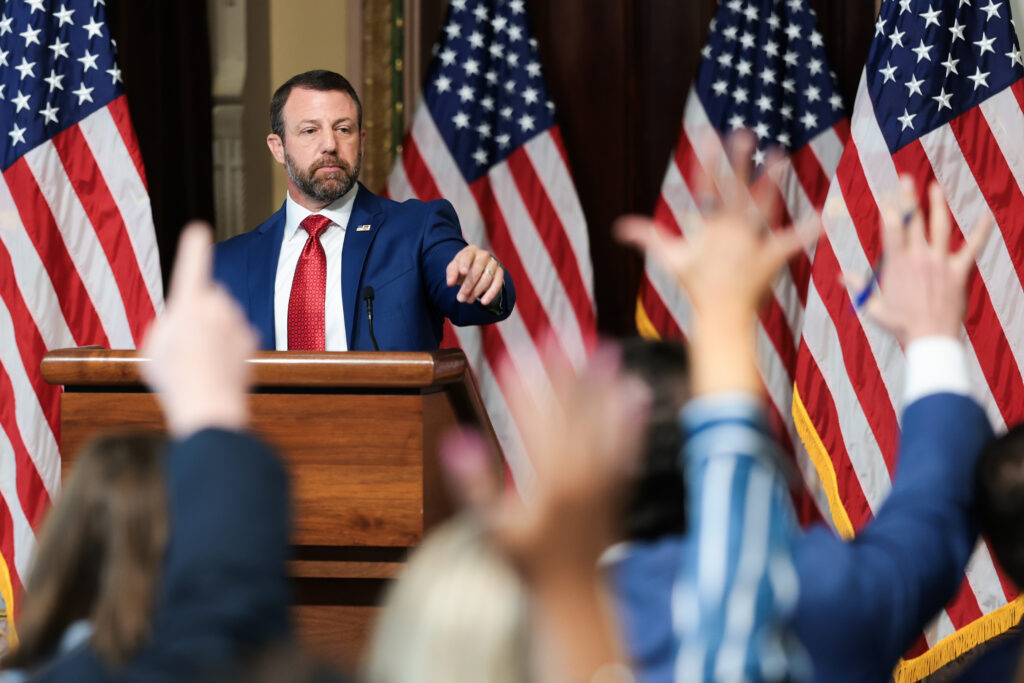
Homeland Security Secretary Markwayne Mullin announced Friday that the Trump administration would continue to withhold election security support from states unless they use a faulty federal database to maintain their voter rolls.
That quid pro quo — election security support from the Cybersecurity and Infrastructure Security Agency (CISA) in return for increased federal oversight of voter rolls — marks another effort by the Trump administration to expand the executive branch’s limited authority over state election procedures.
Get updates straight to your inbox — for free
Join 350,000 readers who rely on our daily and weekly newsletters for the latest in voting, elections and democracy.
Mullin made the announcement during a diatribe against U.S. elections, in which he also threatened state election chiefs with criminal charges if they do not use the database. His speech followed President Donald Trump’s attack on U.S. elections from the White House Thursday night.
“At President Trump’s direction, our cybersecurity team at CISA will release an updated election infrastructure plan, and it will be public within 30 days,” Mullin said. “That’ll give states the resources they need to help from the cyber side.”
“From us, if they participate in the SAVE program, we’ll provide this service for the resources and training to support state and election integrity,” he added.
Since Trump returned to office last year, his administration has made significant cuts to CISA’s funding, in particular to its election security programs. Secretaries of state have repeatedly warned that the cuts could make U.S. election systems vulnerable to digital threats.
Now, Mullin appeared to claim that the Trump administration would restart CISA election programs and again provide security resources to states that feed their registration rolls through the Systematic Alien Verification for Entitlements (SAVE), a Department of Homeland Security (DHS) database that Trump officials are attempting to retrofit into a new system to monitor and directly shape state voter registration lists.
Critics of the SAVE effort have warned that the database, which was never designed to police voter rolls, is deeply defective. Several investigations have revealed that it regularly misidentifies eligible voters, particularly naturalized citizens.
“The SAVE system was never designed to verify citizenship, and relies on outdated and inaccurate information that risks false matches and wrongful disenfranchisement while exposing sensitive voter data to potential misuse,” Tim Harper, a project lead at the Center for Democracy and Technology, said in a statement to Democracy Docket.
“If DHS truly wants to protect election integrity, it wouldn’t condition federal cybersecurity assistance on the use of a faulty system like SAVE while threatening to leave election officials to fight sophisticated nation-state cyberattacks without help,” Harper added.
A court order currently blocks DHS from using the SAVE database to police most state voter rolls.
Reacting to Mullin’s speech, Lawrence Norden, a vice president at the Brennan Center for Justice, told Democracy Docket Friday that he found it ironic that DHS was now attempting to leverage election security resources after “all their cuts to federal agencies and task forces that used to work on this.”
“None of those services are valuable if the state and local officials don’t trust CISA,” Norden said. “And at this point, I think they have completely eviscerated the trust between those states that are fighting them and CISA and any other federal agency.”
Norden added that Mullin threatening election officials for not using SAVE “doesn’t make any sense, because he’s asking them to comply with something that DHS has been barred from doing.”
Mullin’s announcement appears to be separate from DHS’s threat to withhold terrorism-prevention funding from states unless they adopt several anti-voting policies, including sending their voter rolls through the SAVE database.
The secretary also announced that DHS, with the Department of Commerce, would soon make new “security enhancements” on voting machines “mandatory” by conditioning state grants on their adoption.
“If these states want a grant, and they want to be reimbursed to run federal elections, they are going to have to implement security issues, just security issues,” he said. “We’re saying the machines have to be secured and that your voter registration list needs to be scrubbed.”
It’s unclear whether this particular action is related to his later announcement on CISA resources.