Top Dems: GOP’s monster voter suppression bill is ‘dead on arrival’
Democrats and pro-voting advocates reacted with outrage and unwavering opposition after House Republicans unveiled the Make Elections Great Again (MEGA) Act — a sweeping proposal that would dramatically restrict voting access and remake federal elections in ways critics say are designed to suppress turnout.
Key Democrats in both chambers promised the bill was “dead on arrival.”
Get updates straight to your inbox — for free
Join 350,000 readers who rely on our daily and weekly newsletters for the latest in voting, elections and democracy.
The measure, introduced by Rep. Bryan Steil (R-Wis.), Chair of the House Administration Committee, goes far beyond the already restrictive SAVE Act, which passed the House last year and focuses on requiring documentary proof of citizenship to register to vote.
The new proposal adds a strict ID requirement to cast a ballot, mandates aggressive voter roll purges, creates a centralized voter database, bans universal vote-by-mail, bars states from counting ballots that arrive after Election Day and makes it easier to sue election officials — changes opponents say amount to a full-scale attack on the right to vote.
The sharpest criticism came from Democrats who oversee election policy in the House.
Rep. Joe Morelle (D-N.Y.), the top Democrat on the House Administration Committee, said the bill reflects Republicans’ fear of voters rather than any genuine concern about election integrity. Morelle has previously criticized the SAVE Act as one of the most extreme assaults on voting rights in modern U.S. history.
“President Trump and House Republicans are terrified of the American people. They are desperate to rig the system so they can choose their voters,” Morelle said in a statement. “This bill is their latest attempt to block millions of Americans from exercising their right to vote. I will fight this bill at every turn.”
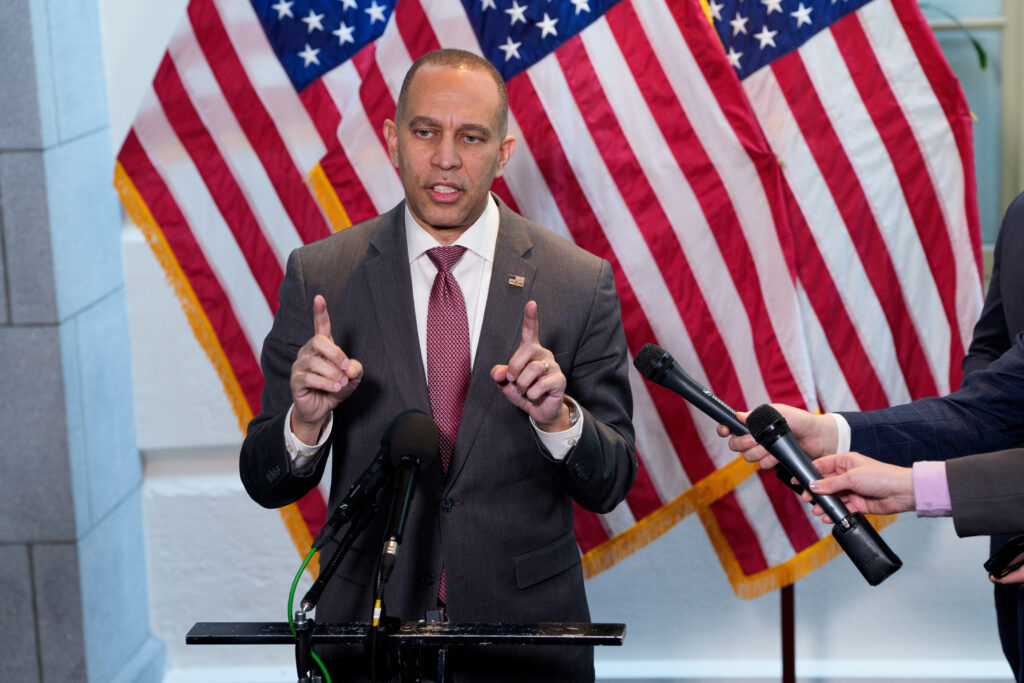
House Democratic leaders framed the proposal as part of a broader pattern of GOP election denial and voter suppression. Rep. Hakeem Jeffries (D-N.Y.), the House minority leader, dismissed the bill as a political stunt aimed at undermining free and fair elections.
“It’s a dead-on-arrival bill. They know it,” Jeffries said during a press conference. “Voter suppression is part of the Republican plan to try desperately to hold on to power. Republicans don’t want a free and fair election because they know when that happens, they’re going to lose.”
In the Senate, Democrats echoed those warnings, framing the MEGA Act as a clear escalation after Republicans failed to advance the SAVE Act. Alex Padilla (D-Calif.), the ranking member of the Senate Rules and Administration Committee and California’s former secretary of state, said the new proposal is rooted in conspiracy theories rather than facts.
“Donald Trump and House Republicans know the SAVE Act is dead on arrival in the Senate. Instead of legislating based on reality, they are doubling down with an even more extreme anti-voting rights bill based on the same baseless conspiracy theories,” Padilla said. “The MEGA Act would disenfranchise millions of married women, service members, and rural and minority voters, while enabling vindictive lawsuits against state election officials. It would overturn historic reforms like Motor Voter registration and vote-by-mail that are essential to helping Americans participate in elections.”
Voting rights experts, meanwhile, warned that the proposal would disenfranchise millions of eligible voters through paperwork barriers and database-driven purges. Brennan Center for Justice said the bill mirrors the SAVE Act while dramatically expanding its reach.
“House Republicans just introduced a new version of the SAVE Act, which would block millions of eligible American citizens from voting. The bill would require Americans to show documents like a passport or birth certificate when they register to vote. More than 21 million eligible American citizens don’t have those documents readily available. Only about half of American adults even have a passport,” Sean Morales-Doyle, director of the Brennan Center’s Voting Rights and Elections Program, posted on social media. “SAVE Act 2.0 would upend voting in other ways, including by imposing a photo ID law stricter than nearly any state’s current law, banning universal vote-by-mail, and requiring burdensome voter list maintenance practices that would risk purging eligible voters. In short, this bill is bad for American voters and should face the same fate as the original SAVE Act.”
Pro-democracy advocates condemned the MEGA Act proposal as an effort to cling to power by suppressing participation.
The bill is controversial even on the right.
Stephen Richer, an adjunct scholar at the libertarian Cato Institute, wrote that the MEGA Act was better than Trump’s executive order in March, which tried to do many of the same things but has largely been blocked by federal courts for exceeding the executive’s authority, but still flawed.
“Election administration is one of the few remaining areas of American policy that is still largely determined by the states. And that’s a good thing,” Richer said. “Federalism in election administration allows states to recognize their unique attributes (e.g., western states support mail voting because of the larger geographic distances), it strengthens election security (there isn’t one hack that can disrupt all 50 states), and it encourages democratic entrepreneurship (states can test different ideas and learn from each other).”
The reactions underscore the scale of opposition to the MEGA Act — not just as a single bill, but as a signal of how far Republicans are willing to go to restrict access to the ballot after repeated electoral defeats. For Democrats and voting rights advocates, the message was blunt: the proposal is not about election security, but about which voters get to participate in American democracy at all.