The real strategy behind DOJ’s Alaska lawsuit. (It isn’t winning in court)
 Prefer us on Google
to see more of our voting rights news coverage when you search.
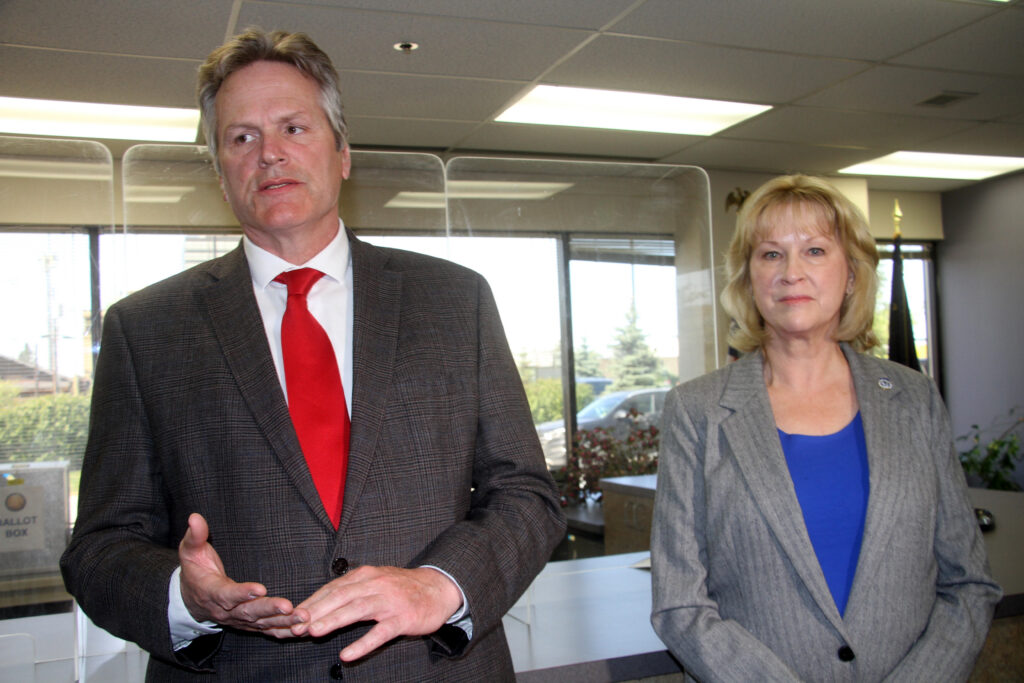
The Department of Justice (DOJ) is asking a federal judge to stop Alaska from certifying its U.S. Senate election if Sen. Dan Sullivan (R) loses under circumstances the government claims could have been affected by voter confusion*.
But winning in court may not be the prime goal of that extraordinary lawsuit.
Instead, the effort — even if ultimately unsuccessful in federal court — appears aimed in large part at laying the groundwork for a separate fight after Election Day over whether the winner actually reaches the U.S. Senate.
Get updates straight to your inbox — for free
Join 350,000 readers who rely on our daily and weekly newsletters for the latest in voting, elections and democracy.
“The litigation is designed to tee up this ‘confusion’ issue for these other institutions,” election law professor Richard Pildes argued this week. “Thus, even if DOJ loses in the federal courts, as it will, the litigation will give ammunition to anyone in the certification process, particularly the Lt. Gov.”
Under state law, the formal responsibility for certifying the winning candidate belongs to the director of elections, Carol Beecher. Once the state ballot-counting review is complete, the director “shall certify” the candidate receiving the most votes as elected and issue that candidate a certificate of election.
Beecher, a defendant in the lawsuit, has called it baseless and warned that it threatens to cast doubt on the integrity of the election.
But that isn’t the end of the process.
After certification, federal law requires the governor — currently Gov. Mike Dunleavy (R) — to send the U.S. Senate a separate certificate formally documenting the senator-elect’s election. Federal law separately requires the certificate to be countersigned by the state’s chief election official, who is the lieutenant governor.
That creates a potential pressure point even if DOJ loses its lawsuit and Beecher certifies a winner. The unsuccessful lawsuit could nonetheless establish a public record of voter confusion allegations that candidates or officials might invoke when the state moves from declaring a winner to formally credentialing that winner for the U.S. Senate.
And Lt. Gov Nancy Dahlstrom (R) may be especially worth watching.
Dahlstrom, whose office did not immediately respond to a request for comment, initiated the state’s earlier effort to remove a Republican candidate, Daniel J. Sullivan, from the ballot, arguing that his candidacy could confuse voters because his name is similar to that of the GOP incumbent. The Alaska Supreme Court ultimately allowed Daniel J. Sullivan to remain on the ballot.
Dahlstrom has also previously cooperated with the Trump administration on election matters.
Her office provided DOJ with Alaska’s unredacted voter registration data and entered into an agreement governing voter list maintenance. Voting rights groups sued over the arrangement, and an Alaska judge recently allowed that lawsuit to proceed.
She also ran for Congress in 2024 with Trump’s endorsement before dropping out of the race.
Notably, DOJ did not name Dahlstrom as a defendant in its new Senate-election lawsuit. The case instead targets Beecher and other officials directly involved in administering the election.
Nothing in DOJ’s lawsuit itself gives Dunleavy or Dahlstrom new legal authority to disregard the result. Federal law describes issuance of the Senate certificate as a duty of the state executive, not an optional step.
The department wants a federal court to prevent Alaska from certifying the election if the incumbent loses and votes cast for Daniel J. Sullivan could theoretically change the outcome if transferred to the senator.
The government wants certification blocked pending an investigation into whether voters who selected Daniel J. Sullivan actually intended to support the incumbent.
President Donald Trump said he personally ordered DOJ to bring the case.
*The Elias Law Group (ELG) represents proposed intervenors in this case. ELG Firm Chair Marc Elias is the founder of Democracy Docket.