Supreme Court open to enforceable ethics reform, justices tell Congress
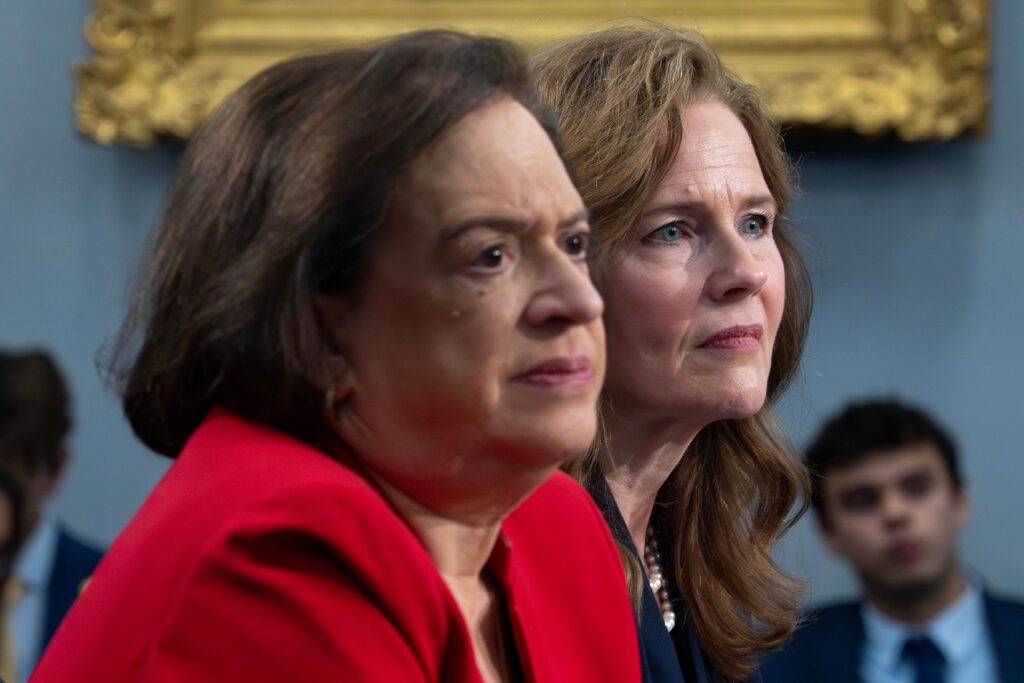
Congressional Democrats used a pair of budget hearings to implore Supreme Court Justices Amy Coney Barrett and Elena Kagan to support judicial ethics reform and stand up to President Donald Trump.
Kagan, a Barack Obama appointee, and Coney Barrett, a Trump appointee, appeared before the House and Senate Appropriations subcommittees to discuss the Court’s request for a $16.6 million budget increase to bolster security amid rising death threats against the justices.
But Democrats used the occasion to take aim at the Court’s ethical lapses. In recent years, it has been rocked by revelations that some conservative justices have accepted lavish gifts from wealthy benefactors with interests before the bench.
In her opening remarks, House Appropriations’s top-ranking Democrat, Rep. Rosa DeLauro (D-Ct.), argued the Court needed reform to save it from collapsing public confidence.
“To restore this trust, we must provide more transparency through increased financial disclosure requirements and a binding and enforceable code of ethics,” DeLauro said. “The status quo of self-policing, voluntary disclosure, and unenforceable guidelines is woefully insufficient. I say this to provide the public with the reassurance that they deserve that when a decision is handed down, it is the result of rigorous Constitutional analysis, not private parochial interest.”
“Independence and accountability are not competing values — they are complementary pillars of a constitutional democracy worthy of the public’s trust,” she added.
Get updates straight to your inbox — for free
Join 350,000 readers who rely on our daily and weekly newsletters for the latest in voting, elections and democracy.
The justices are supposed to abide by the Supreme Court’s Code of Conduct, which directs them to rule impartially and avoid political activity.
But ethics compliance is self-policed, with no independent enforcement. As the Court has increasingly issued highly partisan rulings in monumental cases that frequently overturn decades of precedent, some justices have also refused to recuse themselves despite apparent conflicts. And lower-level federal judges have rebuked the Supreme Court for its imperious reliance on the shadow docket.
Democrats have introduced a number of Supreme Court ethics bills in recent years. And Sen. Chris Van Hollen (D-Md.) urged the Court to adopt voluntary reforms before Congress imposed them.
Sen. Jack Reed (D-R.I.) asked the justices whether they had attempted to create an effective system of ethics enforcement.
“That’s a complex question,” Barrett answered. “That’s one that we’ve talked about a lot as a conference, and I don’t think it’s one that we’re entirely at rest on yet.”
She said it would be “tricky” to figure out who should enforce such a code because the separation of powers principle in the federal government would make having the executive branch supervise the Court problematic. Having other members of the judiciary try to police their superiors on the high bench would also create “awkwardness,” she added.
“We’ve talked about the possibility of senior judges or retired judges, but then there’s still a structural problem because then you need to have an appeal process,” Barrett said.
The lengthy debates, Kagan said, had led her to agree someone needs to enforce the Court’s ethics rules “if the enforcement mechanism is of the right kind.”
“It’s important for public perception of the Court,” Kagan said. “It’s also important to give the justices a way to show that some of the charges against them are so much poppycock.”
But the enforcer cannot be someone beholden to the president or Congress, Kagan added. “It has to come from within the judicial branch itself if the Supreme Court is to remain independent, and it’s incredibly important that it remain independent.”
Kagan said the challenges of using senior or retired federal judges to enforce ethics could be overcome.
Steny Hoyer (D-Md.), ranking member of the House Appropriation’s Financial Services and General Government subcommittee, urged the justices to preserve the balance of power among the three branches of government — and not let Trump run wild.
“This administration is routinely engaging in conduct that tests the limits of our Constitution,” Stoyer said. “Just as we in Congress must do our duty to hold the executive and judicial branches accountable, so too must the Court carry out its responsibility to keep an overreaching executive or legislature in check without overreaching itself.”
Tuesday’s hearings were the first time sitting justices testified before Congress since 2019. Justices used to appear regularly to discuss all sorts of matters — not just budget requests — at least once a year in the decades before 2012.
During the hearings, Kagan and Barrett also defended the Court’s use of the “emergency” or “shadow docket” to issue major decisions on limited briefing and often without a written opinion. Federal judges, judicial scholars, and Democrats have all criticized the Court’s overreliance on this less transparent mechanism for delivering rulings.
But Kagan and Barrett also said the Court recognized a need to write more detailed opinions on controversial matters.