New York court strikes down congressional map, potentially handing Dems another seat
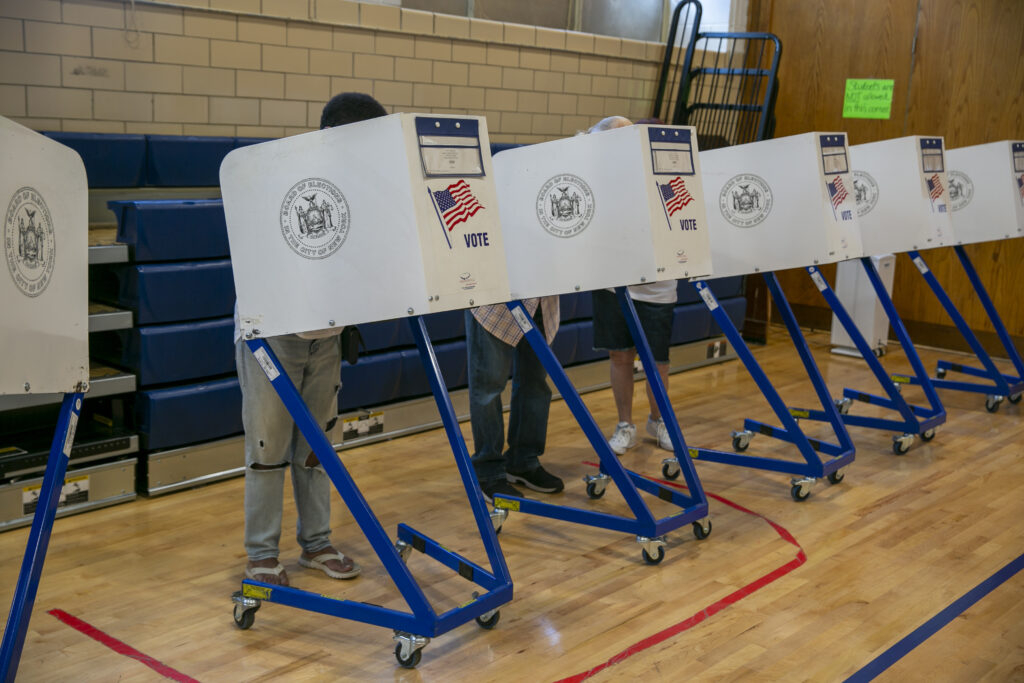
A New York court ruled Wednesday that the state’s 2024 congressional map illegally diluted the political power of Black and Latino voters*, ordering an immediate redraw that would likely give Democrats another seat in this year’s midterms.
The decision, issued by Justice Jeffrey H. Pearlman of the Supreme Court of the State of New York, declared the lines for the 11th Congressional District unconstitutional and barred the state from using them in any future election.
The district is currently held by Rep. Nicole Malliotakis, a Republican.
Get updates straight to your inbox — for free
Join 350,000 readers who rely on our daily and weekly newsletters for the latest in voting, elections and democracy.
The ruling requires the state’s Independent Redistricting Commission to reconvene and produce a new map by early February, reopening a district criticized for suppressing Staten Island’s minority voters.
“It is clear to the Court that the current district lines of CD-11 are a contributing factor in the lack of representation for minority voters,” Pearlman wrote. “It is evident that without adding Black and Latino voters from elsewhere, those voters already affected by race discrimination will remain a diluted population indefinitely.”
After a trial and extensive expert testimony, the court concluded the congressional district lines that include all of Staten Island and part of South Brooklyn denied Black and Latino voters a fair chance to influence New York elections.
The court found overwhelming evidence of racial segregation and polarized voting in Staten Island.
“A demonstration of racially polarized voting shows that the minority groups at issue vote as a bloc, as do White voters, and that the minority-preferred candidates ‘usually’ lose,” the ruling reads. “White voters voted against the candidates preferred by Black and Latino 73.7 percent of the time.”
The ruling goes beyond the federal Voting Rights Act, which is expected to be significantly weakened by the U.S. Supreme Court. The court reaffirmed that New York’s constitution provides stronger protections for voters than those guaranteed by Congress.
As federal courts have narrowed the scope of the Voting Rights Act, state constitutions like New York’s have become a critical line of defense.
“Petitioners are correct in their assertion that the New York State Constitution provides greater protections against racial vote dilution than the federal constitution or the federal Voting Rights Act,” Pearlman added. “Assertions that the federal Voting Rights Act controls simply do not hold up under a basic logical analysis.”
Rather than impose a court-drawn map, Pearlman ordered the commission to fix the problem and redraw its 2026 congressional map.
“We are reviewing the judge’s decision and our options to protect the voices of the people of Staten Island and Brooklyn,” Malliotakis said in a statement following the ruling. “Nothing changes the fact that this is a frivolous attempt by Washington Democrats to steal this congressional seat from the people and we are very confident that we will prevail at the end of the day.”
The decision lands amid nationwide gerrymanders, with Republican-controlled states pushing aggressive mid-decade map redraws to lock in control of the U.S. House before votes are cast, while Democrats aim to counter them.
New York’s ruling signals that state courts can still step in when politicians manipulate maps to suppress voters.
*The plaintiffs in the case were represented by the Elias Law Group (ELG). ELG firm chair Marc Elias is the founder of Democracy Docket.