Mississippi governor plans to redraw congressional map, eliminate majority-Black district after midterms
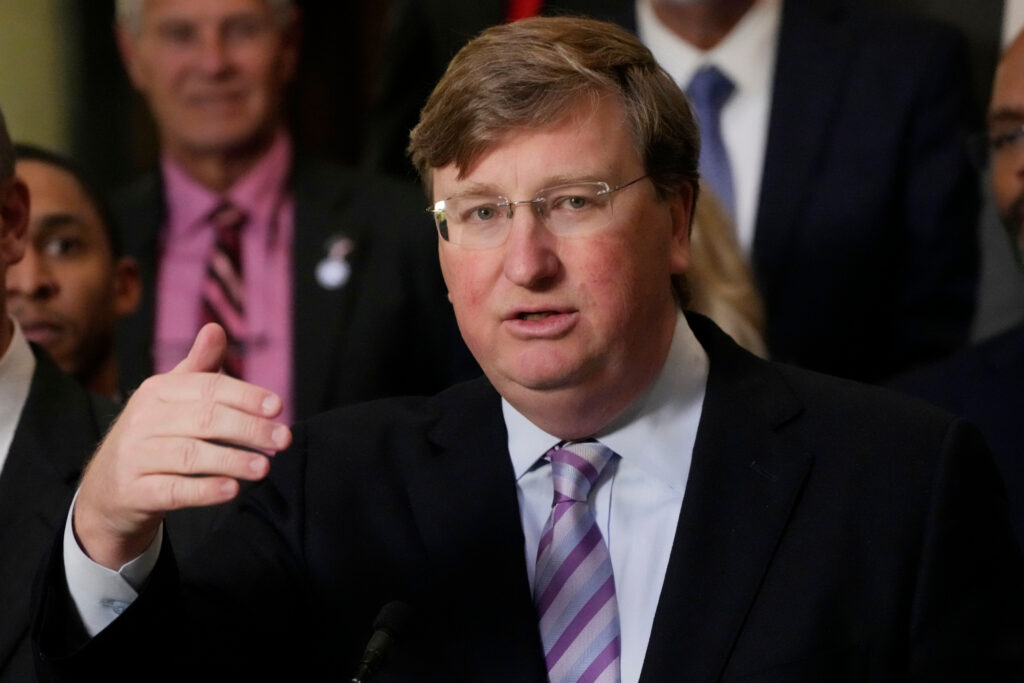
Mississippi Gov. Tate Reeves (R) said Wednesday that Republicans are planning to redraw the state’s congressional map and dismantle the state’s lone majority-Black district by 2027.
The state has a higher share of Black residents — 38% — than any other in the U.S.
While Reeves backed off an immediate redistricting push before the 2026 midterms, his remarks signal that Republicans plan to relentlessly redraw electoral maps and undermine Black voting power across the South after a U.S. Supreme Court ruling in Louisiana v. Callais gutted the Voting Rights Act last month.
Get updates straight to your inbox — for free
Join 350,000 readers who rely on our daily and weekly newsletters for the latest in voting, elections and democracy.
Speaking on a Mississippi radio show, Reeves made clear that congressional redistricting remains a priority — even as he canceled a planned special session to redraw the state’s Supreme Court districts following a federal appeals court ruling.
Reeves directly targeted Rep. Bennie Thompson (D), who represents Mississippi’s 2nd Congressional District, a majority-Black district that has long anchored Black political representation in the state.
“What I would tell you is the tenure of Congressman Bennie Thompson raining terror on the 2nd Congressional District is over,” Reeves said. “It is not a question of if, it’s a question of when.”
The comments are among the most explicit acknowledgments yet from a Southern Republican governor that GOP officials are set on eliminating districts that ensure Black voters can elect candidates of their choice.
Mississippi currently has four congressional districts, just one of which — Thompson’s — is majority Black.
Civil rights advocates have long argued that the district is essential to ensuring representation for the state’s Black voters.
Reeves indicated that immediate redistricting ahead of the 2026 elections is unlikely, in part because Mississippi has already held its congressional primaries — meaning lawmakers would need to void those elections and start over.
Instead, he suggested Republicans are looking toward redrawing maps before the 2027 elections.
“Just to clarify, I said I expect lawmakers to redraw congressional lines BETWEEN NOW and [the] 2027 elections!” Reeves later wrote on social media.
Even so, Reeves’ broader comments suggest a sweeping approach.
During the interview, he said Mississippi lawmakers should consider redrawing not just congressional districts but also legislative and judicial maps — and explicitly argued they should be drawn “based upon partisanship.”
That framing reflects a growing strategy among Republican officials, who argue that post-Callais maps are being redrawn for partisan — not racial — reasons in an attempt to sidestep legal limits on diluting Black voting power.
Reeves also sharply criticized prior Voting Rights Act enforcement, claiming it had been used to advantage Democrats in red states.
The developments in Mississippi come as other Southern states, including Alabama, Louisiana and Tennessee, move to aggressively redraw congressional maps in the wake of Callais, with critics warning that those efforts are dismantling Black political power across the region.
While Mississippi’s timeline appears slower, Reeves’ comments underscore that the state is nonetheless willing to be part of the same broader push.
So far, no new congressional map has been introduced in the Magnolia State. But Reeves’ remarks leave little doubt about the direction Republican leaders intend to take — and the stakes for Black representation in Mississippi in the years ahead.