Xavier Becerra could become California’s next governor. Will he follow Gavin Newsom’s lead in the fight to protect democracy from Trump?
 Prefer us on Google
to see more of our voting rights news coverage when you search.
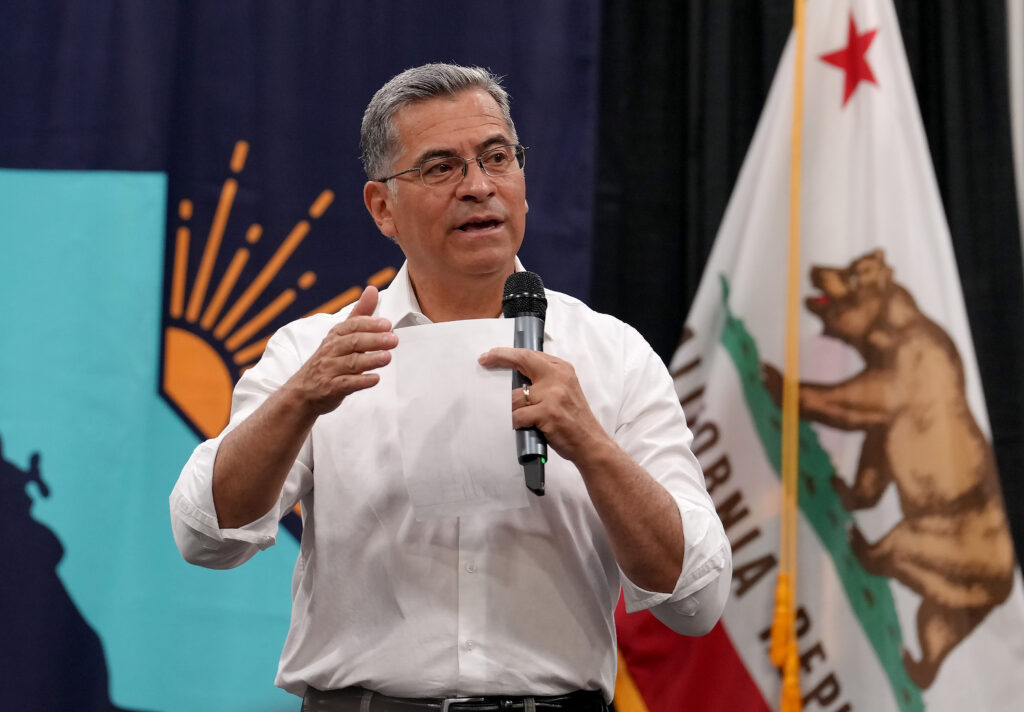
Democrat Xavier Becerra has advanced out of California’s jungle primary and is now headed for the general election to become the state’s next governor.
Votes are still being counted, but he’ll likely face Republican Steve Hilton, who was endorsed by President Donald Trump, or Democrat climate activist Tom Steyer in November.
Current Gov. Gavin Newsom (D) used his large bully pulpit as leader of the nation’s wealthiest and most populous state to counter Trump’s assault on democracy.
But Newsom leaves office in January, and so a key question looms: Will Becerra — a former longtime congressman and former state attorney general who served as Health and Human Services (HHS) secretary under former President Joe Biden — follow in Newsom’s footsteps to ensure that the Golden State leads the resistance to Trump’s authoritarianism, if he’s elected in November?
Get updates straight to your inbox — for free
Join 350,000 readers who rely on our daily and weekly newsletters for the latest in voting, elections and democracy.
Newsom has been one of Trump’s most prominent critics, clashing frequently with the president online and in interviews. Newsom’s combative approach has drawn Trump’s ire, earning him the presidential sobriquet “Gavin Newscum,” and fueling expectations of a 2028 presidential run.
But more than merely trading barbs with our terminally-online president, Newsom has consistently fought back against him with legislation, lawsuits, and stark warnings about Trump’s threat to democracy.
After Trump launched the mid-decade gerrymandering war last summer, it was Newsom who responded, successfully launching and selling a voter referendum to allow Democrats to counter the GOP’s gerrymandering in Texas.
Thanks to that quick action, Democrats will likely flip five GOP-held congressional seats in California. California was the only state to successfully strike back — besides Virginia, no other Democratic-controlled state even tried.
Along with California Attorney General Rob Bonta (D), Newsom has also led numerous legal challenges against Trump policies, including a lawsuit seeking to block his executive order attempting to take unprecedented control over elections. And Newsom sued the White House to stop Trump’s deployment of national guard soldiers in Los Angeles.
For his part, Becerra is no stranger to suing Trump. Over the course of his four years as California’s attorney general, Becerra brought 122 lawsuits challenging the White House during Trump’s first term — more than any other state.
Newsom has also signed a number of pro-democracy measures into law during his time in Sacramento. In 2023, he signed a series of bills making it easier to vote, and ensuring more mail-in ballots are counted. In 2024, Newsom inked another law banning California localities from implementing voter I.D. requirements.
And after Riverside County Sheriff (and failed GOP gubernatorial candidate) Chad Bianco seized 650,000 referendum ballots in March, Newsom signed another law that bans anyone — including federal or local law enforcement — from unlawfully seizing ballots, voter rolls, or other election materials.
During Becerra’s 24 years in Congress, he cultivated a reputation as a progressive policy wonk who rose to leadership positions in the Democratic caucus. Becerra’s policy focus leaned toward healthcare and immigration more than election reforms.
Becerra joined other members of Democratic leadership in voting against the Help America Vote Act in 2002, siding with progressives who opposed the bill’s identification requirements. He later joined the Congressional Voting Rights Caucus, cosponsoring and backing a handful of election reform bills that ultimately went nowhere.
From noisy Newsom to buttoned-down Becerra
While other Democratic governors have sued this administration, signed pro-voting legislation, and worked to counter GOP redistricting, few have matched Newsom’s ability to sound the alarm over Trump’s attacks on voting rights and the rule of law.
Newsom has consistently connected the dots between the administration’s disparate acts, noting how the White House has systemically worked to undermine democracy. After the Department of Justice (DOJ) announced plans to send election observers to California and New Jersey ahead of the 2025 elections, Newsom called it out as another facet in a wider voter suppression effort.
“They have no business doing that. They have no basis to do that,” Newsom said of the DOJ’s monitoring effort. “This is about voter intimidation. This is about voter suppression, period. Full stop.”
Newsom was similarly crystalline in his denunciation of Trump’s deployment of national guard troops to U.S. cities.
“The Trump Administration is unapologetically attacking the rule of law itself and putting into action their dangerous words — ignoring court orders and treating judges, even those appointed by the President himself, as political opponents,” Newsom said.
“This isn’t about public safety, it’s about power. The commander-in-chief is using the U.S. military as a political weapon against American citizens,” Newsom added. “We will take this fight to court, but the public cannot stay silent in the face of such reckless and authoritarian conduct by the President of the United States.”
Not every Democratic governor has been so clear in assessing and opposing the MAGA threat.
Early in the second administration, Democratic criticism was often muted, and some politicians attempted to work with Trump rather than fight him. Colorado Gov. Jared Polis (D) recently succumbed to White House pressure to commute the sentence of Tina Peters, a Republican election clerk convicted of providing unauthorized access to county voting equipment.
Becerra is seen as more deliberate than Newsom, and less likely to seek out the limelight. He is unlikely to build the kind of online following Newsom has — 3 million followers on X, compared to Becerra’s 60,400.
As Becerra’s candidacy took off late this spring, insider accounts criticizing his leadership at HHS emerged. A former Biden DOJ spokesman said Becerra was “not effective” leading the agency. Becerra let others take the lead in briefing the public and Congress during the COVID pandemic, a move his allies called deferential to the Biden White House but critics say reflected his impotence as a cabinet member. A recent Politico profile described Becerra’s political style as “less showman than suburban accountant.”
But Becerra has shown a willingness to speak out on election matters. After the U.S. Supreme Court gutted the Voting Rights Act with its ruling in Louisiana v. Callais, Becerra put out a short video criticizing the decision.
“I think it’s a vicious attack on fairness in our electoral process, and it’s almost a whitewashing of history,” he said. “It may take time, but we will right the ship, because this is not the way you do democracy. This is not the way you do elections. And the Supreme Court may be nine powerful people, but you cannot stop a movement.”
Newsom, of course, isn’t leaving the political spotlight any time soon. There’s little reason to expect him to stop using his megaphone as a leading contender for the Democratic nomination to call out the administration’s anti-democratic tendencies. But once he leaves office in January, his power to shape events in California will diminish.
If Becerra succeeds him, he may not play as prominent a public role as Newsom has in resisting Trump. But Becerra’s record suggests he’ll stand up for democracy all the same.