Letitia James, James Comey take aim at DOJ attempt to revive failed criminal cases
 Prefer us on Google
to see more of our voting rights news coverage when you search.
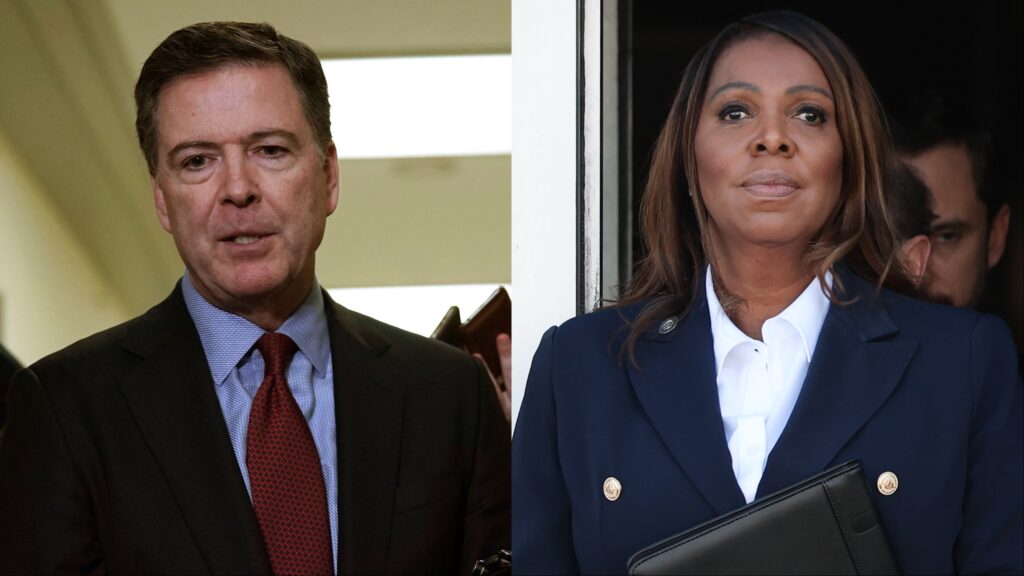
Nearly a month after a judge dismissed politically motivated charges against New York Attorney General Letitia James (D) and former FBI Director James Comey, the U.S. Department of Justice (DOJ) moved in late December to resuscitate the cases through appeal.
The DOJ has also sought to combine their two separate cases into one before the Fourth Circuit Court of Appeals.
Now, James and Comey are asking the court to grant them separate opportunities to rebut the department’s cases, alleging serious, but distinct improprieties in their prosecution.
Get updates straight to your inbox — for free
Join 350,000 readers who rely on our daily and weekly newsletters for the latest in voting, elections and democracy.
The requests represent the latest battle in the Justice Department’s shambolic quest to use the courts to extract revenge on two of President Donald Trump’s most prominent foes.
The DOJ has insisted that James and Comey must consolidate their formal challenges. But in new filings to the Fourth Circuit, James and Comey argued that their individual criminal cases, which were brought by a prosecutor handpicked by President Donald Trump, involve unique issues that merit two opposing motions.
Last year, both James and Comey were indicted by Lindsey Halligan just days after Trump installed her as the top federal prosecutor in eastern Virginia. The cases came shortly after the president publicly ordered Attorney General Pam Bondi to target them and other political foes more aggressively.
The indictments Halligan secured accused Comey of making false statements in a congressional hearing and claimed James committed mortgage fraud during a home purchase in Norfolk, Virginia.
But in November, a federal judge dismissed both cases, finding that Trump and Bondi circumvented the Constitution and federal vacancy laws when they installed Halligan as an interim U.S. attorney.
Because Halligan was unlawfully serving as a temporary U.S. attorney, the indictments she sought were fundamentally tainted and the cases must be set aside, the judge determined.
In her new motion, James’ attorney said she intends to raise the fact that Halligan continued to present herself as the top federal prosecutor in eastern Virginia in failed attempts to re-indict New York’s chief law enforcement officer.
Federal prosecutors in Halligan’s office tried to charge James on the same initial mortgage fraud allegations twice, but grand juries rejected both attempts.
In at least one of those attempts, Halligan claimed she was the “U.S. Attorney for the Eastern District of Virginia” — appearing to drop “acting” or “interim” from her title even though she was never confirmed by the Senate or judges in the federal district.
James’ counsel said she seeks to argue before the appeals court that Halligan’s continued claim to the U.S. attorney post violates the district court’s finding that she was unlawfully appointed.
In his motion, Comey’s defense said it hoped to raise a unique statute-of-limitations issue with his case.
Comey was charged for allegedly making false statements in a Senate committee hearing in 2020 on the FBI’s investigation into Russian interference in the 2016 presidential election.
On her fourth day in office, Halligan sought to indict Comey just days before the five-year statute of limitations for his comments — which were foundational to the case — were set to expire.
When Comey’s case was dismissed, the judge also rejected the DOJ’s claim that it should be able to invoke a law that allows federal prosecutors to refile charges within six months of a dismissal, even if the original statute of limitations has expired.
The DOJ claimed that because Bondi “ratified” Halligan’s actions on Oct. 31, 2025 — a full 31 days after the statute of limitations on making false statements passed — federal prosecutors would be able to re-indict the former FBI chief under the law.
Comey said he will push back on the DOJ’s ratification claim in future court filings.
Both Comey and James also asked the appeals court to reject the DOJ’s request for an extension on when it has to file its initial appeal argument on why the district court’s dismissal and unlawful appointment determination against Halligan was incorrect.
Despite appealing the cases in December, the department has yet to file an opening brief.