‘DOJ doesn’t have authority to run a state’s elections’: West Virginia’s GOP election chief pushes back on voter roll grab
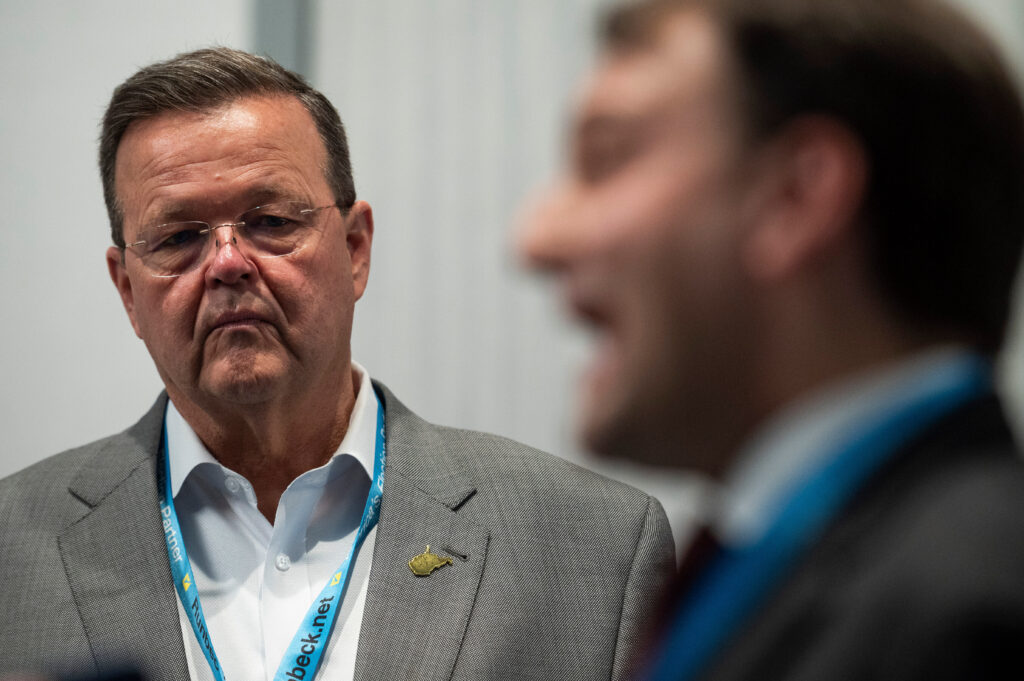
West Virginia’s Republican chief election official denied the U.S. Department of Justice’s (DOJ) demand for full access to the state’s voter roll, rejecting what he described as an unlawful attempt to seize the sensitive personal data of individual voters by the Trump administration.
Secretary of State Kris Warner (R) is the latest in a string of Republican chief election officials to push back against DOJ’s voter roll grab — a stark sign that the effort is spurring opposition even among some supporters of President Donald Trump.
“State law is clear: voter lists are available in a redacted format from my office, but I’ll not be turning over any West Virginian’s protected information,” Warner said in a statement. “We have offered to work cooperatively with the federal government to maintain the continuity of elections nationwide, but the DOJ doesn’t have authority to run a state’s elections. I support efforts to strengthen election integrity, but I will not break the law, give up our State’s rights, or compromise the privacy of our citizens.”
As part of the DOJ’s unprecedented effort to obtain the full, unredacted voter rolls of every state, the department sent a letter in early September to Warner demanding full access to the state’s voter registration records — including the full names, addresses, driver’s license numbers, and partial social security numbers of every registered voter.
Get updates straight to your inbox — for free
Join 350,000 readers who rely on our daily and weekly newsletters for the latest in voting, elections and democracy.
In a response sent Wednesday to Eric Neff, the acting chief of the DOJ’s voting section, Warner said the “various legal authorities” that the department cited in its demand for voter data — including the Help America Vote Act, the National Voter Registration Act, the Civil Rights Act of 1960, and the Privacy Act of 1974 — don’t actually entitle federal government to states’ private voter information.
“Our Office performed a thorough review of the cited statues, none of which require compliance with such a broad request,” Warner wrote.
After a number of states initially refused DOJ’s demands, the department started to sue individual states in hopes that a judge would compel states to hand over their unredacted voter rolls. The DOJ has, so far, sued 25 states and the District of Columbia, but not a single judge has ruled in the federal government’s favor yet.
On Tuesday, a Trump-appointed federal judge dismissed the DOJ’s lawsuit against Michigan, concluding that federal law does not require states to provide requested records to the department.
“There is simply no basis in the Federal Rules of Civil Procedure for the United States’s suggestion that it can file a HAVA [Help America Vote Act] claim, allege no violations of HAVA, and obtain information to support its (as-yet-nonexistent) claim via discovery,” U.S. District Judge Hala Jarbou wrote.
In a press release, Warner cited Jarbou’s ruling as a reason for not complying with the DOJ’s request.
“The DOJ claims it wants to enforce voter list maintenance laws and receiving West Virginians’ personal information is the way to do it,” Warner said. “I dare say that the DOJ cannot do a better job than the 55 West Virginia county clerks who have accomplished the herculean task of refreshing more than half of the State’s voter rolls over the last 9 years, and continue to do so on a daily basis.”
Warner is one of several Republican state election leaders who has rejected the DOJ’s voter roll demands. Both New Hampshire and Pennsylvania’s secretaries denied the DOJ’s demands to hand over their voter rolls last year. Missouri Secretary of State Denny Hoskins (R) reportedly told a state House committee last week that he wouldn’t provide the DOJ a copy of the state’s full, unredacted voter roll without a court order.
And other GOP state election leaders are starting to speak out against the DOJ’s efforts.
At an annual conference for secretaries of state earlier this month, Utah Lt. Gov. Deidre Henderson (R) called out the DOJ’s state voter roll hunt during a session with Jared Borg, deputy director at the White House Office of Intergovernmental Affairs.
“The things that have been said publicly, frankly, are quite appalling,” Henderson said to Borg, speaking about Attorney General Pam Bondi’s numerous remarks about state voter rolls.
“She’s pretty much slandered all of us,” Henderson said. “And to me, that’s problematic to publicly claim that secretaries of state are not doing our jobs and the federal government has to do it for us. Not OK.”
While Henderson has provided the DOJ a copy of its publicly available statewide voter roll, she is currently considering whether to enter into an agreement with the Trump administration to hand over the full, unredacted version of the state’s voter roll — an agreement that may violate federal law.