Todd Blanche falsely claims DOJ isn’t seeking to block Alaska from certifying Senate contest
 Prefer us on Google
to see more of our voting rights news coverage when you search.
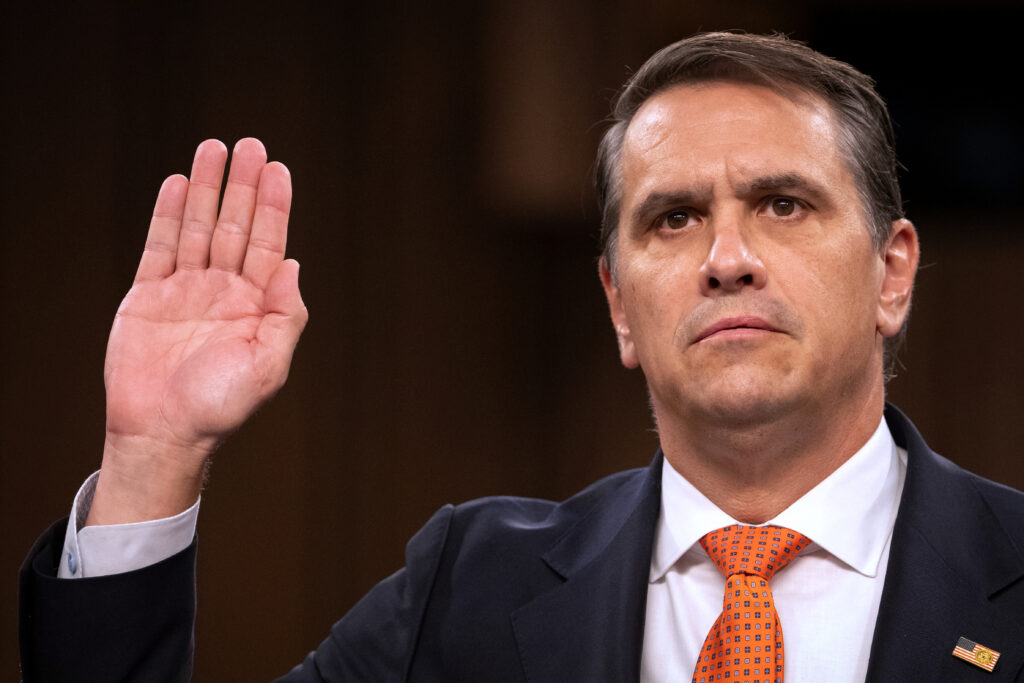
U.S. Attorney General Todd Blanche claimed Saturday that the Justice Department’s lawsuit against Alaska does not seek to stop certification of the state’s U.S. Senate election results.
His own department’s complaint flatly contradicts him.
But Blanche’s attempt to reframe the lawsuit — which President Donald Trump said he personally ordered — appears to be a bid to push back against how it has been widely, and correctly, interpreted: as a dangerous effort to intrude on state authority and lay the groundwork to subvert results.
Get updates straight to your inbox — for free
Join 350,000 readers who rely on our daily and weekly newsletters for the latest in voting, elections and democracy.
“The Department of Justice does not seek to stop any ballot from being cast or to stop the certification of Alaska’s election,” Blanche wrote on social media. “This litigation seeks to ensure that after Alaskans cast their ballots, they are preserved in a manner so that only Alaska’s governing officials have the information necessary to make a determination as to whether Alaskan voters were confused or mislead.”
The lawsuit was spurred by the inclusion of a candidate on the ballot with the name Daniel J. Sullivan Jr. That’s similar to the name of theincumbent, Sen. Daniel Sullivan (R), who is running for reelection.
DOJ claims in its lawsuit that voters will be confused by the similar names.
“Should Alaska certify any electoral results tainted by the inclusion on the ballot of Daniel J. Sullivan,” the complaint alleges, “the State and its officers will fail in its (sic) obligation to protect the integrity of its election.”
It continues:
‘[I]t is vital that Defendants not certify any election result that may be impacted by voter confusion. An election result may be impacted by voter confusion if: (1) Senator Sullivan does not win the election; and (2) had all votes cast for Daniel J. Sullivan been cast instead for Senator Sullivan and Alaska’s rank-choice process played out accordingly, Senator Sullivan would have won the election.”
DOJ then asks the court to “[d]eclare that certification of any result that may be impacted by voter confusion, as defined above, would violate Defendants’ duties under the NVRA to ‘protect the integrity of the electoral process.’”
It also asks the court to block the state “from certifying any result that may be impacted by voter confusion, as defined above, pending an investigation to determine whether votes cast for Daniel J. Sullivan were meant to be cast for Senator Sullivan and any further procedures or relief this Court deems necessary and appropriate to determine what the result would have been absent Daniel J. Sullivan’s inclusion on the ballot.”
(DOJ appears to leave out a key verb at the start of the sentence above, but in context the meaning is clear.)
Those are the only steps DOJ asks the court to take, other than to “award any other relief it deems just and proper.” Despite what Blanche claims, the lawsuit says nothing about requiring election officials to preserve ballots, which in any case would do little to reveal whether voters were confused.
In other words, DOJ asks the court to stop the certification of Alaska’s Senate election until an investigation into the role played by voter confusion can be conducted. The “investigation” would entail giving all of the votes for Daniel J. Sullivan to the incumbent.
And as former Obama administration official and TIME magazine editor Richard Stengel points out, the lawsuit says nothing about the voters who might mistakenly think they are voting for the challenger Sullivan but instead vote for Sen. Sullivan.
It’s inarguable that the lawsuit does aim to stop certification, even if temporarily, in order to try to change the result.
More importantly, Blanche’s effort to instead present the lawsuit as a modest attempt to guard against the effect of voter confusion suggests the DOJ may have overplayed its hand. And that it now sees a need to fight off the idea that the lawsuit aims to challenge results and potentially subvert a GOP loss.