Beyond Callais: We need new tools to uphold voting rights
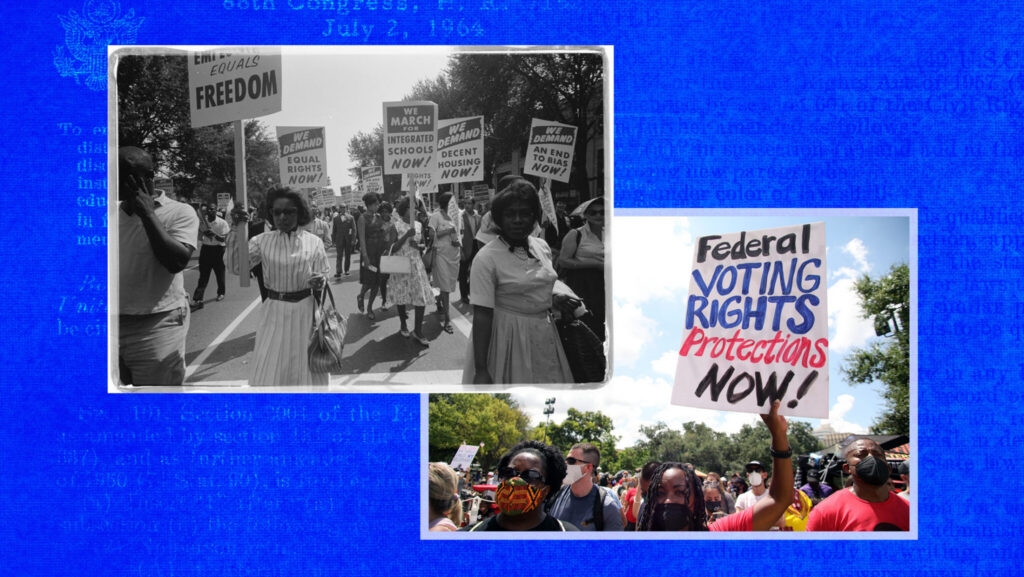
Louisiana v. Callais, a major case about the power of the Voting Rights Act (VRA) to stop racial discrimination in voting and redistricting laws, is once again before the Court, with a decision expected imminently. Over 60 years of precedent and protection for voters of color, especially Black voters, could be upended and voided if SCOTUS fails to uphold the right to vote.
The Court in Callais may decide whether federal courts can order race-specific remedies to address racial discrimination that violates Section 2 of the VRA. This seemingly straightforward question belies both the sinister effort to undermine Black political power and the need for other protections that will be necessary to defend democracy.
Get updates straight to your inbox — for free
Join 350,000 readers who rely on our daily and weekly newsletters for the latest in voting, elections and democracy.
Congress adopted Section 2 to address the exclusion of Black people from the electoral process. More broadly, it prohibits standards, practices or procedures that result in the denial or abridgement of the right to vote based upon race, color or language. Along with other important components of the Voting Rights Act, it was a signature achievement of the Civil Rights Movement and the necessary predicate for much of the progress in civil rights that followed.
The Trump Administration is rabidly seeking to reverse that progress. The president has expressed regret for the nation’s advances in civil rights, claiming that white people have been “very badly treated.” If recent decisions are any guide, it seems a majority of the Supreme Court agrees— especially when it comes to voting rights.
Already, the Court has nullified or weakened core provisions of the Voting Rights Act. In Shelby County v. Holder, it struck down the formula that powered the important preclearance provision in Section 5 of the Act, which required jurisdictions with the most troubling history of voting discrimination to get approval from the Justice Department or a federal court before changing voting practices. The decision was based upon the misguided notion that racism has abated and a hostility to civil rights progress, focusing more on perceived fairness to the rights of states instead of protecting the rights of the people.
Over 60 years of precedent and protection for voters of color, especially Black voters, could be upended and voided if SCOTUS fails to uphold the right to vote.
The disastrous consequences that followed Shelby County are well-documented. It opened the floodgates to renewed voter suppression and discrimination, undermining efforts to achieve equal access to the ballot.
In Brnovich v. DNC, the Court went a step further, erecting new obstacles to proving vote denial claims under Section 2. Instead of claiming that circumstances have changed, the Court expressed a willingness to accept restrictions on time, place, and manner of elections, even when they disproportionately impact voters of color.
In the years since, we’ve seen a resurgence of rampant gerrymandering in the South, the region of the nation that still has the highest concentration of Black residents. We’ve seen maps that slice and dice largely Black and Brown communities in ways that can be explained only as efforts to give more political power to white people and less to people of color. And we’ve also seen redistricting efforts that brazenly threaten to oust duly-elected Black leaders and also target districts in which Black and Brown voters band together to elect their candidates of choice.
It is against this backdrop that the Court will determine the future of Section 2 in Callais. Without Section 5 or an effective remedy under Section 2, these tactics will likely continue unabated, and the political gains by voters of color in places like Louisiana, Mississippi and Alabama, and in cities and counties across the country, could be rolled back. Black voters in particular will be left with rights on paper, but no effective remedies in fact.
Protecting the right to vote has been integral to the mission of the Lawyers’ Committee for Civil Rights Under Law since our founding in 1963. One of our late board members played a key role in drafting the Voting Rights Act, and we have litigated more cases under that legislation in the past decade than even the Department of Justice.
We can use our voices and platforms to demand more federal voting rights protections
Yet, as important as Section 2 is, it represents a floor — the minimum protection necessary to sustain our democratic experiment. That is far from enough. We need more power to root out underhanded and suppressive tactics and prevent them from gaining a foothold. The right to vote is among the most sacred rights we possess. It is the source of all other rights. This fundamental fount of our liberty cannot rise or fall on one provision or one statute. The ability of Black and Brown communities to be heard, to have a fair say in determining their own fate and fortune, should not depend on the legal views or the whims of a handful of judges. As the discriminatory barriers to the ballot box become more sophisticated and calculated, the need for bolder, stronger federal voting rights protections is long overdue.
So, even as we prepare for the potential impact of any Supreme Court decision, we are thinking proactively about new tools we will need to continue upholding voting rights in the country.
Regardless of whether the Voting Rights Act remains at its current strength, the Constitution still protects the right to vote through the Fifteenth Amendment. We have the determination and the means to challenge racial discrimination. In addition to deploying the protections of multiple sections of the Voting Rights Act, we will bring civil rights cases to vindicate constitutional guarantees. We will also invoke state constitutions and laws that protect the right to vote.
We are not powerless in the face of the current assault. We can use our voices and platforms to demand more federal voting rights protections. A decision weakening Section 2 would set us back, but would also spur us to be more creative and strategic. That includes calling on Congress to pass the John R. Lewis Voting Rights Advancement Act to restore the full power of the Voting Rights Act and combat anti-voting laws that target Black people and other communities of color. It includes fighting for new voting policies that reflect today’s realities: same-day registration, no-excuse absentee voting and fair and flexible ID rules. We also need early voting sufficient to alleviate Election Day logjams, and enough polling places so that long lines, distant polling places and discrimination do not deter any voters from making their voices heard. But these strategies must also include exploration of alternative electoral structures, like various forms of proportional representation and ranked-choice voting, so that all votes and all voices will matter.
This moment isn’t just about one map or one case — it’s about protecting Black communities and our right to fair representation and political power. Our forebears in the Civil Rights Movement fought and died to secure these rights, bringing fortitude and creativity to meet that moment in history. We are committed to honoring their sacrifice by exhibiting those same qualities in our time.
Damon Hewitt is the President and Executive Director of the Lawyers’ Committee for Civil Rights Under Law