Ballot measures are core to democracy. That’s why they’re under attack
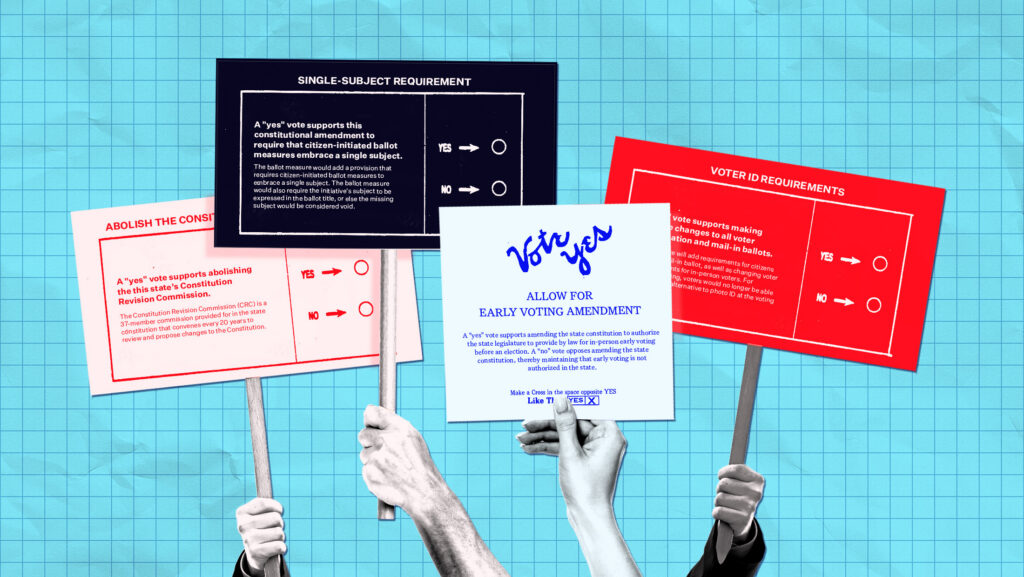
High-profile attacks on voting in the United States have filled headlines over the last year, from photo ID requirements to proof of citizenship mandates to the elimination of popular reforms like vote-by-mail. These issues demand our attention, but so does another critical frontline in American democracy: ballot initiatives.
To understand why, you have to first understand the power of the ballot initiative — the People’s Tool. At a time when voters feel disenfranchised and disconnected from democracy, ballot initiatives allow us to directly engage and make a tangible impact in our day-to-day lives. The history of direct democracy goes back over a century and has been used to win women’s suffrage, expand Medicaid access, legalize the freedom to marry, create the right to unionize, and so much more.
Get updates straight to your inbox — for free
Join 350,000 readers who rely on our daily and weekly newsletters for the latest in voting, elections and democracy.
Critically, ballot initiatives have increasingly been used by Black, Latiné, Native, Asian-American & Pacific Islander communities and young people to bring bold structural change to improve people’s lives where elected officials have failed. So it’s no surprise that direct democracy is under systematic, institutionalized attack by those who resent the power of the people and the promise of collaborative governance. The heart of the matter is this: extremists and authoritarians are afraid of voters’ power and they’re doing whatever they can to crush it.
Last year, legislatures across the country pushed for anti-initiative policies that have made it increasingly challenging — if not impossible — to lead a successful ballot measure campaign. For example, Arkansas legislators passed a series of anti-petition laws that would have strangled the process had a federal court judge not ruled against six of them. The judge called the laws ‘draconian’ and repeatedly stressed concerns about their First Amendment violations and the chilling effect they would have on voters. And in Florida, House Bill 1205 introduced requirements so extreme that zero citizen-led initiatives were able to qualify for the 2026 ballot.
And this November, proposals for supermajority passage thresholds (like the 60% requirement that prevented Florida’s popular reproductive rights amendment from succeeding in 2024) will appear on ballots in Missouri, North Dakota, South Dakota, and Utah. Of these, Missouri’s is the most extreme: requiring that a citizen-led amendment pass in each of the state’s eight congressional districts — while allowing legislatively-referred measures to pass with a simple statewide majority. In other words, as few as 5% of voters could defeat an amendment supported by 95% of Missourians.
While there are, of course, several recent examples of bald-faced authoritarianism — like threats to federalize elections or ICE’s state-sanctioned violence — what we’ve witnessed over the past year is in line with what political scientists call ‘competitive authoritarianism’. Under competitive authoritarianism, democratic structures remain while their purpose is hollowed out and the power of their intent is stripped away. Elections still happen. Ballot initiatives still exist. But the rules are manipulated so outcomes can be managed.
Using this lens, it’s easy to see how attacks on ballot initiatives and elections mirror one another. Onerous qualification requirements like proof of citizenship mandates or geographic distribution requirements for initiative petitions make it more difficult to reach the ballot box. Bad-faith claims of supposed election integrity concerns or the need for “systemic reforms” are used to justify photo ID requirements and foreign funding bans. Fights extend long past Election Day, with ballot measure implementation challenges and election fraud conspiracies dragging on for years. And of course, those in power abusing their offices to quell dissent, like a presidential administration ordering an FBI raid on Georgia’s Fulton County election offices or a state attorney general threatening to sic ICE on a citizen-led referendum effort.
If 2025 was the year these trends became unmistakable, 2026 must be the year we disrupt them. Defending direct democracy has to be a collective imperative for our movement. Democracy advocates must recognize that anti-direct democracy attacks are explicit threats to voting rights and access. We must treat the defense of the ballot measure process as core democratic infrastructure. It’s not a matter of choosing whether to focus on defending voting rights or defending the ballot initiative process. It’s about understanding that chipping away at the People’s Tool is stripping away our voting power.
In a time when many are concerned about rising authoritarianism and loss of rights, BISC knows that ballot initiatives give people agency and provide us with an opportunity to experiment and re-imagine what our democracy can and should be. It is precisely this success — and the threat it poses to entrenched power — that has made the ballot measure process a primary target. Defending direct democracy is ultimately about more than preserving a procedural mechanism. It is about safeguarding the ability of communities to govern themselves and ensuring that democracy remains responsive, participatory and accountable. To defend direct democracy is to defend democracy itself.
Chris Melody Fields Figueredo is the executive director of the Ballot Initiative Strategy Center (BISC), an organization which implements a national progressive strategy to analyze and support the ballot measure landscape. In 2021 and 2022, BISC monitored more than 215 proposed restrictions against the ballot measure process and continues to track these efforts.