Will Mississippi’s Jim Crow-era voting ban save GOP Senate seat?
 Prefer us on Google
to see more of our voting rights news coverage when you search.
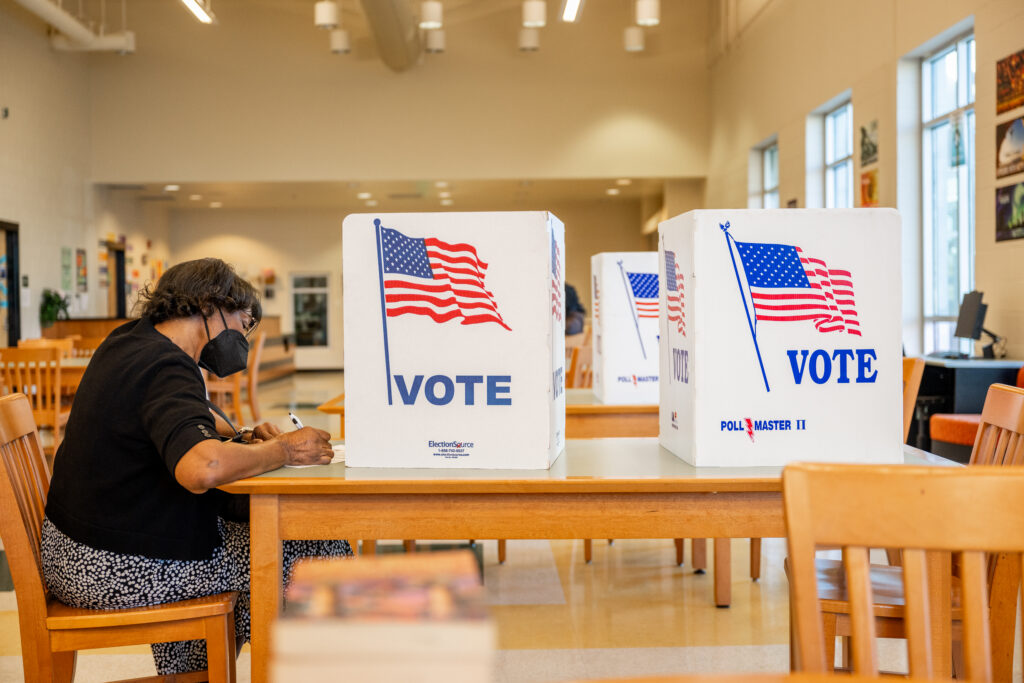
The closest U.S. Senate race of the midterm election is in Mississippi, where Scott Colom is challenging Republican incumbent Cindy Hyde-Smith to become the state’s first Democratic senator in nearly 40 years. He would also be the state’s first Black senator since Reconstruction.
As of Wednesday morning, Colom had a 0.01% lead of fewer than 100 votes, according to the New York Times. Forecasts previously predicted a comfortable victory for Hyde-Smith.
But the Republican could still eke out a victory, likely thanks to a Jim Crow-era law that overwhelmingly harms Black Mississippians, who typically vote for Democrats: The state permanently bans people convicted of certain felonies from voting.
That’s 68,731 people — or roughly 3% of the eligible voting population — who are incarcerated, on parole, on probation or who have completed their sentence, according to the most recent estimates from The Sentencing Project. Most of those people – 47,932 – remain disenfranchised post-sentence.
And it includes 43,744 Black Mississippians — over 5% of the state’s Black population, the anti-incarceration organization found.
Get updates straight to your inbox — for free
Join 350,000 readers who rely on our daily and weekly newsletters for the latest in voting, elections and democracy.
Under Mississippi law, a person loses their right to vote upon conviction for one of 23 felonies. Those crimes include murder, rape, arson and theft, but also nonviolent and less violent offenses like obtaining money or goods under false pretense, perjury and forgery.
To have their voting rights restored, individuals who complete their sentence must receive a pardon from the governor or a bill of suffrage from the state legislature — both of which are rare.
In 2018, Black Mississippi residents sued the state, contending the lifetime voting ban violated the 14th Amendment’s guarantee of equal protection and the Eighth Amendment’s prohibition on cruel and unusual punishment.
In 2023, a three-judge panel of the 5th Circuit Court of Appeals agreed the voting ban violated the Eighth Amendment, ruling that it was unconstitutional.
But the next year, the full appellate court overturned that decision in a 13-6 vote. The plaintiffs appealed to the U.S. Supreme Court, but it declined to hear the case.
That means that, to this day, Mississippi continues to disenfranchise tens of thousands of voters.