‘ERIC under the Feds’: Concern over plan for voter-data sharing network run by Washington
Chicago — A group of election officials is asking a key federal voting panel to create an expansive voter registration data-sharing network between states.
The idea, dubbed by one proponent “ERIC under the Feds,” sparked concern among some local election officials at a conference of the U.S. Election Assistance Commission (EAC) here Tuesday.
Get updates straight to your inbox — for free
Join 350,000 readers who rely on our daily and weekly newsletters for the latest in voting, elections and democracy.
ERIC is the nonpartisan Electronic Registration Information Center, the most prominent of several voter registration data exchange initiatives that already exist. But the proposed new network could be the first to be administered and partially funded by a federal agency.
A panel of election officials from Florida, Texas and North Carolina who presented a proposed “framework” for the network said that the effort was meant to increase the accuracy of state voter registration by allowing states to cross-reference their rolls with other states.
The proposal comes as President Donald Trump has taken unprecedented steps to create a national voter registration database — a vast trove of election data the federal government has never had and that it likely lacks the authority to collate and maintain.
Voting and legal experts have repeatedly warned that a centralized nationwide voter roll controlled by the executive branch poses severe privacy and security risks and could be used to threaten civil liberties, undermine state control over elections and potentially disenfranchise eligible voters.
The proposed resolution for the EAC to pursue an interstate voter registration data sharing network is currently before the commission’s Local Leadership Council (LLC), a 100-member advisory body composed of local election officials from across the nation. The LLC is holding its annual meeting in Chicago this week.
On Wednesday, LLC members voted to table the proposed resolution until its annual meeting next year. Despite the decision to postpone an official vote, the resolution is technically still active.
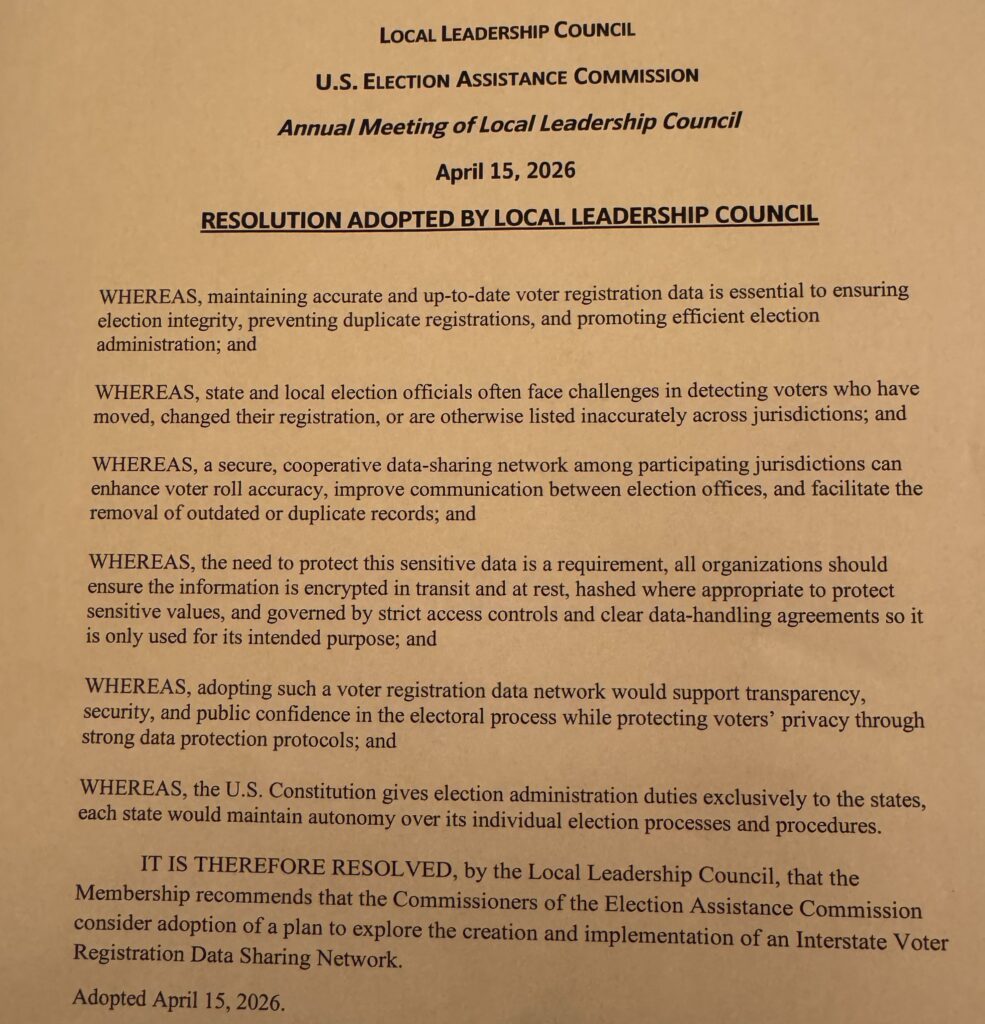
The idea’s proponents say that public trust in the democratic process would be served by more accurate rolls and that data collected by the network would be protected and obtained in compliance with federal and state law.
But during a question and answer session, several other LLC members said they were wary of the federal government’s involvement in the network. Their wariness stemmed from the fact that the U.S. Constitution gives states — not the executive branch — the primary authority over election administration, including maintaining voter rolls.
A political and legal “alligator pit” is how Jamie Shew, the clerk for Douglas County, Kansas, described it.
“I want everyone to be aware that this is a much larger discussion than just this resolution,” Shew said. “There’s complexities to this, and it will open a big can.”
Mark Earley, supervisor of elections for Leon County, Florida, and one of the panelists Tuesday, said situating the network under the EAC’s umbrella would ensure “the participation of all states” and that “participation is seen in a positive light.”
“That’s one of the reasons we’re talking about bringing this under a federal umbrella, so we don’t get the notions that, you know, one side or the other are the ones managing the data,” Earley said.
Earley stressed that the network wouldn’t amount to a national voter registration database but is intended to be a state-to-state information sharing tool.
But under the proposed framework, the network would operate under the EAC and would be formally controlled by a board of governors derived from members of the LLC or the Standards Board, an 110-member group of state and local election officials that assists EAC in creating voluntary elections-related guidance and best practices for states.
One slide of the panel’s presentation proposed that the network could need between $5 to $10 million annually to operate, some of which could come from EAC-funding.
Greene County, Missouri Clerk Shane Schoeller objected to federal dollars being used in the network, saying instead it should be an interstate compact between states.
“Just like we do port authorities. Just like we do adoptions. It doesn’t have to be adopted by all states, but all states willing to participate are able to do that,” Schoeller said.
Wesley Wilcox, the supervisor of elections for Marion County, Florida, and one of the panelists Tuesday, said they would be “naive” to think the data collected by the network wouldn’t be targeted by hackers or other entities seeking the data for efforts unrelated to elections. But he said they were prepared to ensure the data would be secure and couldn’t be used for law enforcement purposes.
Even if passed, it’s unclear whether the EAC would act on the LLC’s resolution. Legally, the LLC only has the power to advise the EAC, and the creation of such a network would be no easy task.
The EAC would first have to receive congressional authority to establish the network’s governing board. The commission is also currently facing budget cuts, so it would likely need an infusion of funding from Congress to support the network.
However, because the LLC only has advisory powers, the EAC could also move forward with a data sharing network without considering the proposed framework.
Camden Kelliher, the EAC’s general counsel, asked LLC members to think of the panel’s proposed framework and the resolution as “two totally separate things.” He said if the resolution passes, the EAC could come back in around a year with its own interpretation of how the network is governed and functions.
“In the most polite way possible, that also includes maybe hearing some of your presentation and going, ‘Well, we don’t like that as the EAC,’” Kelliher said.
It’s unclear how many states would participate in the network. Due to the Department of Justice (DOJ) aggressive legal efforts to force states to turn over their voter records, trust between state election officials and the federal government have been severely damaged. They are likely to be suspicious of any federal initiatives to collate voter data.
Confidence in the EAC as a fair, impartial and bipartisan commission has also been shaken by recent public comments by some of its commissioners. Christy McCormick, a Republican-appointed commissioner, falsely claimed last year that Democrats promote and rely on votes from “illegal citizens” in order to win elections. Democrats and state election officials called on her to resign over those comments.
25 states and the District of Columbia also already participate in ERIC, the non-profit voter roll. Created in 2012, ERIC was meant to help states maintain accurate voter rolls voluntarily. Whether due to election-related conspiracy theories or disagreements with the center’s emphasis on increasing access to voter registration, several Republican states withdrew from ERIC after the 2020 election.
Michelle Blue, the director of Dakota County, Minnesota, noted that the proposed network seemed “duplicative” to ERIC and said she didn’t understand why they shouldn’t instead invest in a system that is already functioning.
“You’re not the only one thinking that,” Earley responded, though he added that the network would be “ERIC under the feds.”
Julie Freese, the clerk for Fremont County, Wyoming, questioned how election officials in states that have laws barring government officials from disclosing sensitive personal information — particularly within voter registration lists — could participate in the network.
Wilcox said federal involvement in the network could have a “peer pressure” effect on those states, potentially prompting state legislators to amend state law.
“Voters could come in and say, ‘Well, these 49 other states are participating in this, why aren’t we?’” Wilcox said.
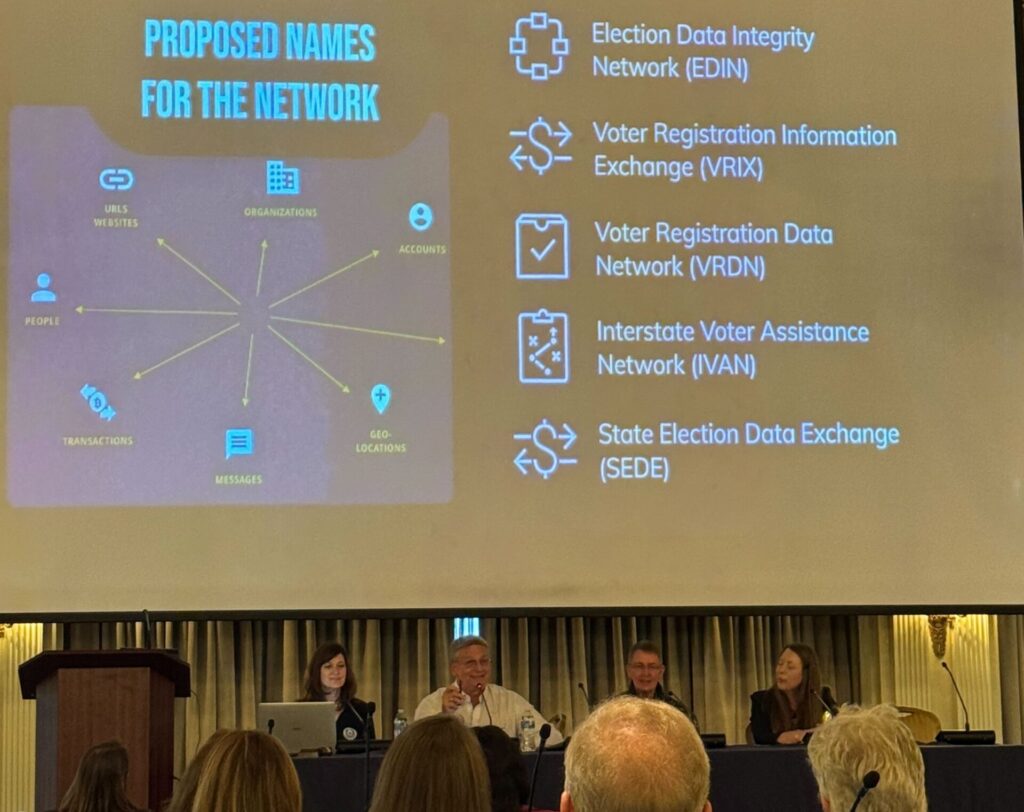
The proposed network is in its very early stages. In fact, it doesn’t yet have a name or a ubiquitous obscure acronym common to so many federal programs, policies and tools.
So, the panelists suggested some.
One included the “State Election Data Exchange,” or “SEDE” for short, which Earley admitted “could maybe be confused with ceding control of our data.”
This story has been updated.