Trump appointee Ed Martin claims executive privilege in bid to evade misconduct charges
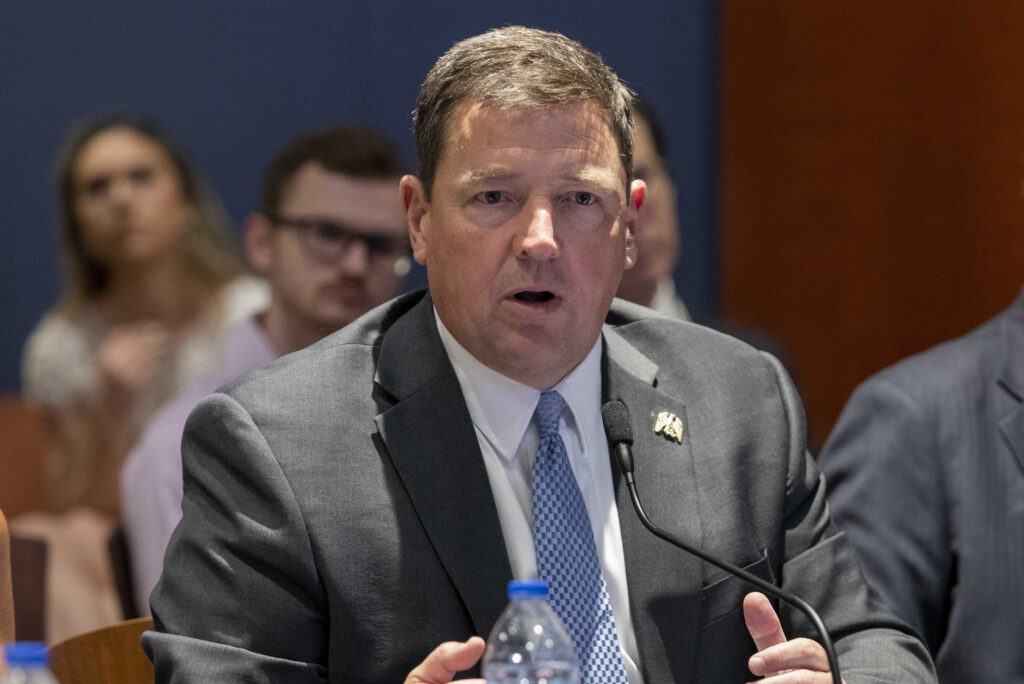
Ed Martin, the hardline MAGA Republican serving as President Donald Trump’s pardon attorney, is attempting to claim executive privilege in a bid to evade misconduct charges from attorney ethics regulators in Washington, D.C.
In a wild new legal filing this week, Martin lashed out against the D.C. Disciplinary Counsel, which polices attorney misconduct in the nation’s capital, alleging that its ongoing ethics case against him violates Trump’s authority.
Get updates straight to your inbox — for free
Join 350,000 readers who rely on our daily and weekly newsletters for the latest in voting, elections and democracy.
Martin’s astounding arguments appear to claim that the president and federal attorneys are indistinguishable and that any attempt to hold Department of Justice (DOJ) officials accountable for misconduct amounts to an unconstitutional attack on the president’s authority.
The D.C. Disciplinary Counsel formally accused Martin of violating ethics rules last month over threatening letters he sent to Georgetown University’s law school while he was serving as the acting U.S. attorney in the district in early 2025.
Martin, who has been licensed to practice law in D.C. since 2003, could ultimately be sanctioned or disbarred in the ethics case.
Among his bizarre, scattershot claims, Martin asserted in the filing that Hamilton Fox, a prominent lawyer who heads D.C.’s Office of Disciplinary Counsel, could not investigate him because Martin — as acting U.S. attorney — had already opened a probe into Fox.
As evidence of his probe into the Disciplinary Counsel, Martin included a letter he allegedly sent to Fox in February 2025 demanding information about how the D.C. Bar handles investigations and actions against attorneys practicing in the district.
Martin’s inquiry appeared to be targeting previous ethics actions against Jeffrey Clark, a former DOJ attorney who assisted Trump’s efforts to subvert the 2020 presidential election.
However, there was one glaring issue with Martin’s letter: The D.C. Bar and Fox’s office are two distinct, separate entities. While the bar maintains the minimum ethical standards lawyers in the district must follow, it has no authority to investigate, prosecute or discipline its members.
“You appear to be under the impression that the Office of Disciplinary Counsel is a part of the D.C. Bar. We are not; we are an arm of the District of Columbia Court of Appeals,” Fox said in reply after he eventually received Martin’s letter.
Martin’s defense attorney appears to have made a similar error in his new filing by referring to Fox’s title as the “D.C. Board on Professional Responsibility Bar Disciplinary Counsel.” Like the bar, the Board on Professional Responsibility is a separate entity from the Disciplinary Counsel.
Because of his previous probe against Fox, Martin said the counsel was prejudiced against him and that the ethics case should now be moved from D.C.’s local courts to federal court. A federal venue would also allow him to raise a host of constitutional defenses, Martin said.
Among them, Martin said he would argue in federal court that the Disciplinary Counsel’s probe violates Article II of the Constitution because the president and federal attorneys are, in essence, synonymous.
“The President’s exercise of his authorities under the Take Care Clause through his U.S. Attorneys cannot be interfered with or hobbled by harassing and pretextual enforcement actions,” Martin argued.
“The President of the United States is the client of all attorneys appointed pursuant to the President’s Article II authority, and every executive branch attorney is bound by the President’s decisions concerning the objectives of the representation defined by their respective appointments,” he continued.
In his formal response to the Disciplinary Counsel’s charges, Martin raised 40 separate defenses, ranging from jurisdictional arguments to legal protections like attorney-client privilege and claims that the ethics case amounted to selective prosecution.
Amidst his defenses, he asserted that the misconduct charges violated D.C.’s Human Rights Act by discriminating against him for his “political affiliation and beliefs.”
Trump withdrew Martin’s nomination to serve as D.C.’s permanent U.S. attorney last May after key Republican senators said they wouldn’t confirm him due his past defense of Jan. 6 rioters and his erratic behavior while serving in an acting capacity.
Martin’s arguments, though bombastic, weren’t entirely surprising. They follow the logic of the Trump DOJ’s new confrontational approach to state bar associations.
Last month, the department proposed new rule changes that would effectively short-circuit misconduct proceedings, such as the D.C. Disciplinary Counsel’s case against Martin.
The DOJ’s proposals would bar former and current department attorneys from cooperating with state bar ethics investigations if the DOJ decides to conduct its own review first. In theory, this would allow the DOJ to indefinitely stave off any state bar investigation against one of its lawyers by opening — and indefinitely stalling — its own investigation.
Thousands of state and local bar associations, state attorneys general, former DOJ prosecutors and members of the public denounced the proposed changes, which were posted in the Federal Register last month.
The National Organization of Bar Counsel (NOBC), a professional nonprofit for lawyers specializing in attorney regulation, said the changes were “unprecedented, unnecessary, inappropriate” and lacked both “congressional and constitutional authority.”
“They do nothing to support the public protection mission of regulating and, when necessary, disciplining licensed attorneys. To the contrary, they will detract from the public trust in attorney regulation,” the NOBC added.