Minnesota secretary of state, other Dems preparing for Trump to interfere in the midterms
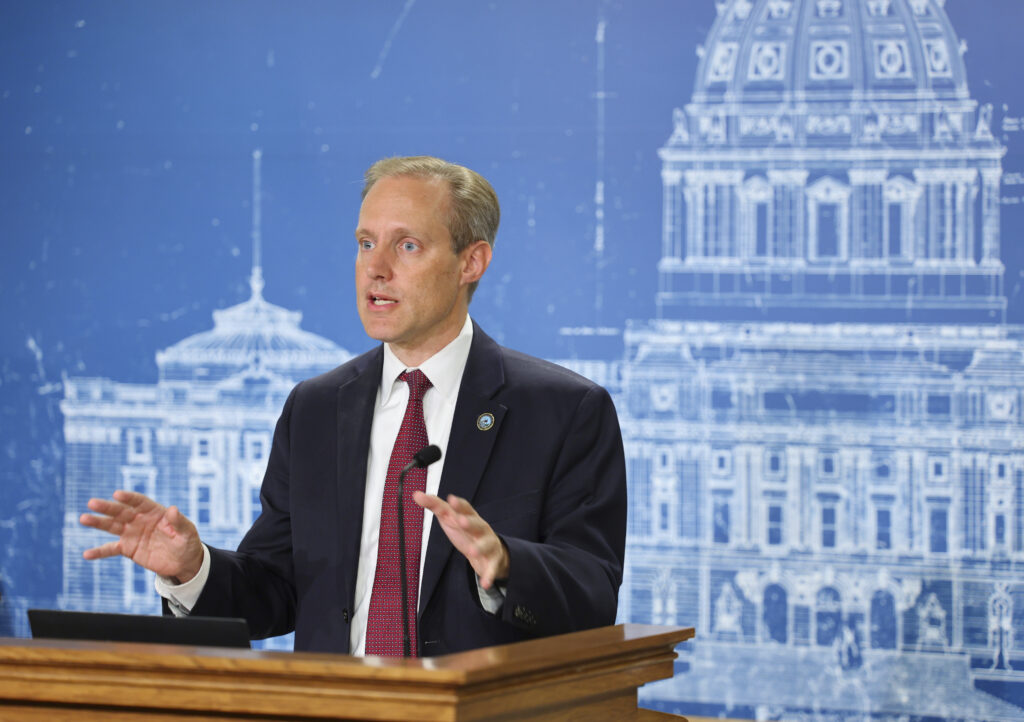
Should the Trump administration try to interfere with the midterm elections, Democratic states will be ready, according to Minnesota Secretary of State Steve Simon (D).
“We’re imagining ways in which the federal government might explicitly or implicitly interfere with the administration of elections, and we’re planning out what our response would be,” Simon told Democracy Docket in a recent interview.
Get updates straight to your inbox — for free
Join 350,000 readers who rely on our daily and weekly newsletters for the latest in voting, elections and democracy.
Simon discussed the planning his office is doing with other Democratic states and national partners for potential meddling by the Trump administration — and how they might respond. He spoke on the same day that federal agents raided a key elections center in Georgia, adding to fears that President Donald Trump will seek to interfere with or suppress voting this fall.
Simon also spoke about the recent killings of Minnesota residents Renée Good and Alex Pretti at the hands of federal agents and Attorney General Pam Bondi’s letter to Gov. Tim Walz (D), which offered to withdraw ICE troops from Minneapolis in exchange for access to the state’s unredacted voter rolls.
This interview has been edited for clarity and length
When you first saw the letter from Pam Bondi to Gov. Tim Walz, what was your reaction? How would you characterize what the Trump administration is trying to do with this tragedy and the state’s voter rolls?
My reaction when I saw the letter was that it was jarring and disturbing, particularly because it was sent on Saturday, hours after a second US citizen was killed by ICE agents or border patrol in as many weeks. We get this letter with three demands in it, and one of which was [voter rolls], which, let’s set aside the dispute for a moment, has nothing to do with the facts on the ground. [Voter rolls] have nothing to do with public safety or immigration policy or force levels or ICE procedures or anything of the kind. It was an unrelated part of what I call a ransom note, which sought to tie a resolution of the ICE surge to this unrelated item — which, as you well know, and the Attorney General well knows, is already the subject of litigation. We’re already in court on this. In fact, we have a March 3 hearing date on our motion to dismiss. And so this isn’t a new issue. It’s not a new request. It’s just another vector of pressure to disclose sensitive personal data on millions of people.
There’s been a swift blowback to ICE’s actions in Minneapolis and Bondi’s letter — the Trump administration seems to be reacting to it. Customs and Border Protection senior official Greg Bovino was demoted and removed from the scene, some federal agents are leaving the city. Have you noticed the temperature has turned down in Minneapolis at all in the past few days?
I would call it an exhale, in the sense that, in the last 48 hours, we know that the President and Governor Walz have spoken. We know that the President and Mayor Frey of Minneapolis have spoken. We know that Governor Walz met with Tom Homan, who is apparently now in charge in Minneapolis. All those are hopeful signs. They signify, at least, that people are talking, which in my book, is better than not talking — whether that will actually result in reduced force levels, changed tactics, redesigned missions, remains to be seen. So I’m not yet at a point where I can say that, in Minneapolis, things have gotten measurably better. But I can say that these developments have at least caused some people to temporarily exhale.
A growing number of Republicans have rebuked not just ICE’s terror campaign, but the Trump’s administration’s various attempts to extort Minnesota for their voter roll data. Are you hoping to see more elected officials from across the aisle speak out against these efforts?
What I hope that elected officials across the spectrum can agree on is that the place to have the argument about an issue like this — namely, the voter rolls — is in court. This belongs in court. This is why we have courts. The Department of Justice maintains that it is allowed under the law to ask for and receive this sensitive personal information. We believe that the law — not our policy preferences, but the law — dictate the opposite result: that under state and federal law, [the Trump administration] are not entitled to this information. And the place where we have those kinds of fights is in court, and that’s what’s been happening. We have a hearing coming up, and I hope — at the very least — we can expect people across the political spectrum to agree that on this particular issue, the place to have the battle is in a courtroom. Not by making it part of an extraneous list of demands in an unrelated immigration-based fight.
You said on MS NOW that you’ve been having conversations with other Democratic secretaries of state to prepare for any possible interference in the midterms by the Trump administration. What’s being discussed? Who’s involved?
I don’t want to name names. It’s up to them to say that they’re involved in these efforts, but I will say that we are actively involved with national partners — who I also shouldn’t name at this point —to think about, game out, and plan interference with the election, either direct or indirect.
I want to be careful not to give a road map to anyone, so I’d rather not get into particulars, except broadly speaking. We’re imagining ways in which the federal government might explicitly or implicitly interfere with the administration of elections, and we’re planning out what our response would be. Part of that’s a litigation response, part of that is a communications response, part of that is a purely administrative response. But we’re planning out what we would do if certain things happen.
And I want to make it clear, as I did on that show: It’s not a prediction. I’m not prepared yet to say I’m predicting it will happen. But as with any category of hazard, whether it’s a bomb threat, or power outage, or a weather event, we have to plan for that stuff. It would be irresponsible for us not to.
On that note: What conversations have you had with the Trump administration about the upcoming midterm elections? I know the Department of Homeland Security (DHS) — and the Cybersecurity and Infrastructure Security Agency (CISA) — historically, works with state election leaders to prepare for upcoming elections.
CISA and DHS have been mostly absent so far. In a way that they haven’t been in the past. Even in the first Trump administration they were, I would say, not just a good but an excellent partner. I want to give credit where it’s due. In the first Trump administration, we had vigorous. consistent, ongoing talks and communications with CISA about all kinds of election security, whether it’s cyber security, or other kinds of security. And we just don’t have those in the second Trump administration. They have retreated from this part of their mission. And so when you ask about conversations with the federal government, normally they would be in that context. Normally they would be with CISA. That’s our go to. Instead, we don’t have that. And that’s concerning.