How quickly Trump admin moved taxpayer money for midterm propaganda ads alarms judge
 Prefer us on Google
to see more of our voting rights news coverage when you search.
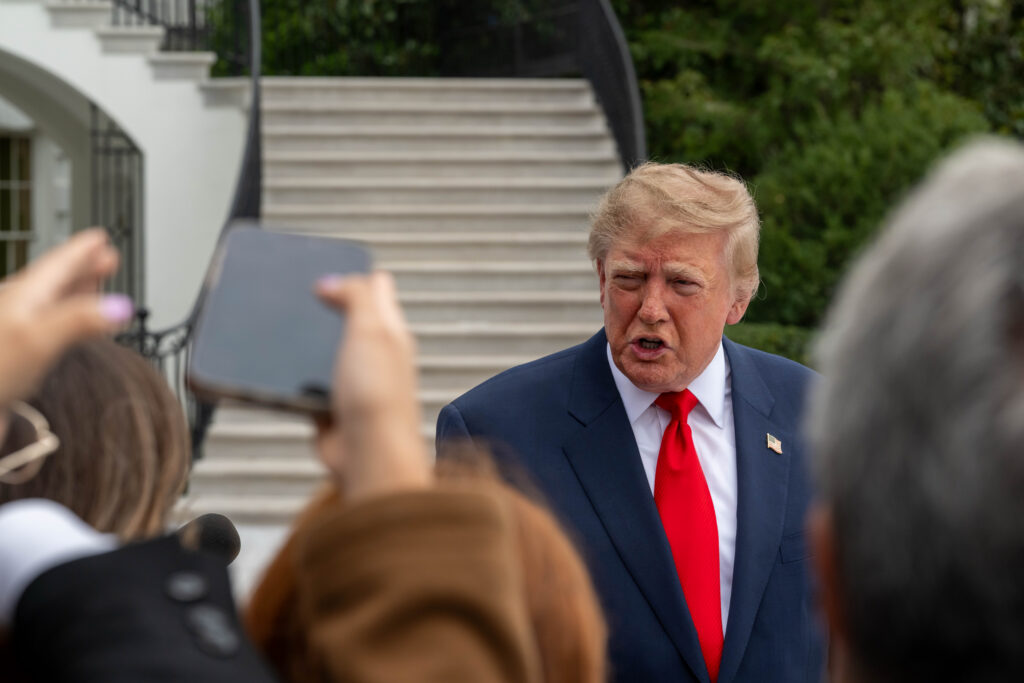
A federal judge expressed alarm at how quickly the Trump administration moved to use taxpayer funds for midterm election advertisements following an Oval Office meeting between President Donald Trump and Republican operatives.
U.S. District Judge Jennifer Rochon issued a temporary restraining order Sunday to immediately stop the propaganda ads, a win for pro-democracy groups who argue they are an illegal misuse of funds appropriated by Congress.
The White House Office of Management and Budget (OMB) was able to shift $20 million for the ads in a matter of hours, Rochon said in a 40-page opinion Monday explaining her decision. The restraining order is necessary to ensure the government doesn’t just “reapportion funds from another source to continue running similar advertisements,” she wrote.
The New York Times reported earlier this month that Trump and his White House chief of staff, Susie Wiles, met with Republican strategists on August 7 to talk about the midterms and how to use money from a super PAC to support Republican candidates.
“During that meeting, President Trump reportedly expressed a desire to promote his administration and showed the strategists videos of himself, including footage later incorporated into one of the challenged advertisements,” Rochon wrote in her opinion.
Trump then tapped OMB Director Russell Vought to “find government funds to pay for the advertisements,” she added.
“Defendants do not deny that this meeting took place or dispute the reported substance of the various discussions, even though the Court expressly asked Defendants during the [temporary restraining order] conference on October 9, 2026 to address whether they disputed the reports of this meeting,” Rochon wrote.
Get updates straight to your inbox — for free
Join 350,000 readers who rely on our daily and weekly newsletters for the latest in voting, elections and democracy.
Little over a month after the Oval Office meeting, the funds were made available through a U.S. Customs and Border Protection (CBP) account for “commemorative events.” The process took just a few hours, the judge said.
“OMB initially apportioned $500,000 towards the commemorative category in November 2025,” Rochon wrote in her opinion. “On September 19, 2026, at 6:15 p.m., CBP submitted a request to OMB to reapportion funds that were appropriated by section 90004 of the Working Families Tax Cut Act within CBP’s ‘Operations and Support’ account. The CBP request sought to make an additional $20 million available for obligations under line 6043 for ‘commemorative events’ by reallocating funds from the following fiscal year. The request was approved by OMB that evening, less [than] two hours later, at 7:50 p.m.”
The next day, on Sept. 20, CBP made a $20 million purchase to LMD Agency for a “National Media Campaign.”
“The present apportionment was done quickly … and President Trump has publicly conveyed his belief that using appropriated taxpayer money is not only legal but a ‘standard thing to do,’” Rochon wrote.
In addition to not receiving “reasonable assurances” that the White House won’t find funds from another source to keep running the same or similar ads, Rochon said it’s unclear where the initial media buy stands.
A Department of Homeland Security (DHS) official told the court that the department hadn’t directed LMD to make “any additional” ad purchases past October 11.
“But this representation is somewhat unclear and leaves open whether LMD has already purchased ad placements scheduled to air after October 11, thereby continuing the alleged harm” to pro-democracy groups, Rochon said.
“Even if LMD has not purchased any further media buys for placement after October 11, Defendants have not shown that the ‘allegedly wrongful behavior could not reasonably be expected to recur,’” Rochon wrote.
The judge ordered the Trump administration to report back on its compliance with her order within 24 hours. Under the temporary restraining order, DHS can’t create, disseminate or air the challenged advertisements or enter into new contracts to do so.