GOPers, anti-voting activists spread misinformation about Michigan’s voter rolls
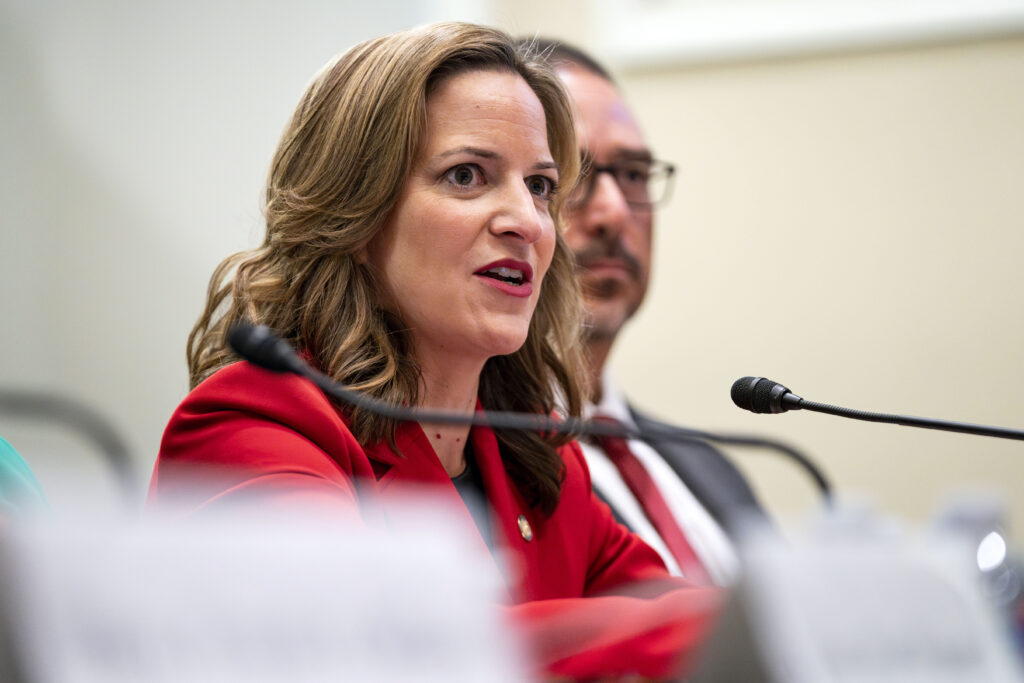
In recent weeks, anti-voting activists and a Republican county election official have made bold claims about Michigan’s voter rolls, alleging that an untold number of noncitizens were illegally registered to vote in the state.
But experts say the unverified claims rely on cherry-picked data to paint a misleading picture in an effort to attack Secretary of State Jocelyn Benson, the leading Democratic candidate for governor.
Anthony Forlini, the Macomb County Clerk and a Republican candidate for secretary of state, said this week that his office pulled the names of 239 alleged noncitizens who were picked for possible jury duty service in the past few months. Forlini added that he cross-checked that list with the county’s voter rolls, finding that at least 14 of the names were registered to vote at some point.
“The fact we have discovered this egregious flaw, indicates to me that there may be a much larger issue throughout the State that needs investigation,” he wrote.
Benson said in an interview with Democracy Docket that her office is looking into Forlini’s allegations but added that there’s a good chance he may be misreading and misrepresenting data.
Get updates straight to your inbox — for free
Join 350,000 readers who rely on our daily and weekly newsletters for the latest in voting, elections and democracy.
“Our department is looking into the specific allegations, because we take any allegations of ineligible residents voting very seriously,” Benson said. “It’s not clear that the data that the county clerk is referring to has been clearly and rigorously analyzed to ensure the allegations that he’s making have any merit to it.”
But that didn’t stop Forlini from blasting his findings out in a press release and on social media. Despite only uncovering data in Macomb County, Forlini said that he uncovered “potential massive voter records issues” that could extend throughout the state.
Forlini’s statement on Macomb County’s voter rolls quickly reverberated among anti-voting activists and right-wing influencers. The influential conservative activist Scott Presler shared Forlini’s press release on social media, falsely claiming that Benson, “has allegedly allowed for non-citizens to register to vote in Macomb County, Michigan.”
Presler’s post even caught the attention of Assistant U.S. Attorney General Harmeet Dhillon, who hinted that the U.S. Department of Justice (DOJ) might even investigate Forlini’s alleged findings.
But the problem is that Forlini is cherrypicking data to present misleading information about alleged noncitizens illegally voting in Macomb County, according to David Becker, the executive director of The Center for Election Innovation & Research and a former DOJ Civil Rights Division attorney.
“It is much more likely that these people are committing fraud on the courts with regard to sitting as jurors, than fraud on elections,” Becker told Democracy Docket. “And to release this information without actually trying to see whether or not the jury lists are inaccurate, or the voter lists are inaccurate, is pretty irresponsible — and obviously for political purposes.”
Potential jurors are selected from the state’s field of driver’s license applicants, which is maintained by Benson’s office. Noncitizens are eligible to obtain a driver’s license, but not eligible to vote or serve on juries — and Benson’s office is responsible for ensuring that all registered voters in Michigan are actually eligible to vote.
“We did our own investigation internally to ensure that we knew of the data, and we found that instances of noncitizens voting in Michigan are extremely rare,” Benson said.
Her office released a statewide review in April 2025 comparing the state’s driving and voting records, and found that 0.00028% of the more than 5.7 million votes cast in 2024 were potentially illegally cast by noncitizens.
“Michigan likely has some of the most accurate voter lists in the country,” Becker said. “They check every box on everything states should do from a best practice perspective. They give automatic voter registration. They integrate DMV with their voter lists in a way that very few states do. In fact, they’re one of only two states where both DMV and elections are both under the secretary of state.”
Benson said her office did several rounds of data validation on the state’s voter rolls to ensure that the instances of noncitizen voting were extremely rare.
“It’s not clear that the Macomb County Clerk looked at the data he’s citing with any level of rigor, and that’s what we are working with him to uncover and figure out,” Benson said.
It’s easy for someone who’s not trained at pouring through large datasets to draw the wrong conclusions from them, Becker added. Especially if they have a political agenda.
“He might be mismatching the data, which happens all the time,” Becker added. “It’s really hard — he might be matching old data to new data, in the middle of which someone might have naturalized and become a citizen.”
Becker pointed out that the initial data on noncitizens in the jury pool might not be accurate to begin with for a simple reason: People may have lied to get out of jury duty.
“If it’s news to this Macomb County Clerk that a lot of people like to get out of jury duty and are willing to say anything to get out of jury duty, there’s a Curb Your Enthusiasm episode I can show them,” Becker said. “That’s not to say that it’s okay. But it’s not election fraud. It’s probably fraud in the courts.”
Forlini isn’t the only right-wing figure to spread misinformation on Michigan’s voter rolls in recent weeks. Earlier this month, the Cleta Mitchell-tied anti-voting group Michigan Fair Elections Institute (MFEI) published an investigation alleging more than 60,000 voter registrations that didn’t line up with Social Security Administration data. Like Forlini’s findings, MFEI’s investigation similarly cherry picks federal data with state voting data that might not be accurate — creating an incomplete snapshot of data that creates a misleading narrative of voter fraud.
“One of the biggest challenges of our time is the devolution of how people are getting accurate information,” Benson said. “And whether it’s the loss of investment in local media or just a number of different things, it’s becoming harder and harder and more difficult for citizens to get access to reliable information on anything. And we’re seeing, as a result, a lot of conspiracy theories grow because of that.”
Benson is seeing several of conspiracy theories center around her — with election deniers and anti-voting activists alleging that she’s somehow corrupting the state’s voter rolls to ensure she wins her election.
“All of this is playing out in a hyper-partisan, politically driven environment,” Benson said. “The specifics of voter registration maintenance and accuracy can oftentimes be lost or confused with a number of other databases and specifics that overall make something very difficult to even investigate or allege.