‘It will destroy the Postal Service’: USPS plan to crack down on mail voting spurs alarm
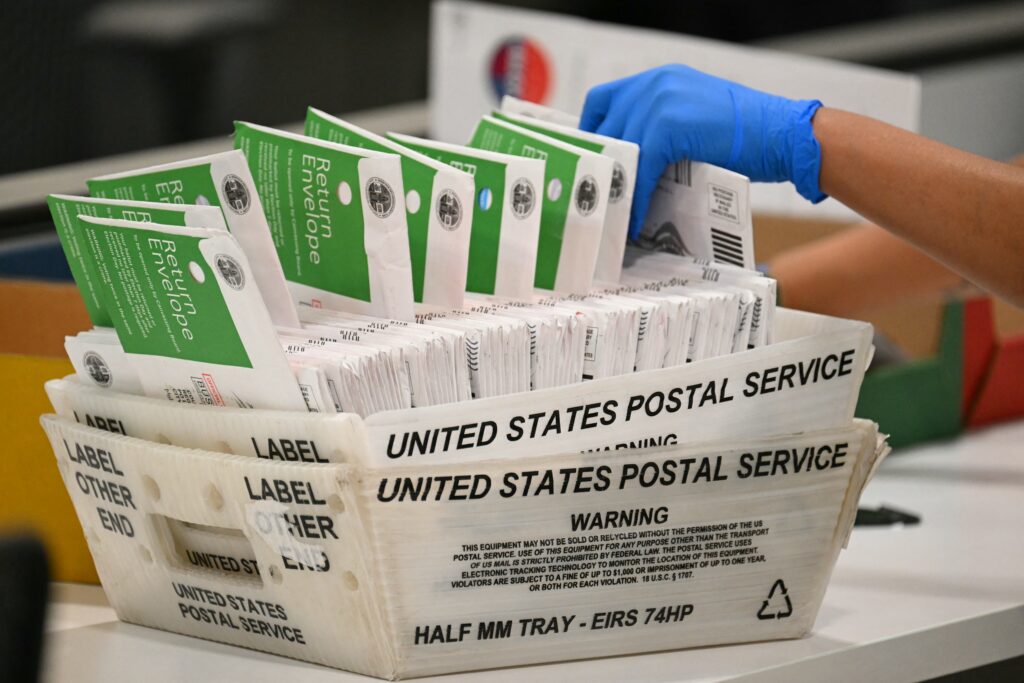
Testimony by the top U.S. postal official Wednesday marked the first time that the United States Postal Service (USPS) attempted to publicly defend its plan to implement President Donald Trump’s anti-mail voting executive order.
But rather than trying to assuage concerns that Trump is using USPS as a vehicle to seize control of U.S. elections, Postmaster General David Steiner all but confirmed lawmakers, election officials and Postal Service advocates’ worst fears.
He told lawmakers that under a new proposed rule ordered by Trump, the Postal Service would not deliver mail-in ballots in states that refuse to hand over their voter rolls to the federal government.
Reacting to the hearing, Steve Hutkins, a retired New York University professor and a leading advocate for the USPS through savethepostoffice.com, told Democracy Docket that if the agency ultimately moves forward with the proposal, he believes “it will destroy the Postal Service.”
“It won’t just be tainted. Its whole brand will be destroyed. All those states — if they can’t do voting by mail in California or Oregon because they won’t give over the lists, that’ll be the end of the Post Office,” he said. “Those states are some of the strongest defenders of the Post Office.”
Hutkins added that he was disappointed in Steiner, saying the postmaster general minimized the significance of the proposal throughout the hearing.
Instead of addressing the senators’ concerns, Steiner claimed that the proposal formalizes best practices for election mail that the Postal Service promulgates to the states each year. He also claimed that the voter lists were just delivery “manifests.”
“It’s essentially a national voter registration,” Hutkins said. “It’s much more than a mere manifest.”
Hutkins said he was particularly struck by Sen. Gary Peters (D-Mich.), the ranking member of the Senate Homeland Security Committee, saying that the Postal Service’s Board of Governors did not approve of the proposal.
“That was huge. I almost jumped out of my seat when I heard that,” Hutkins said, adding that he wasn’t sure how the senator knew that. “Of course, anything of that magnitude should have been approved by the Board of Governors.”
Conversations between Senate Homeland Security Committee members and Postmaster General Steiner and his team indicated that the board did not formally approve the proposed rule, according to a committee aide.
Specifically, the Postal Service’s proposal would require state election officials to send USPS a list of voters who have requested a mail-in or absentee ballot at least 30 days before ballots are sent out under state law. If voters aren’t on the list, they will not receive a ballot.
During a panel discussion Wednesday hosted by the Center for Election Innovation and Research, a nonprofit pro-elections group that supports election officials, Minnesota Secretary of State Steve Simon (D) said the USPS’s proposal was “extremely problematic on a number of levels.”
“We’re 132 days from general elections, so to be talking about standing up this kind of apparatus now at this close date is something that I think elections administrators everywhere are very, very nervous about,” Simon said.
He added that the proposal simply would not work with certain state laws, including his, which has no deadline for requesting a mail ballot.
After the hearing, Sen. Elisa Slotkin (D-Mich.) wrote in a social media post that the proposal and Steiner’s leadership of the Postal Service were “part of a much bigger story.”
“President Trump does not believe that elections he loses are valid,” Slotkin said. “It’s all part of his authoritarian playbook.”
During the hearing, she urged the postmaster general to “push back on being a pawn on this authoritarian playbook.”
A day before Steiner’s testimony, Senate Democrats sent him and other USPS leaders a letter demanding that they abandon the proposal, calling it an “unconstitutional and illegal attempt” to turn USPS into an election administration agency.
“Ultimately, the proposed rule seeks to create a centralized national absentee voter database with individualized barcodes connected to the voters’ names under the control of the President that contains the voting information of millions of Americans,” the senators wrote.
They added that such information “would be ripe for potential abuse or improper disclosure potentially imperiling the integrity of American elections.”